
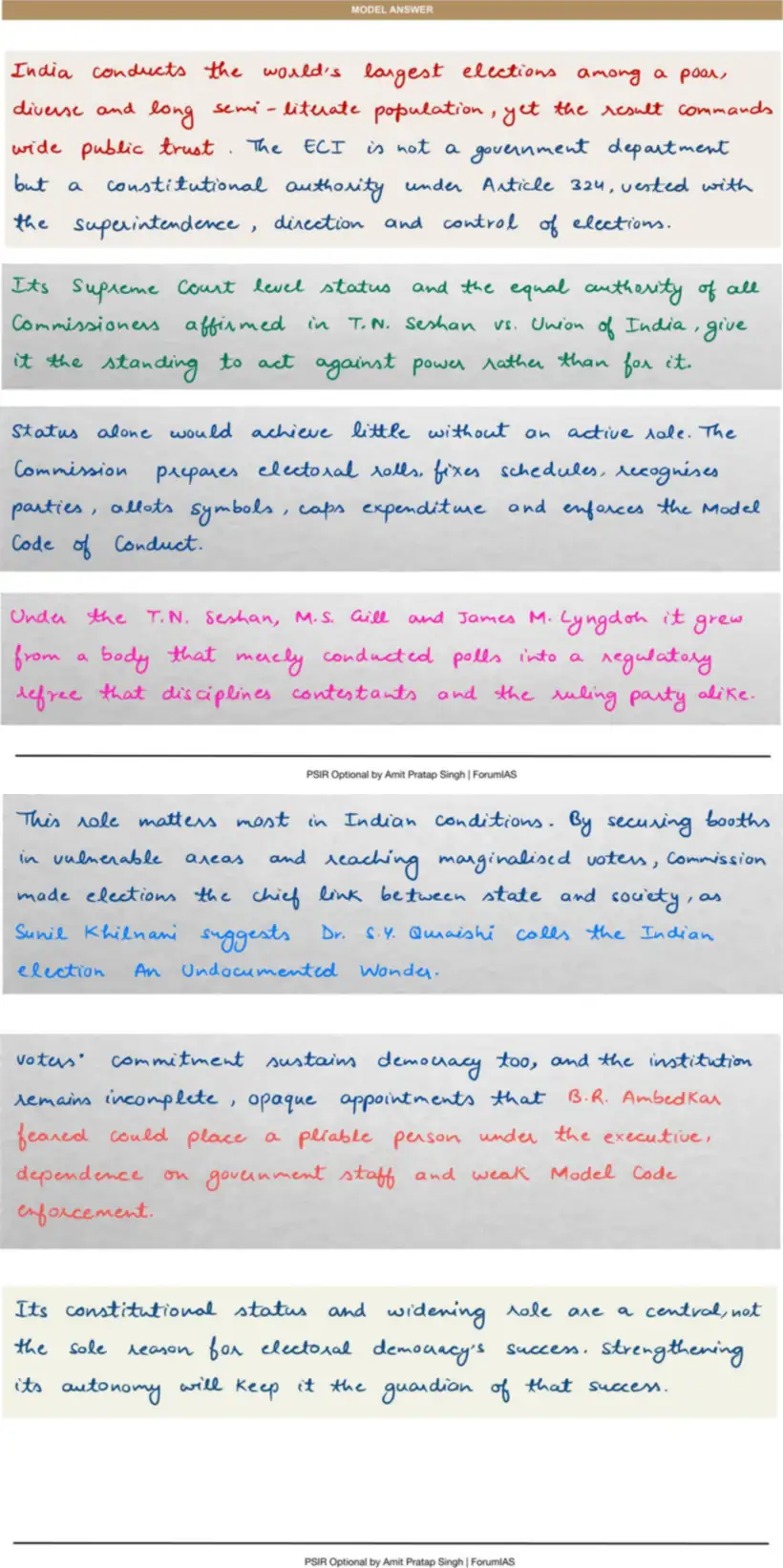
“The success of electoral democracy can partly be attributed to the status and role of the Election Commission of India.” Explain.
How the answer moves
The flow snapshot — the routes in, the body, the counter-view and the routes out.
Route 1 world’s largest elections in a poor, diverse society → trust traced to one institution → Article 324 status
Route 2 ECI not a government department but a constitutional authority → independence (Seshan case) → standing to act against power
Article 324 status → SC-level rank + equal Commissioners (Seshan v. Union) → core functions (rolls, schedules, parties, symbols, expenditure, MCC) → Seshan / Gill / Lyngdoh: conductor → regulatory referee → modernisation (EVM / VVPAT / NOTA / EPIC / SVEEP) → reaching marginalised voters → Khilnani: link between state and society → Quraishi: An Undocumented Wonder
“partly” is honest → voters’ own commitment also sustains democracy → institution incomplete: opaque appointments (Ambedkar’s fear), staff dependence, weak Model Code enforcement
Route 1 status + role a central, not sole, cause of success
Route 2 strengthening autonomy preserves ECI as guardian of that success
Model answer
Handwritten, in the form it would be written in the examination hall.
Also asked on this head
Statutory Institutions / Commissions — 12 questions in the Vault.
- There is a debate on the procedure for appointment of the Chief Election Commissioner and Election Commissioners to the Election Commission of India. Analyse its various...
- Discuss the policy initiatives of the Fourteenth Finance Commission aimed towards promoting and strengthening agricultural development in India.
- How far has been the National Human Rights Commission successful in achieving its objectives? Comment.
How this is taught
The same flow snapshot, built for every head of the syllabus, with the answer written in class.
The first session of Foundation 2027 is published in full.
Six programmes across three levels.