
How far has been the National Human Rights Commission successful in achieving its objectives? Comment.
How the answer moves
The flow snapshot — the routes in, the body, the counter-view and the routes out.
Route 1 state the objective (life / liberty / equality / dignity, PHRA 1993) → verdict: success real but uneven
Route 2 NHRC as rights-protection body → measure success against its own mandate, not an abstract ideal
gains = norm-building + access → national complaint forum → standards on custodial death / prison conditions / police-action deaths → cases: Chakma, Punjab mass cremations, mental health institutions → rights literacy + camp sittings & open hearings (access) → Dayal positive verdict → turn to weakness = enforcement → recommendations non-binding → Krishna Iyer “post office” → Dattu “Toothful Tiger” → one-year bar / staff shortage / armed-forces restriction
norm-building and access are genuine, but the recommendatory design leaves it forwarding rather than enforcing → success without teeth
Route 1 institutionally necessary, but objectives stay unmet without enforceable powers
Route 2 real but partial success → completion needs enforceable powers, independent cadre, stronger autonomy
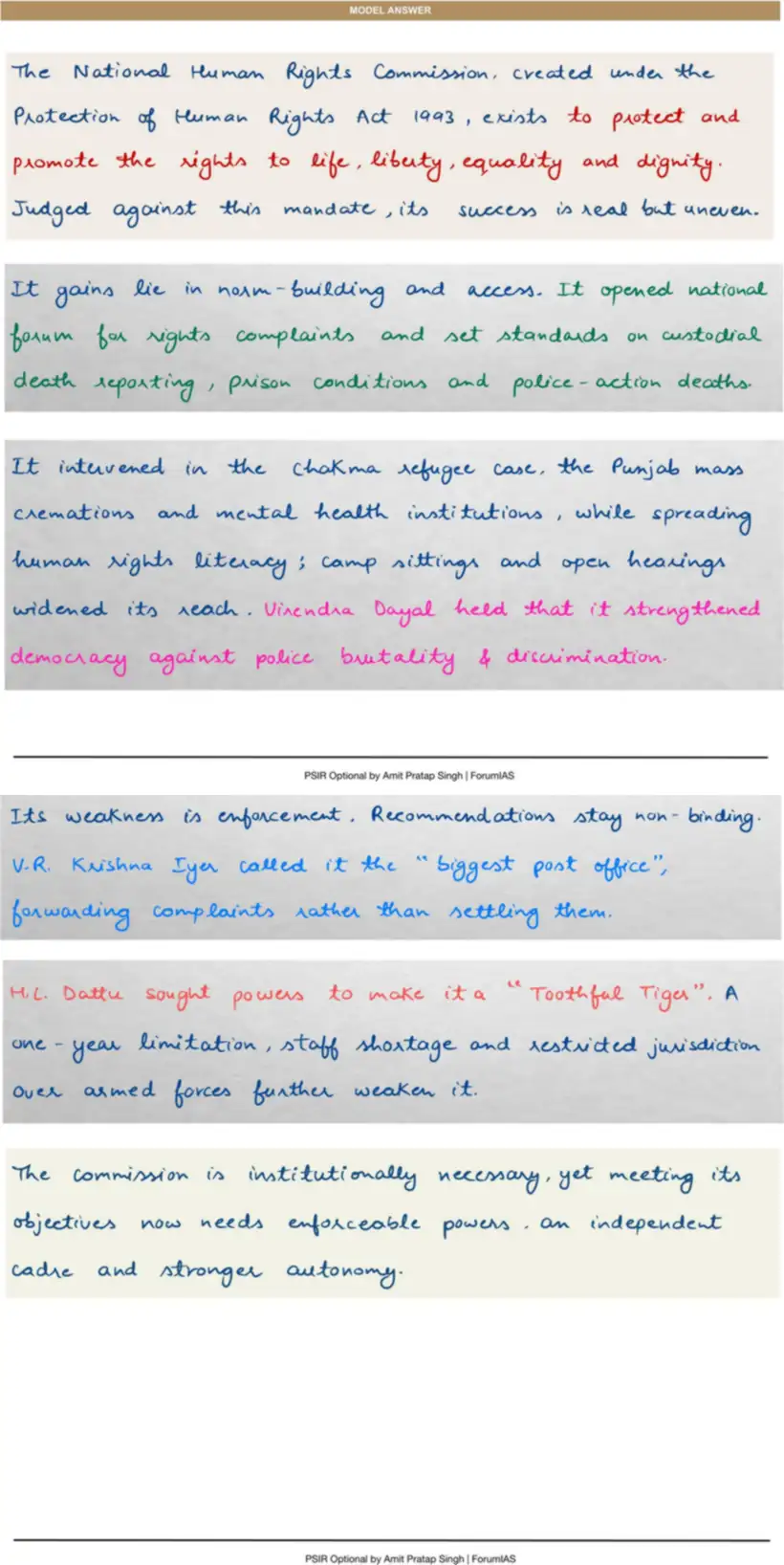
Model answer
Handwritten, in the form it would be written in the examination hall.
Also asked on this head
Statutory Institutions / Commissions — 12 questions in the Vault.
- There is a debate on the procedure for appointment of the Chief Election Commissioner and Election Commissioners to the Election Commission of India. Analyse its various...
- Discuss the policy initiatives of the Fourteenth Finance Commission aimed towards promoting and strengthening agricultural development in India.
- Explain the structure and functions of the National Commission for Women.
How this is taught
The same flow snapshot, built for every head of the syllabus, with the answer written in class.
The first session of Foundation 2027 is published in full.
Six programmes across three levels.