
How far is the National Commission for Backward Classes an empowered body? Assess its role in the context of rising demand for backwardness among dominant communities.
How the answer moves
The flow snapshot — the routes in, the body, the counter-view and the routes out.
Route 1 empowerment real but partial → status without full force
Route 2 statutory origin (Indra Sawhney) → constitutional upgrade (338B) → frame the “how far”
Indra Sawhney 1992 + NCBC Act 1993 → 102nd Amendment / Art 338B → parity with NCSC & NCST → functions (inclusion/exclusion in OBC list, advice) → civil court powers + reports to Parliament → limits: non-binding, no definition of backwardness, weak data/staff → dominant-community demand → evidentiary weakness exposed → sub-categorisation guards advanced groups
form vs effect: constitutional status & inquiry powers ↔ non-enforceable recommendations and dependence on government
Route 1 empowered in form, constrained in effect
Route 2 real test = defending evidence-based classification against political pressure
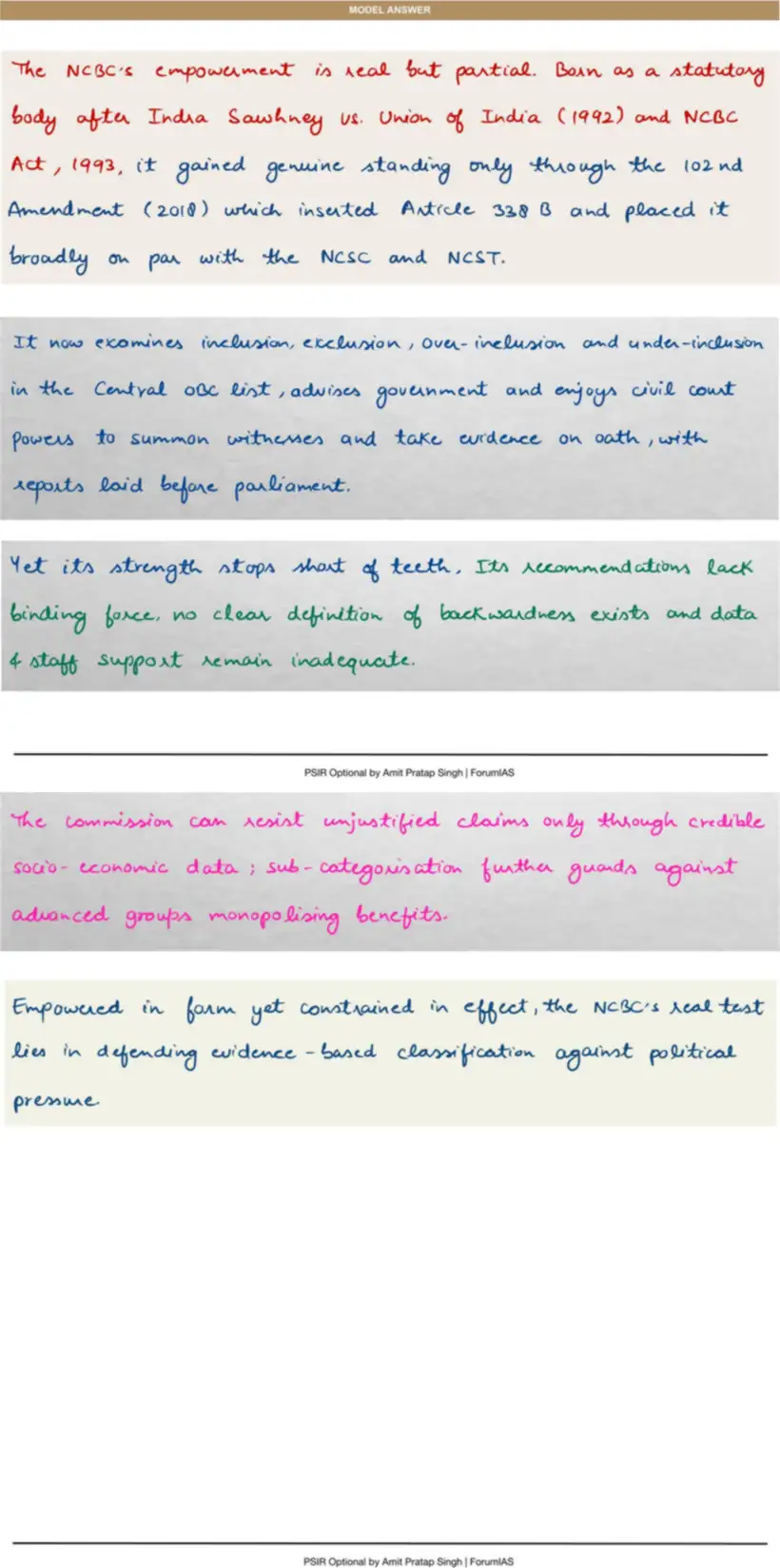
Model answer
Handwritten, in the form it would be written in the examination hall.
Also asked on this head
Statutory Institutions / Commissions — 12 questions in the Vault.
- There is a debate on the procedure for appointment of the Chief Election Commissioner and Election Commissioners to the Election Commission of India. Analyse its various...
- Discuss the policy initiatives of the Fourteenth Finance Commission aimed towards promoting and strengthening agricultural development in India.
- How far has been the National Human Rights Commission successful in achieving its objectives? Comment.
How this is taught
The same flow snapshot, built for every head of the syllabus, with the answer written in class.
The first session of Foundation 2027 is published in full.
Six programmes across three levels.