
Latin America has made moderate success in countering US-led global economic order by forming various
How the answer moves
The flow snapshot — the routes in, the body, the counter-view and the routes out.
Route 1 quarrel older than the organisations → Prebisch / structuralists: primary exports for the region, returns for the North → after 2000 the critique gets written into institutions → spine staked: bargaining space widened, structure untouched
Route 2 take the question’s three terms → each has a body to show for it → each stops short of the structure → that gap is what “moderate” names
ALBA 2004: barter, oil-for-services, regional currency unit vs market conditionality → Bank of the South 2007: finance free of IMF conditions, NIEO in regional form → MERCOSUR: customs union deepened → UNASUR 2008 + CELAC 2011: forums without Washington, OAS answered → Mar del Plata 2005: FTAA restart blocked, talks never resumed → turn → Bank of the South never capitalised, lent nothing → UNASUR fractures after 2018, Argentina/Brazil back only in 2023 → bodies track the electoral cycle, not a settled regional interest → unaligned agendas, weak governance, inequality → Cox: institutions are never neutral → Monroe Doctrine 1823 still live, now aimed at Chinese investment and Russian ties
never a break at all → G20, APEC, Inter-American Development Bank → push for larger presence in the OECD (Mello: Western-led liberal vehicle) → engagement inside the order, not exit from it
Route 1 moderate is the right word → voice won, one veto won, authorship of the rules not won → Parsons’s “hot peace” over any new order
Route 2 refusal proved easier than replacement → the FTAA died, the Bank of the South never lived → resilience and voice, no rupture
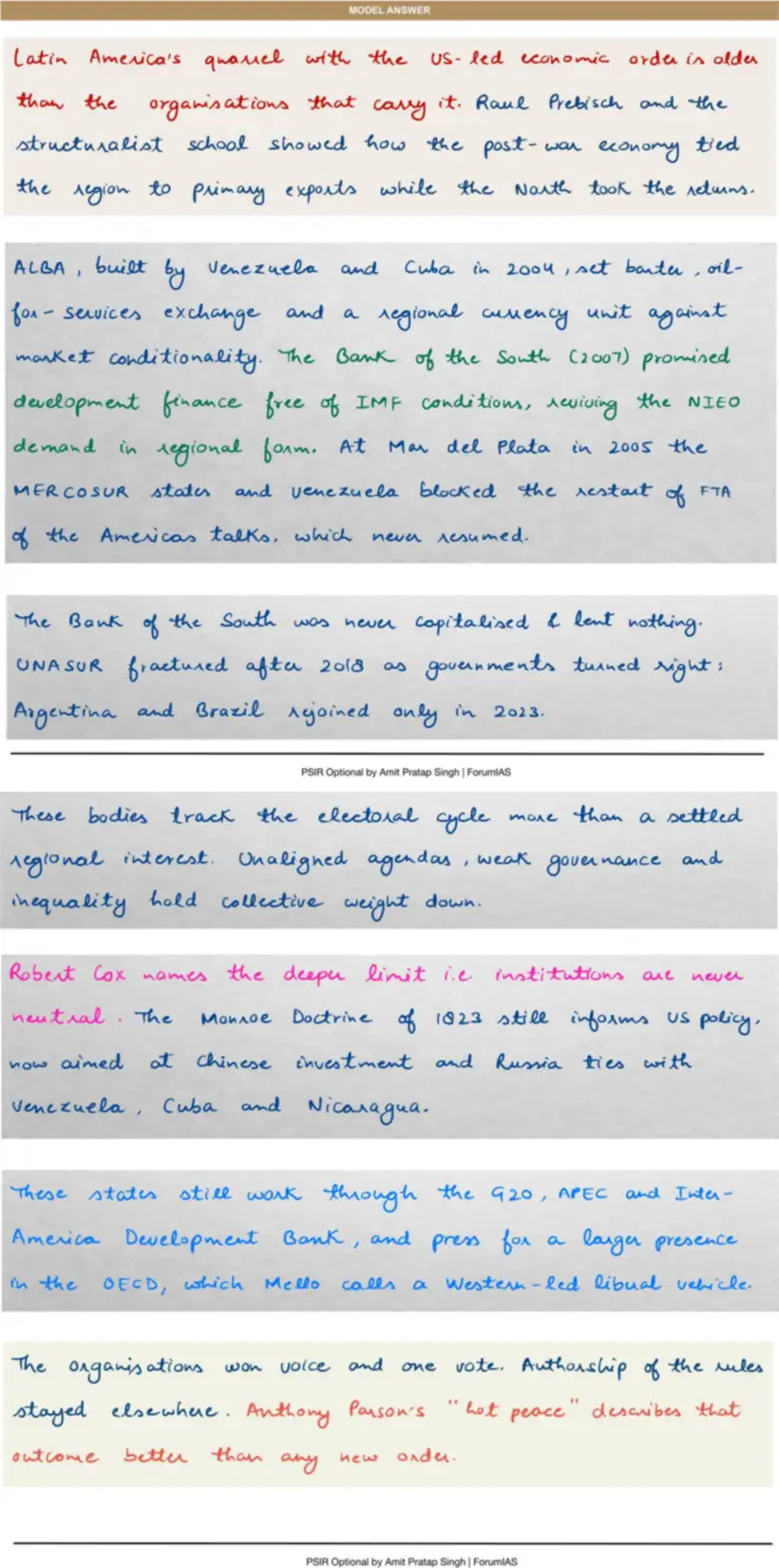
Model answer
Handwritten, in the form it would be written in the examination hall.
Also asked on this head
Evolution of the International Economic System — 10 questions in the Vault.
- How did the Council of Mutual Economic Assistance (CMEA) reflect geo-political division of the world during the cold war?
- Trump’s unilateral imposition of reciprocal tariffs on scores of countries poses impending threat to the future of the rule-based multilateral global trading system under the WTO....
- The return of trade barriers and economic sanctions has diminished the spirit of GATT. In this context, discuss the factors contributing to the decline of WTO...
How this is taught
The same flow snapshot, built for every head of the syllabus, with the answer written in class.
The first session of Foundation 2027 is published in full.
Six programmes across three levels.