
Discuss the efficacy of global conventions to combat international terrorism.
How the answer moves
The flow snapshot — the routes in, the body, the counter-view and the routes out.
Route 1 conventions have multiplied since 1963 → terrorism has not receded → efficacy only partial
Route 2 a widening web of counter-terror law built → but the keystone, an agreed definition, is missing → efficacy capped
phased instruments (1963 aircraft treaty, first of its kind + five sectoral in the 1970s → aviation/shipping) → post-9/11 widening (bombings, financing, nuclear) → institutional support (FATF grey-listing, SCO’s RATS, UNSC 1267/1373/1624 → freezes, incitement) → instruments do curb finance and safe havens → definitional deadlock (no comprehensive convention, CCIT stalled, one state’s terrorist another’s freedom fighter → Heywood, “essentially contested concept”) → selective enforcement (China vs Hafiz Saeed listing under 1267 → “double standards,” BRICS/India protest) → persistence (Afghanistan, Syria)
conventions genuinely constrain terrorist finance, movement and safe havens → set against definitional deadlock + politicised, selective enforcement + terrorism still engulfing whole regions → net verdict is partial efficacy, not decisive result
Route 1 conventions manage terrorism, do not defeat it → finalise CCIT + end “good”/“bad” distinction + tie enforcement to rule of law
Route 2 Annan → a global scourge demands a global response → grounded in law and human rights, not selective convenience
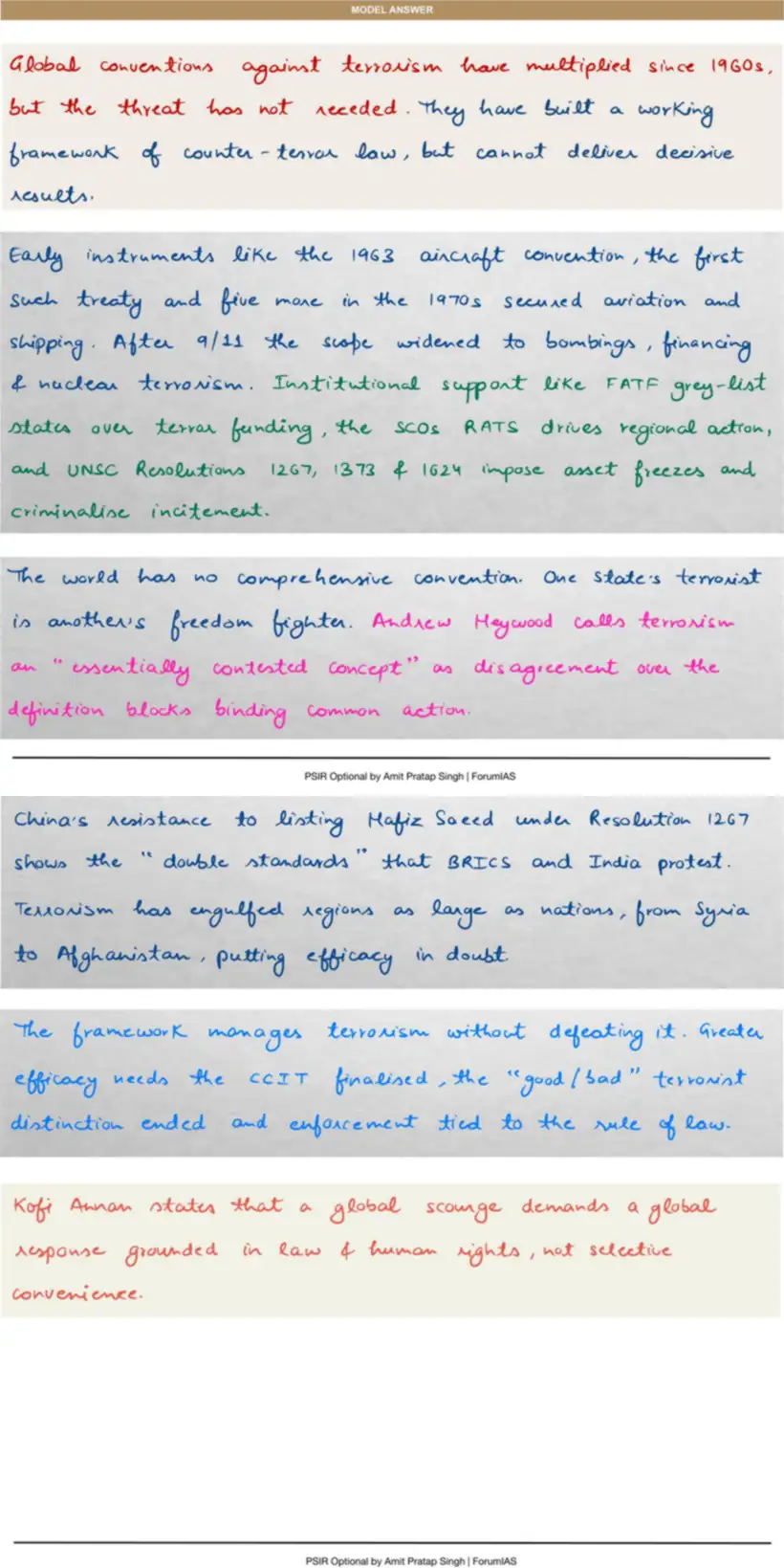
Model answer
Handwritten, in the form it would be written in the examination hall.
Also asked on this head
Contemporary Global Concerns — 22 questions in the Vault.
- International Human Rights frameworks are hostage to politics among nations. Comment.
- How does the regime change and political crisis in Myanmar threaten regional security and peace?
- Discuss the five proposals made by India in the recent COP-26 conference held in Glasgow. (150 words)
How this is taught
The same flow snapshot, built for every head of the syllabus, with the answer written in class.
The first session of Foundation 2027 is published in full.
Six programmes across three levels.