
The withdrawal of the United States of America from the World Health Organization is set to have far- reaching impacts on global health. Reimagining the existing WHO is vital for the global health agenda. Discuss.
How the answer moves
The flow snapshot — the routes in, the body, the counter-view and the routes out.
Route 1 US founded WHO (1948), principal funder + agenda-driver (surveillance, PEPFAR) → exit raises existential questions for global health governance
Route 2 withdrawal as latest US unilateralism (like Paris exit) → deepens democratic deficit in global governance
immediate impacts (funding gaps, reduced US influence, widening health inequities, weakened pandemic coordination, eroded trust) → domino/legitimacy risk (populist/nationalist agendas superseding multilateralism; US loses surveillance + early-warning access) → these expose Stiglitz’s accountability deficit (opaque, unaccountable institutions) → reimagining begins → diversify + stabilise financing (no single donor) → transparency + streamlined decisions + Independent Panel recommendations → greater voice for emerging economies + non-state actors (representation)
nationalist–unilateralist retreat (sovereignty over multilateral commitments) vs. interdependence (borderless threats, shared vulnerability, no one safe until all safe)
Route 1 no population secure until all protected → Linklater’s post-national community of shared problems → multilateral solidarity as safeguard
Route 2 crisis as opportunity → reimagine a more representative, better-financed, more effective WHO
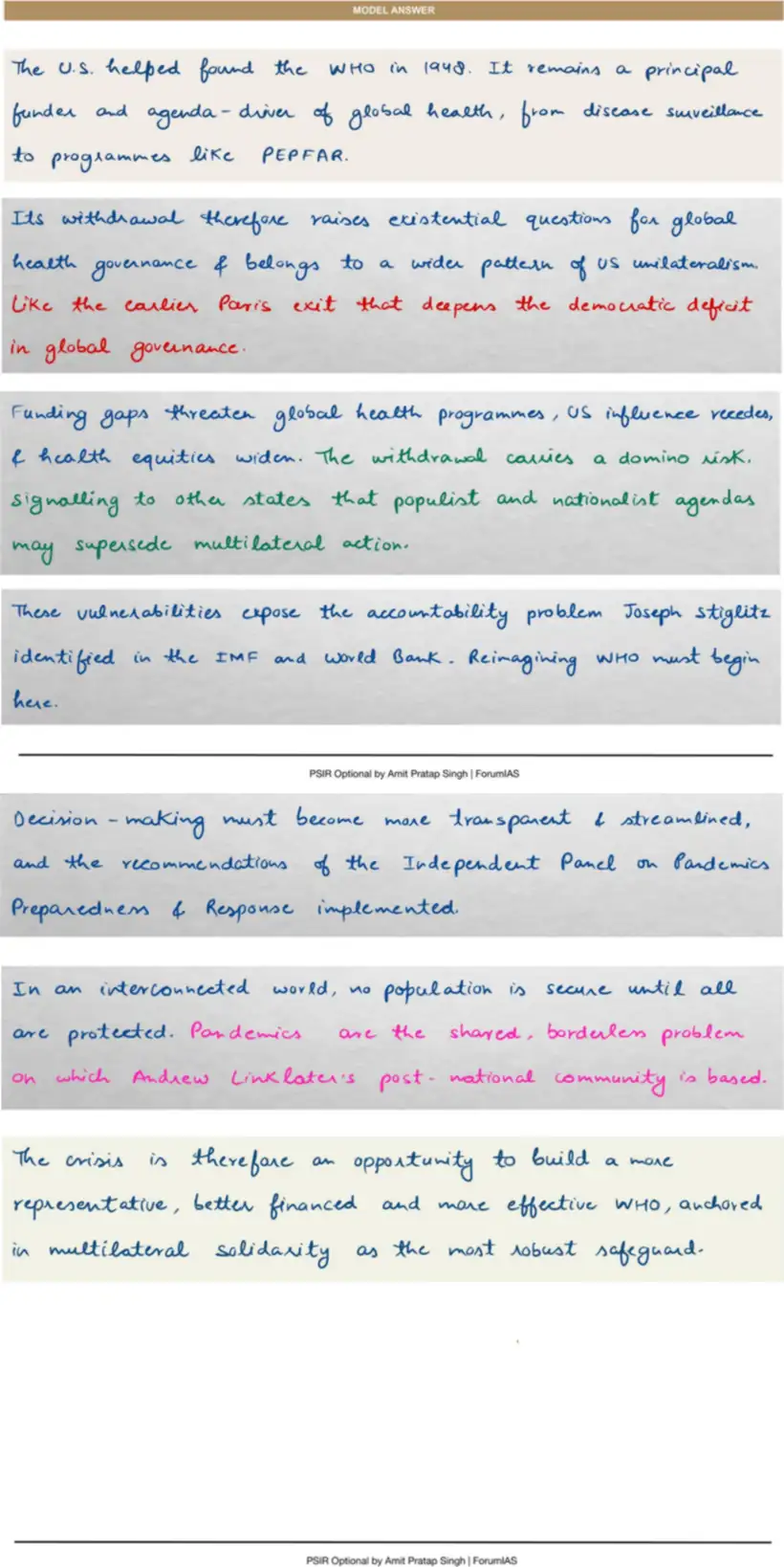
Model answer
Handwritten, in the form it would be written in the examination hall.
Also asked on this head
Contemporary Global Concerns — 22 questions in the Vault.
- International Human Rights frameworks are hostage to politics among nations. Comment.
- How does the regime change and political crisis in Myanmar threaten regional security and peace?
- Discuss the five proposals made by India in the recent COP-26 conference held in Glasgow. (150 words)
How this is taught
The same flow snapshot, built for every head of the syllabus, with the answer written in class.
The first session of Foundation 2027 is published in full.
Six programmes across three levels.