
How does cross border terrorism impede the achievements of peace and security in South Asia?
How the answer moves
The flow snapshot — the routes in, the body, the counter-view and the routes out.
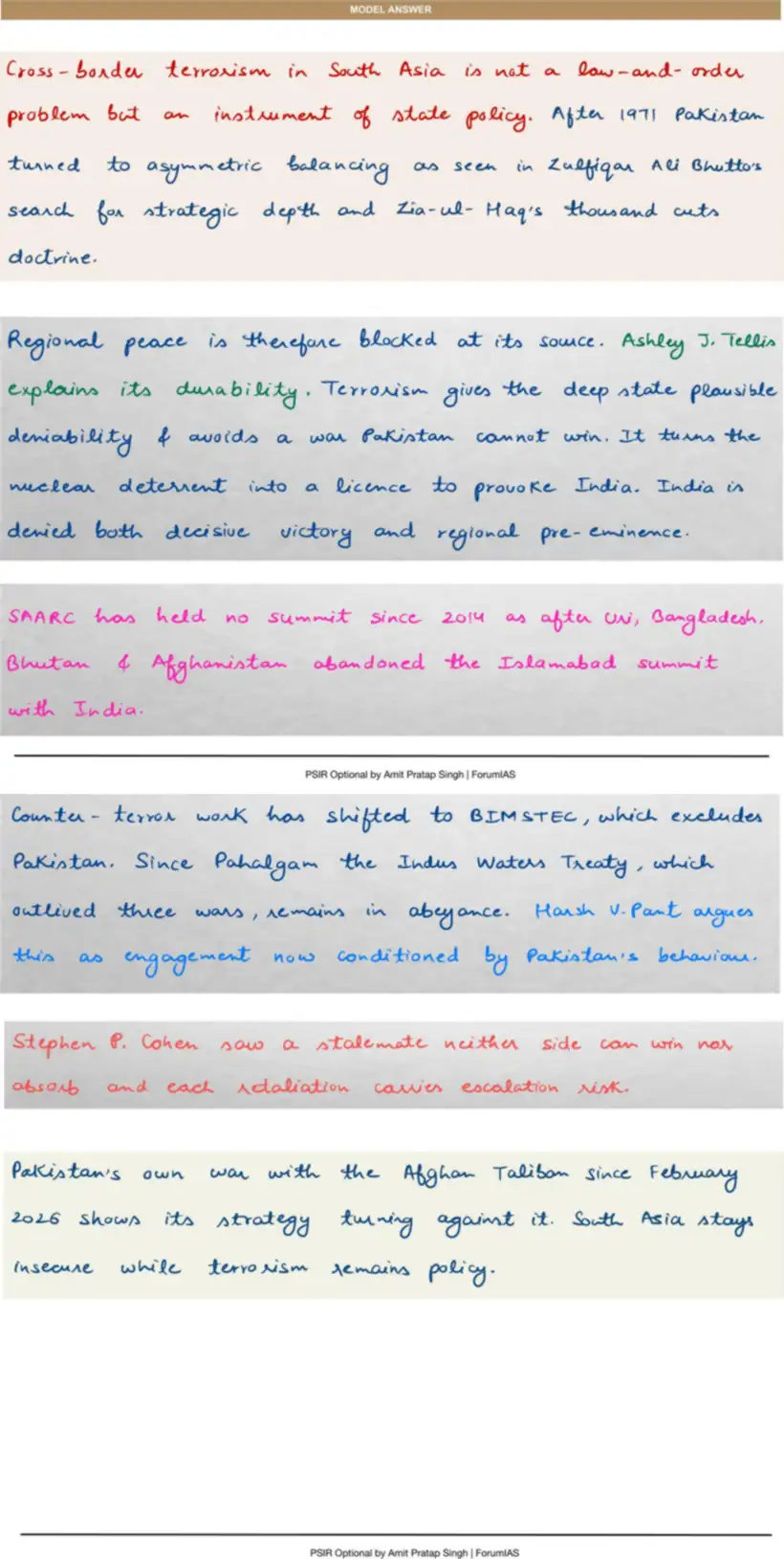
Route 1 terrorism as state policy, not law-and-order problem → 1971 turn to asymmetric balancing → Bhutto’s strategic depth + Zia’s thousand cuts → peace blocked at source
Route 2 Pahalgam → one attack puts a treaty that outlived three wars in abeyance → the instrument is policy, not crime → peace blocked at source
Tellis: plausible deniability + a war Pakistan cannot win + nuclear deterrent as licence → India’s dual denial: no decisive victory, no regional pre-eminence → cost turns regional → no SAARC summit since 2014 → Bangladesh, Bhutan, Afghanistan abandon Islamabad with India after Uri → counter-terror work moves to BIMSTEC, Pakistan out → Indus Waters Treaty in abeyance since Pahalgam → Pant: engagement now conditioned by Pakistan’s behaviour
coercion has not changed the incentive → Cohen: a stalemate neither side can win nor absorb → each retaliation carries escalation risk
Route 1 Pakistan’s own war with the Afghan Taliban since February 2026 → strategy turning on its author → South Asia insecure while terrorism remains policy
Route 2 SAARC dead, BIMSTEC a workaround, Indus Treaty in abeyance → whole regional order now shaped by one strategy → peace waits on that strategy being given up
Model answer
Handwritten, in the form it would be written in the examination hall.
Also asked on this head
India and South Asia — 32 questions in the Vault.
- The island of Kachchatheevu remains an intractable issue in India-Srilanka relations. Comment.
- How does illegal cross border migration pose challenges to India’s security? Discuss the steps taken by the government in this direction and their effectiveness.
- Critically evaluate the important factors of India-Maldives relations on the eve of sixty years of diplomatic ties between the two countries.
How this is taught
The same flow snapshot, built for every head of the syllabus, with the answer written in class.
The first session of Foundation 2027 is published in full.
Six programmes across three levels.