
“The Treaty of Perpetual Peace and Friendship between India and Bhutan needs to be revised with more pragmatic, realistic obligations and responsibilities.’ Comment.
How the answer moves
The flow snapshot — the routes in, the body, the counter-view and the routes out.
Route 1 1949 Article 2 = guidance clause inherited from Sinchula → colonial residue → already removed in 2007
Route 2 the statement targets a text that no longer exists → live question is practice, not parchment
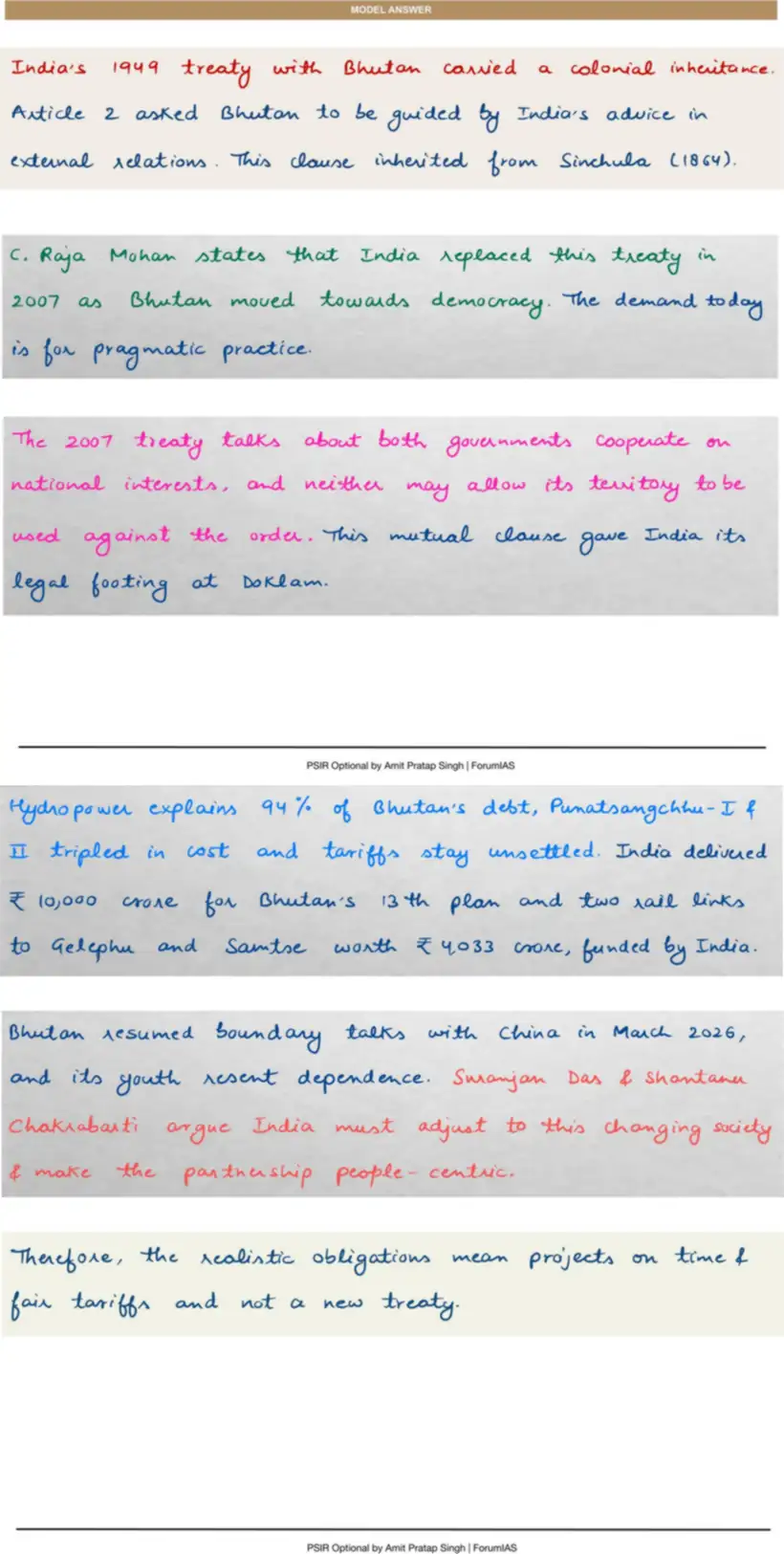
1949 guidance clause → Raja Mohan: replaced in 2007 as Bhutan democratised → 2007 text even-handed, mutual bar on use of territory → legal footing at Doklam → what a treaty cannot fix: hydropower = 94% of debt, Punatsangchhu I & II cost overruns, tariffs unsettled → India’s answer is delivery: ₹10,000 cr thirteenth Plan, ₹4,033 cr Gelephu–Samtse rail, wholly GoI-funded
pressure has not eased → Bhutan–China boundary talks resume, March 2026 → youth resentment of dependence → Das & Chakrabarti: adjust to a changing society, make the partnership people-centric
Route 1 realistic obligations = projects on time + fair tariffs, not a new treaty
Route 2 2007 revised the text; 2026 asks India to revise its conduct
Model answer
Handwritten, in the form it would be written in the examination hall.
Also asked on this head
India and South Asia — 32 questions in the Vault.
- The island of Kachchatheevu remains an intractable issue in India-Srilanka relations. Comment.
- How does illegal cross border migration pose challenges to India’s security? Discuss the steps taken by the government in this direction and their effectiveness.
- Critically evaluate the important factors of India-Maldives relations on the eve of sixty years of diplomatic ties between the two countries.
How this is taught
The same flow snapshot, built for every head of the syllabus, with the answer written in class.
The first session of Foundation 2027 is published in full.
Six programmes across three levels.