
Explain the defence and foreign policy of India to address the challenges emerging out of the current India-China standoff at the Line of Actual control (LAC).
How the answer moves
The flow snapshot — the routes in, the body, the counter-view and the routes out.
Route 1 2020 ended the quiet-boundary assumption → two tracks, defence and diplomacy
Route 2 undefined LAC + the 2020 shock → India answers with capability on the ground and machinery at the table
forward formations, logistics → roads, tunnels, airfields, BRO ₹7,394 crore inside the largest 2026-27 outlay → theatre command pending since April 2026 → denial, no new line → Miller, two-front → Shaksgam rejection, January 2026 → October 2024 Depsang–Demchok patrolling → August 2025 SR machinery: early-delimitation expert group, border-management working group, de-escalation tabled → Beijing review, May 2026 → Chaudhuri, security dilemma, dialogue as restraint → Indo-Pacific partnerships without alliance
buffer zones postpone claims, reserves close behind, calm reversible → Jabin T. Jacob, tactical stabilisation not strategic reset, India reactive, patrolling restricted → Doklam and Siliguri Corridor
Route 1 capability and mechanism contain, they do not resolve
Route 2 boundary moves only when both governments can defend a settlement at home
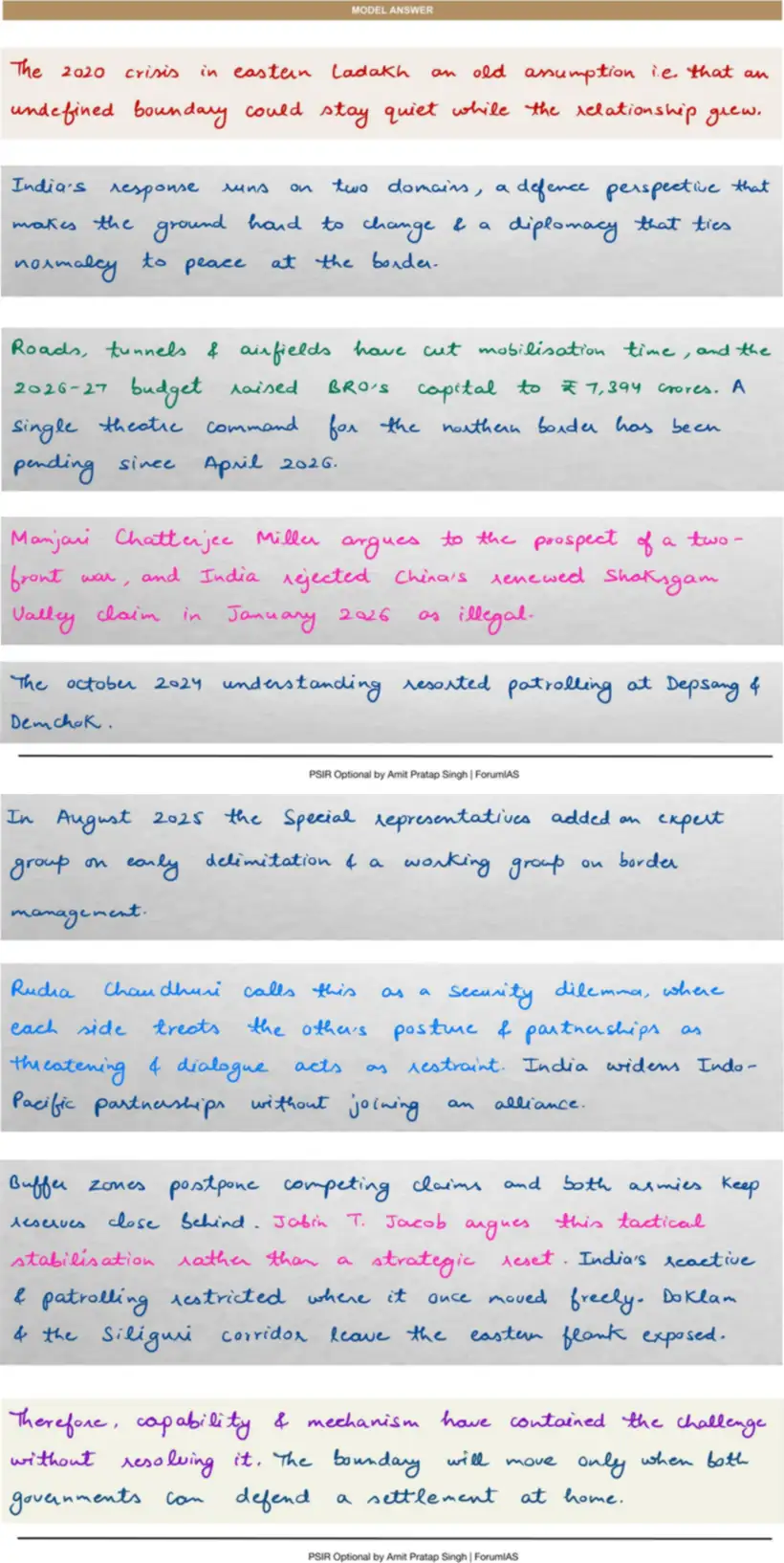
Model answer
Handwritten, in the form it would be written in the examination hall.
Also asked on this head
India and South Asia — 32 questions in the Vault.
- The island of Kachchatheevu remains an intractable issue in India-Srilanka relations. Comment.
- How does illegal cross border migration pose challenges to India’s security? Discuss the steps taken by the government in this direction and their effectiveness.
- Critically evaluate the important factors of India-Maldives relations on the eve of sixty years of diplomatic ties between the two countries.
How this is taught
The same flow snapshot, built for every head of the syllabus, with the answer written in class.
The first session of Foundation 2027 is published in full.
Six programmes across three levels.