
Discuss the consequences of illegal cross-border migration in India’s north-eastern region.
How the answer moves
The flow snapshot — the routes in, the body, the counter-view and the routes out.
Route 1 consequence is political, not demographic → eight states, some 220 ethnic groups → who belongs stays permanently open → nation-building carries the cost
Route 2 migrants share language and ethnicity → identification hard → belonging becomes the region’s open question → the cost is political, not demographic
identification hard → land and jobs → ethnic conflict → Weiner, sons-of-the-soil → AASU agitation → Assam Accord 1985 → NRC → Tripura tribes a minority → cut-off keeps moving: 1971 → 2014 CAA → 2024 Exemption Order → AASU reads Accord displaced → forged voter cards → elites mobilise feeling against migrants → security costs: militants among migrants, trafficking, Myanmar frontier → FMR gone, fencing begun → hill communities split by the line oppose it → remedy breeds grievance → detection outruns due process → 1950 Act, DC decides in ten days, Tribunals bypassed → Supreme Court stays, 2026, fair determination → Murshid: pushbacks and Dhaka reset as one policy at two levels
Baruah locates it differently → Northeast as a frontier shaped by migration and settlement → detection alone cannot settle belonging
Route 1 four decades on → migrants remain → question open
Route 2 remedy breeds grievance → detection outruns due process → belonging still unsettled
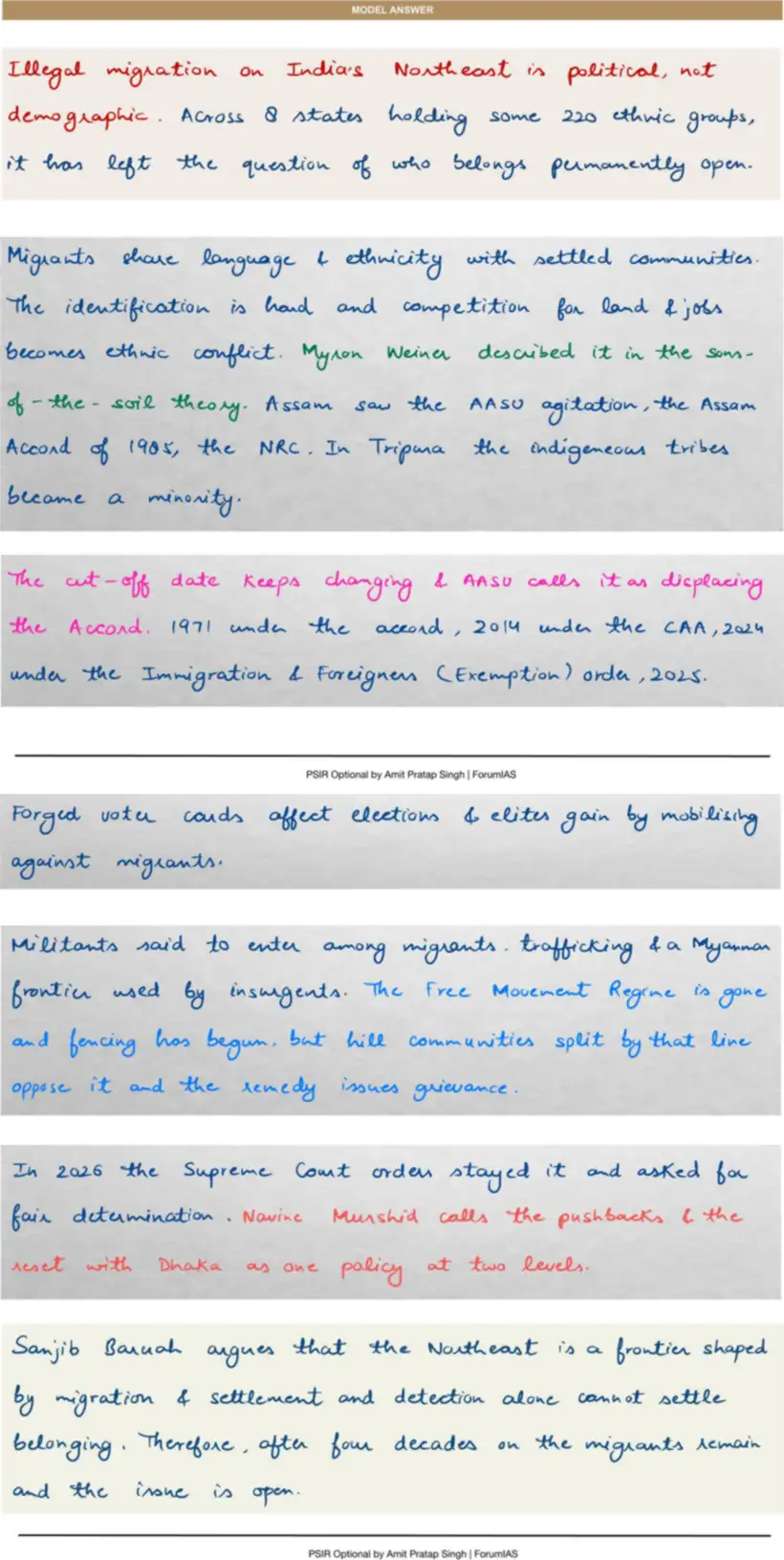
Model answer
Handwritten, in the form it would be written in the examination hall.
Also asked on this head
India and South Asia — 32 questions in the Vault.
- The island of Kachchatheevu remains an intractable issue in India-Srilanka relations. Comment.
- How does illegal cross border migration pose challenges to India’s security? Discuss the steps taken by the government in this direction and their effectiveness.
- Critically evaluate the important factors of India-Maldives relations on the eve of sixty years of diplomatic ties between the two countries.
How this is taught
The same flow snapshot, built for every head of the syllabus, with the answer written in class.
The first session of Foundation 2027 is published in full.
Six programmes across three levels.