
‘Relations between India and Russia are rooted in history, mutual trust and mutually beneficial cooperation. Discuss.
How the answer moves
The flow snapshot — the routes in, the body, the counter-view and the routes out.
Route 1 the phrase is India’s own official vocabulary → all three claims hold, but not equally → history and trust inherited, mutual benefit must be earned afresh
Route 2 a treaty that outlived one of its signatories → the base is real → the question is not whether the three foundations exist but which of them still grows
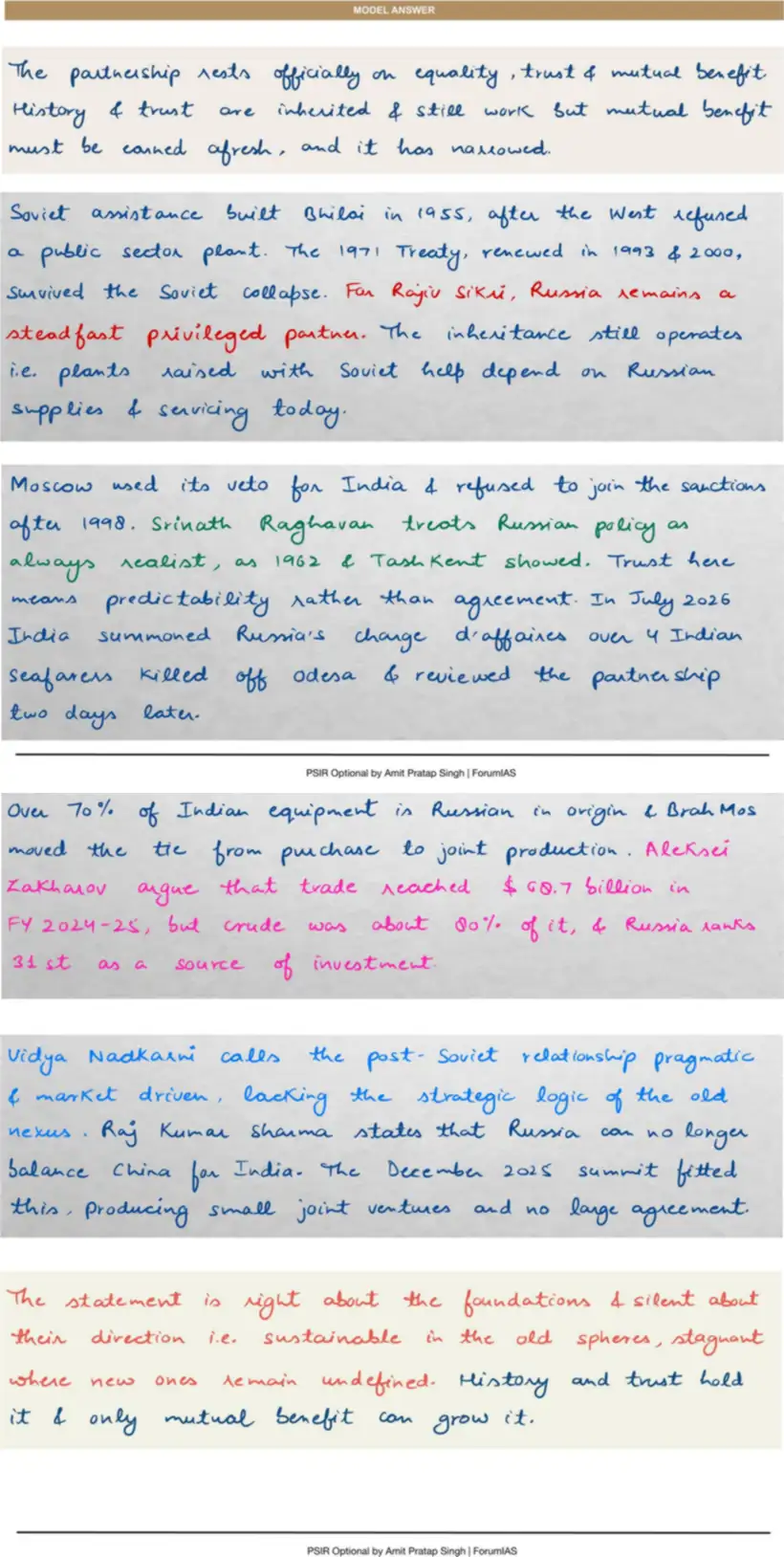
history is structural, not sentimental (Bhilai 1955 / 1971 Treaty renewed 1993, 2000 / Sikri / Cold War plants still on Russian servicing) → trust is a record, not affection (veto, no sanctions after 1998 / Raghavan’s realism, 1962, Tashkent / predictability not agreement / July 2026 protest followed by full review) → mutual benefit has thinned (70% equipment, BrahMos as joint production / Zakharov: $68.7bn FY 2024-25, crude ~80%, Russia 31st in investment)
Nadkarni, pragmatic and market-driven without the old strategic logic → Sharma, Russia can no longer balance China → December 2025 summit: small joint ventures, no large agreement
Route 1 right about the foundations, silent about their direction → sustainable in old spheres, stagnant where new ones are undefined
Route 2 history and trust hold it; only mutual benefit can grow it → the pillar that needs renewal is the one policy can actually touch
Model answer
Handwritten, in the form it would be written in the examination hall.
Also asked on this head
India and the Global Centres of Power — 27 questions in the Vault.
- Critically evaluate India-Russia relations in the 21st century. How have both the countries responded to America meddling in their relations in the recent times.
- “The mother of all deals” is a transformative milestone in Indo-EU trade relations. Elaborate on the new Security and Defence partnership.
- Does the idea of the 21st century as ‘Asian century’ continue to remain feasible given the growing friction between India and China?
How this is taught
The same flow snapshot, built for every head of the syllabus, with the answer written in class.
The first session of Foundation 2027 is published in full.
Six programmes across three levels.