
The natural behaviour of India and the United States is likely to serve each other’s interests. Hence, a deliberate strategy of dovetailing their efforts will obviously benefit both. Elaborate.
How the answer moves
The flow snapshot — the routes in, the body, the counter-view and the routes out.
Route 1 Nehru, 1949, natural allies → fifty years of distance → Kux, estranged democracies → shared democracy settled nothing
Route 2 naturalness is structural, not sentimental → structure changed, behaviour converged → dovetailing pays as far as structure holds
China’s rise is the structure → Varshney’s new triangle, first courts the third → India’s security search + America’s balance search → overlap needs no planning → Menon, unstated but China-driven → deliberate effort converts overlap into capability → 1990s dovetailing with engagement and enlargement → Act East + rebalance on one line → Major Defence Partner, foundational agreements, iCET, F414 → defence trade under $1bn (2008) to over $25bn (mid-2025)
the certainty overreaches → Hagerty, ally’s treatment without alliance → complications over China avoided → neo-nonalignment as default → Himalayan doubt → S-400, tariffs, visas
Route 1 pays where practical: technology, maritime security, supply chains → weakens where continental threats meet global priorities
Route 2 Pant, key partner at a principled distance → entente, not alliance, is the form that fits
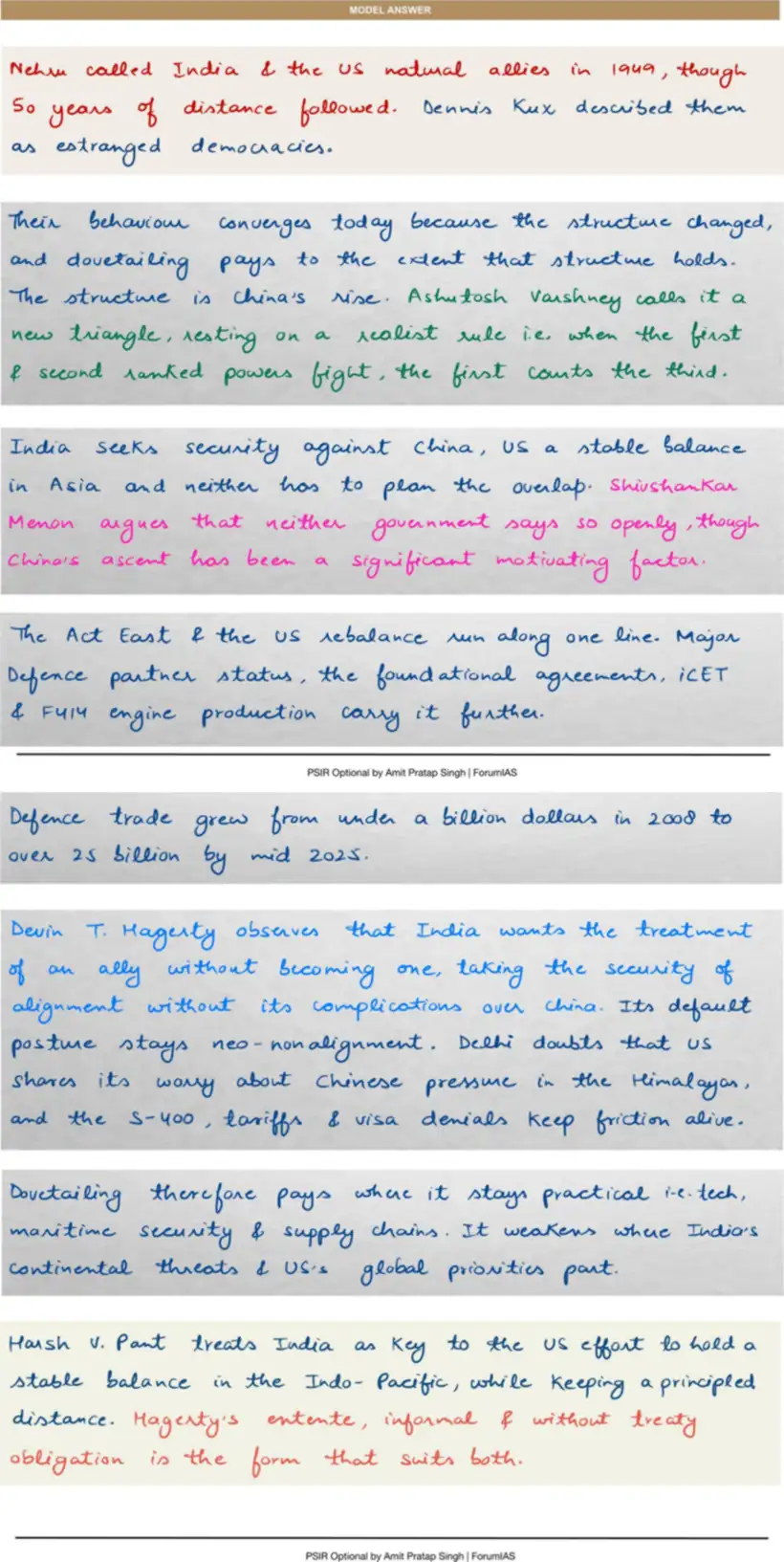
Model answer
Handwritten, in the form it would be written in the examination hall.
Also asked on this head
India and the Global Centres of Power — 27 questions in the Vault.
- Critically evaluate India-Russia relations in the 21st century. How have both the countries responded to America meddling in their relations in the recent times.
- “The mother of all deals” is a transformative milestone in Indo-EU trade relations. Elaborate on the new Security and Defence partnership.
- Does the idea of the 21st century as ‘Asian century’ continue to remain feasible given the growing friction between India and China?
How this is taught
The same flow snapshot, built for every head of the syllabus, with the answer written in class.
The first session of Foundation 2027 is published in full.
Six programmes across three levels.