
Arms trade, economic ties and congruent geo- political interests are no longer the three pillars of India – Russia relationship in the emerging strategic context. Comment.
How the answer moves
The flow snapshot — the routes in, the body, the counter-view and the routes out.
Route 1 right about one pillar, overstated about two → congruence gave the other two their purpose
Route 2 pillars not fallen but turned round → dependence survives, partnership does not
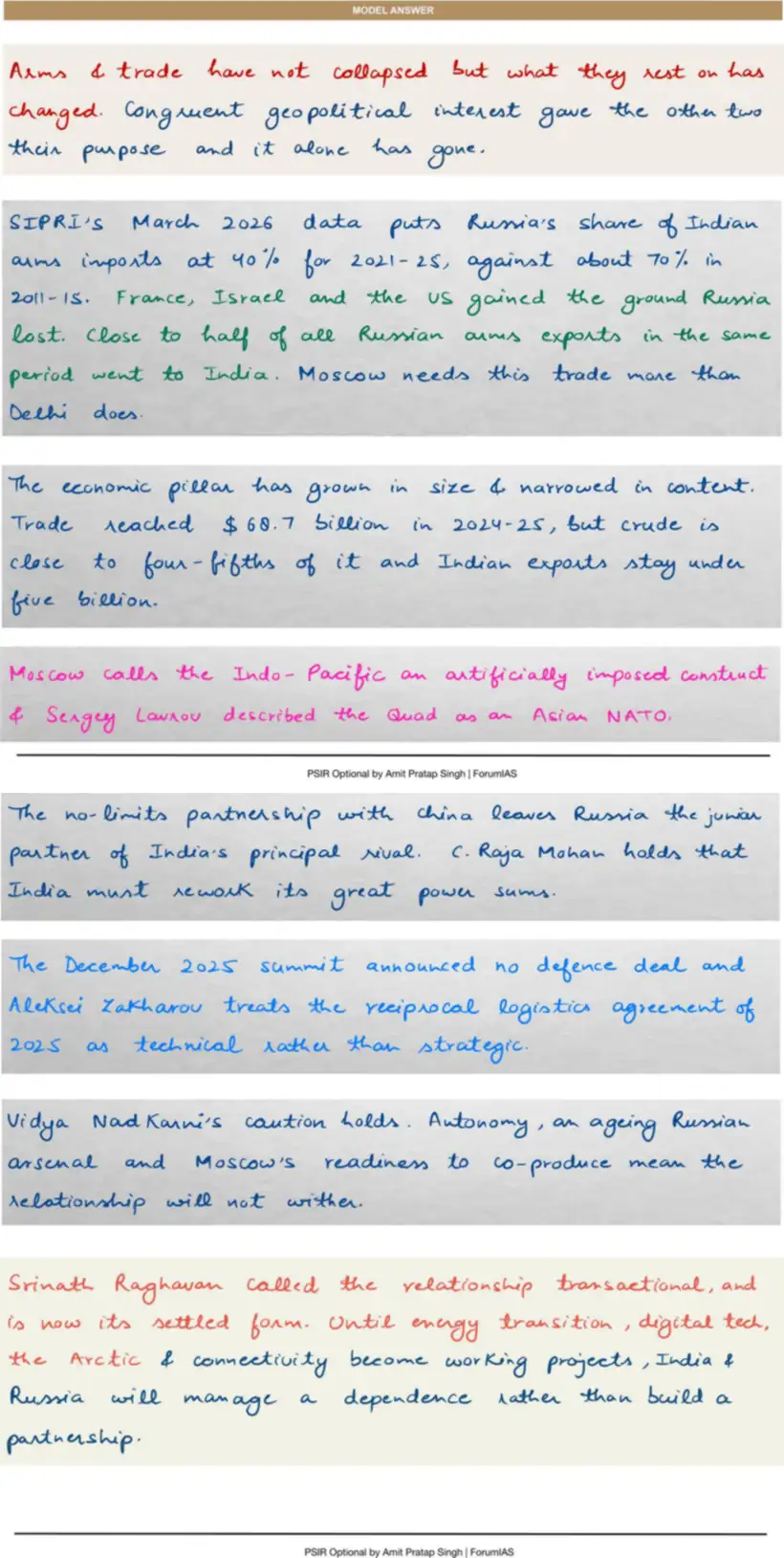
arms still densest → SIPRI: 70 per cent (2011-15) to 40 per cent (2021-25), France/Israel/US take the gap → but India absorbs close to half of Russia’s total exports → dependence inverted, not ended → economy: US$68.7bn but crude four-fifths, Indian exports under five billion → size up, content down → congruence: Indo-Pacific as artificially imposed construct, Lavrov’s Asian NATO, no-limits partnership leaves Russia junior to India’s principal rival → Raja Mohan, rework the great power sums → the cost: no defence deal at the December 2025 summit, Zakharov reads the logistics agreement as technical because outlooks do not align
Nadkarni: autonomy, ageing Russian arsenal, willingness to co-produce → no withering
Route 1 pillars bear weight without giving direction → Raghavan’s transactional as settled form
Route 2 new areas named but not built → managing a dependence, not building a partnership
Model answer
Handwritten, in the form it would be written in the examination hall.
Also asked on this head
India and the Global Centres of Power — 27 questions in the Vault.
- Critically evaluate India-Russia relations in the 21st century. How have both the countries responded to America meddling in their relations in the recent times.
- “The mother of all deals” is a transformative milestone in Indo-EU trade relations. Elaborate on the new Security and Defence partnership.
- Does the idea of the 21st century as ‘Asian century’ continue to remain feasible given the growing friction between India and China?
How this is taught
The same flow snapshot, built for every head of the syllabus, with the answer written in class.
The first session of Foundation 2027 is published in full.
Six programmes across three levels.