
“India and USA have become such strong strategic partners that they need not become formal allies.” Comment.
How the answer moves
The flow snapshot — the routes in, the body, the counter-view and the routes out.
Route 1 Hagerty’s entente → informal, outside treaty, flexible on what support is owed → treatment of an ally without the status of one
Route 2 claim right about where the partnership stands → wrong about why alliance stays away → obligation is the price India will not pay
partnership delivers most of what alliance would → GSOMIA / LEMOA / COMCASA / BECA → interoperability without Article-5 → ten-year Framework, Oct 2025 → what alliance adds is obligation → freedom of manoeuvre + non-aligned record → Parpiani and Pant, autonomy through partnerships → Jaishankar, partner not subordinate ally
the design has a price → 2025 tariffs at fifty per cent, half for Russian oil → framework signed while tariffs stood → February 2026 reset to eighteen → Pant and Bommakanti, 2026 NDS silent on India and the Quad
Route 1 alliance would not have stopped the tariffs → a burden-shifting Washington promises little more
Route 2 India’s reply was capability and hedging, not a treaty → deep in capability, shallow in obligation, both prefer it there
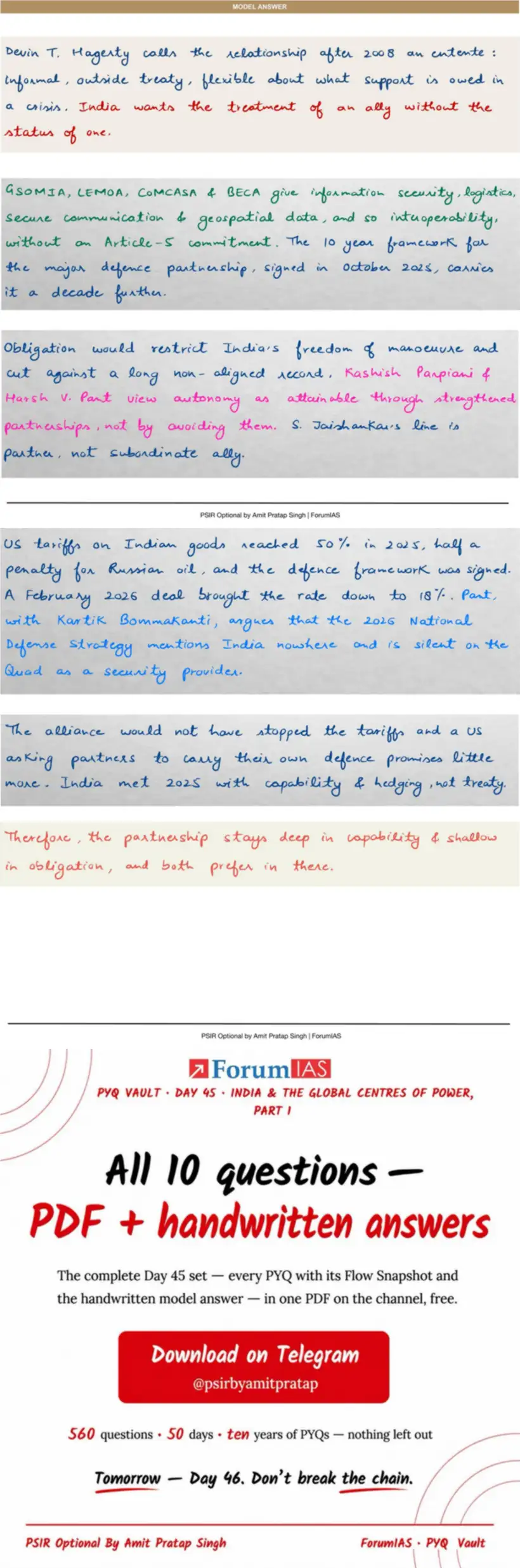
Model answer
Handwritten, in the form it would be written in the examination hall.
Also asked on this head
India and the Global Centres of Power — 27 questions in the Vault.
- Critically evaluate India-Russia relations in the 21st century. How have both the countries responded to America meddling in their relations in the recent times.
- “The mother of all deals” is a transformative milestone in Indo-EU trade relations. Elaborate on the new Security and Defence partnership.
- Does the idea of the 21st century as ‘Asian century’ continue to remain feasible given the growing friction between India and China?
How this is taught
The same flow snapshot, built for every head of the syllabus, with the answer written in class.
The first session of Foundation 2027 is published in full.
Six programmes across three levels.