
Discuss the significance of Indo-US strategic partnership and its implications for India’s security and national defence.
How the answer moves
The flow snapshot — the routes in, the body, the counter-view and the routes out.
Route 1 estrangement to entente (Hagerty) → close in practice, no treaty obligation → autonomy kept, defence stays India’s own responsibility
Route 2 what changed is Indian military capability, not American obligation → so measure the partnership in capability, not guarantees
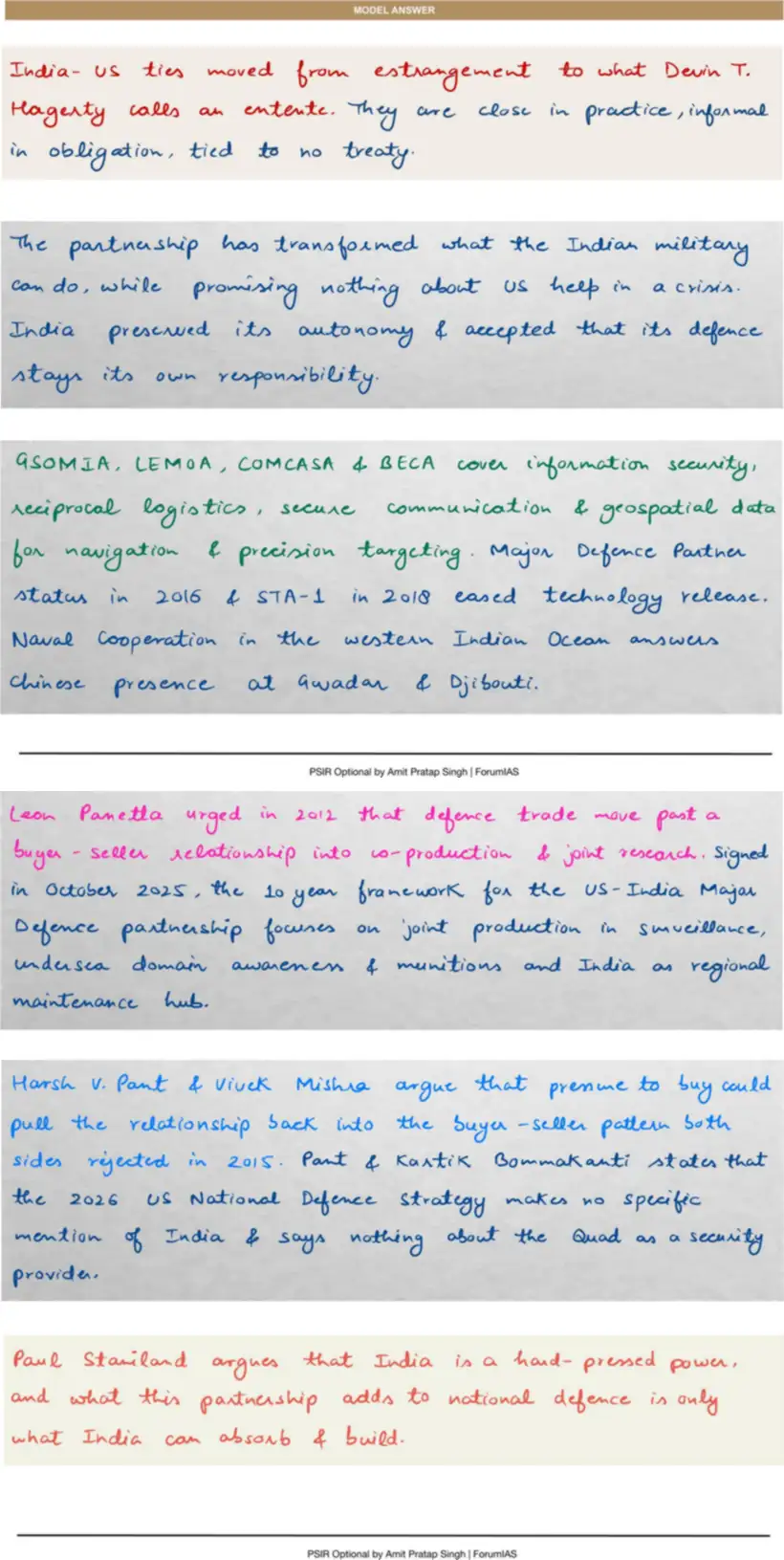
foundational architecture mapped one-to-one (GSOMIA information security → LEMOA logistics → COMCASA secure communication → BECA geospatial data, navigation, precision targeting) → Major Defence Partner 2016 + STA-1 2018, technology release eased → western Indian Ocean cooperation vs Gwadar and Djibouti → the sharper question: capability or only inventory → Panetta 2012, move beyond buyer-seller → October 2025 ten-year Framework as the formal answer: co-production in surveillance, undersea domain awareness, munitions; India as regional maintenance hub
Pant and Mishra: pressure to buy may pull it back into the buyer-seller pattern rejected in 2015 → Pant and Bommakanti: 2026 NDS names India nowhere, silent on the Quad as security provider → commitment cannot be assumed
Route 1 deterrence raised, not underwritten → value equals what India absorbs and builds
Route 2 Staniland: hard-pressed power → the binding limit sits in Indian capacity, not in American intent
Model answer
Handwritten, in the form it would be written in the examination hall.
Also asked on this head
India and the Global Centres of Power — 27 questions in the Vault.
- Critically evaluate India-Russia relations in the 21st century. How have both the countries responded to America meddling in their relations in the recent times.
- “The mother of all deals” is a transformative milestone in Indo-EU trade relations. Elaborate on the new Security and Defence partnership.
- Does the idea of the 21st century as ‘Asian century’ continue to remain feasible given the growing friction between India and China?
How this is taught
The same flow snapshot, built for every head of the syllabus, with the answer written in class.
The first session of Foundation 2027 is published in full.
Six programmes across three levels.