
Discuss the rationale behind replacing the “Asia- Pacific” strategy with the new term “Indo-Pacific” strategy.
How the answer moves
The flow snapshot — the routes in, the body, the counter-view and the routes out.
Route 1 Asia-Pacific: 1960s origin, APEC 1980s → rim-centred map, India outside, Indian Ocean read apart → renaming = deciding who counts
Route 2 a region is a strategic choice, not a coastline → the old map left out India and the Indian Ocean → the new name written to bring India in
Hormuz + Malacca, half of maritime oil trade → India’s weight cannot sit off the map → Khurana 2007, alternative that takes India in → Abe’s confluence, Australian + American support → both oceans one theatre → Quad’s premise → India past South Asia
resistance mirrors adoption → Beijing prefers Asia-Pacific, keeps China central → Moscow: artificial → Chacko: trade density stayed Asia-Pacific, region built from anxiety over China, India as balancer
Route 1 strategic, not cartographic → 2025 NSS hemisphere first, 2026 NDS deterrence second-order → the name holds only while the strategy is funded
Route 2 renaming decided who counts → India gained standing, China lost centrality → a map survives on its sponsors’ investment, not on its logic
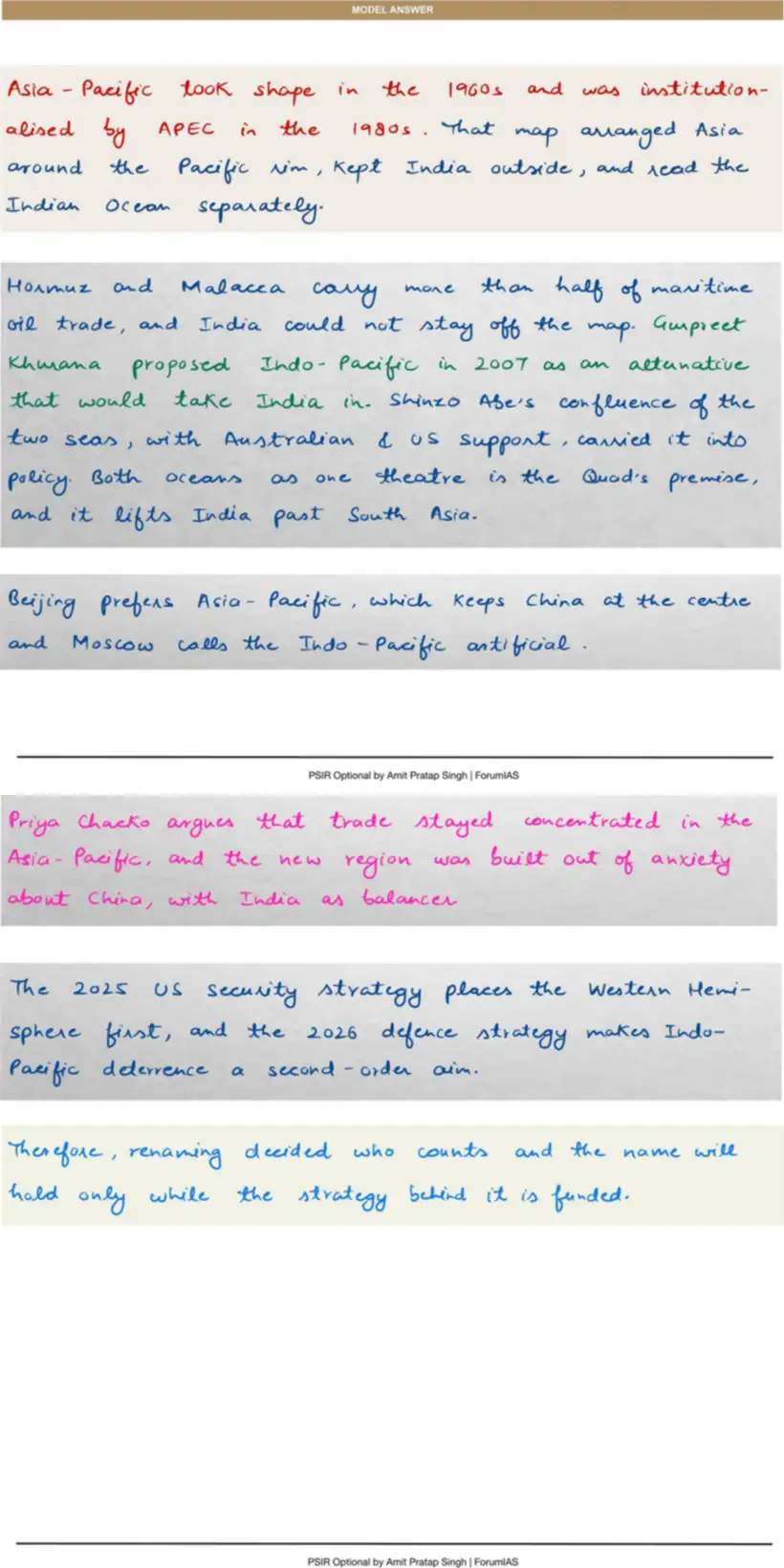
Model answer
Handwritten, in the form it would be written in the examination hall.
Also asked on this head
India and the Global Centres of Power — 27 questions in the Vault.
- Critically evaluate India-Russia relations in the 21st century. How have both the countries responded to America meddling in their relations in the recent times.
- “The mother of all deals” is a transformative milestone in Indo-EU trade relations. Elaborate on the new Security and Defence partnership.
- Does the idea of the 21st century as ‘Asian century’ continue to remain feasible given the growing friction between India and China?
How this is taught
The same flow snapshot, built for every head of the syllabus, with the answer written in class.
The first session of Foundation 2027 is published in full.
Six programmes across three levels.