
How the answer moves
The flow snapshot — the routes in, the body, the counter-view and the routes out.
Route 1 equal citizenship + equal liberty look paired on paper → real value depends on the spread of economic resources
Route 2 democratic citizenship gives equal status → economic inequality decides who is actually heard → relationship is conditional, not fixed
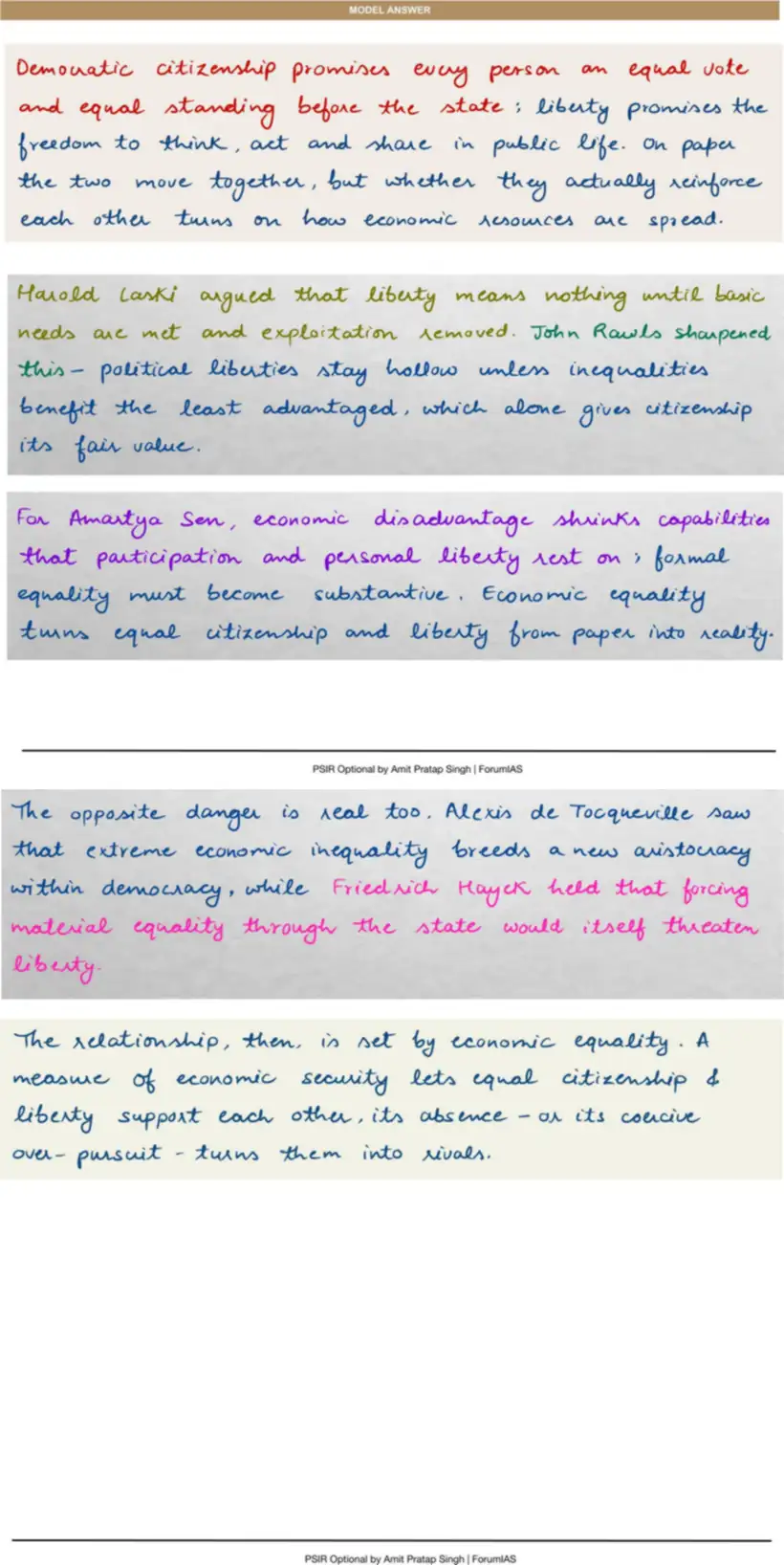
formal equality insufficient when wealth controls participation → patronage / policy capture / poor hold unusable rights → Laski (basic needs, no exploitation) → Rawls (difference principle → fair value of political liberty) → Sen (capability → substantive freedom) → economic equality makes the two complementary
Tocqueville: extreme inequality → new aristocracy within democracy ↔ Hayek: state-forced material equality → threat to liberty
Route 1 economic equality is the deciding variable → security makes citizenship + liberty mutually supporting
Route 2 neither fixed conflict nor automatic harmony → balance of basic economic security with protection of freedom
Model answer
Handwritten, in the form it would be written in the examination hall.
Also asked on this head
Equality — 13 questions in the Vault.
- What is capability approach? Elaborate the distinctive features of the capability theory of equality.
- The freedom of the pike is death to the minnows. (150 words)
- Write a note on the relation between equality and
How this is taught
The same flow snapshot, built for every head of the syllabus, with the answer written in class.
The first session of Foundation 2027 is published in full.
Six programmes across three levels.