
How the answer moves
The flow snapshot — the routes in, the body, the counter-view and the routes out.
Route 1 fairness judged by results, not chances → equal distribution of income / wealth → most radical egalitarianism
Route 2 focus shifts from starting point to end result → distributive equality → fairness measured at the finish
concept (results over chances) → socialist / substantive defence → Marxist abolition of classes → Rousseau (inequality enslaves poor, corrupts rich) → libertarian critique → Hayek (rule of law vs material equality) → Nozick (just steps) → Sen (capabilities redirect)
coercion + conflict with equality before law + self-ownership vs dignity and substantive equality
Route 1 targets real deprivation, but best realised as substantive freedom, not enforced sameness
Route 2 Sen’s capability shift reframes outcome equality as real freedom rather than identical results
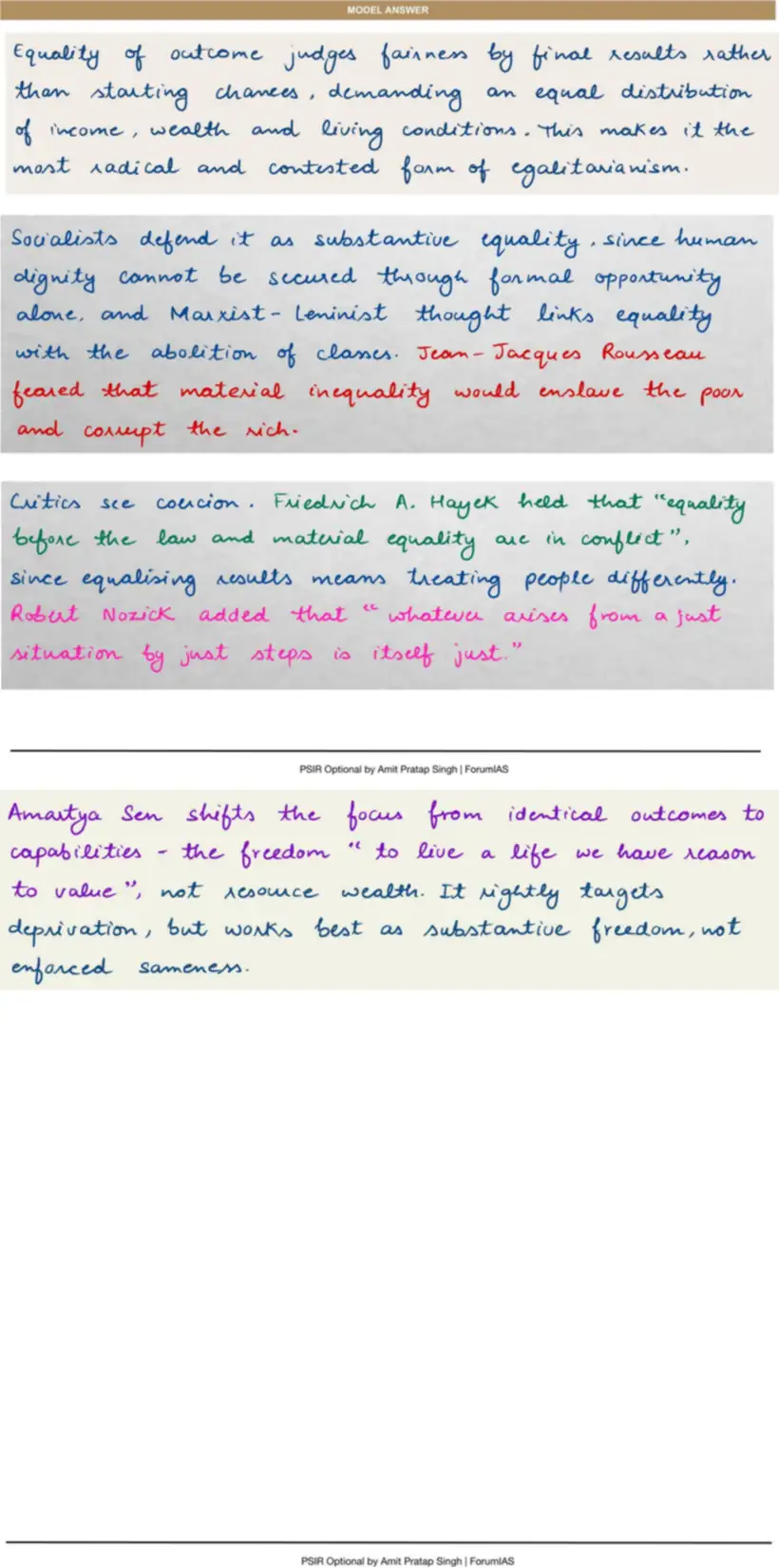
Model answer
Handwritten, in the form it would be written in the examination hall.
Also asked on this head
Equality — 13 questions in the Vault.
- What is capability approach? Elaborate the distinctive features of the capability theory of equality.
- The freedom of the pike is death to the minnows. (150 words)
- Write a note on the relation between equality and
How this is taught
The same flow snapshot, built for every head of the syllabus, with the answer written in class.
The first session of Foundation 2027 is published in full.
Six programmes across three levels.