
Examine the liberal theory of the State in contemporary politics.
How the answer moves
The flow snapshot — the routes in, the body, the counter-view and the routes out.
Route 1 individual primary → state by consent to protect liberty / rights / property → claim of limited, neutral state now strained
Route 2 liberal frame still dominant → neutrality questioned by the market turn, inequality, identity claims
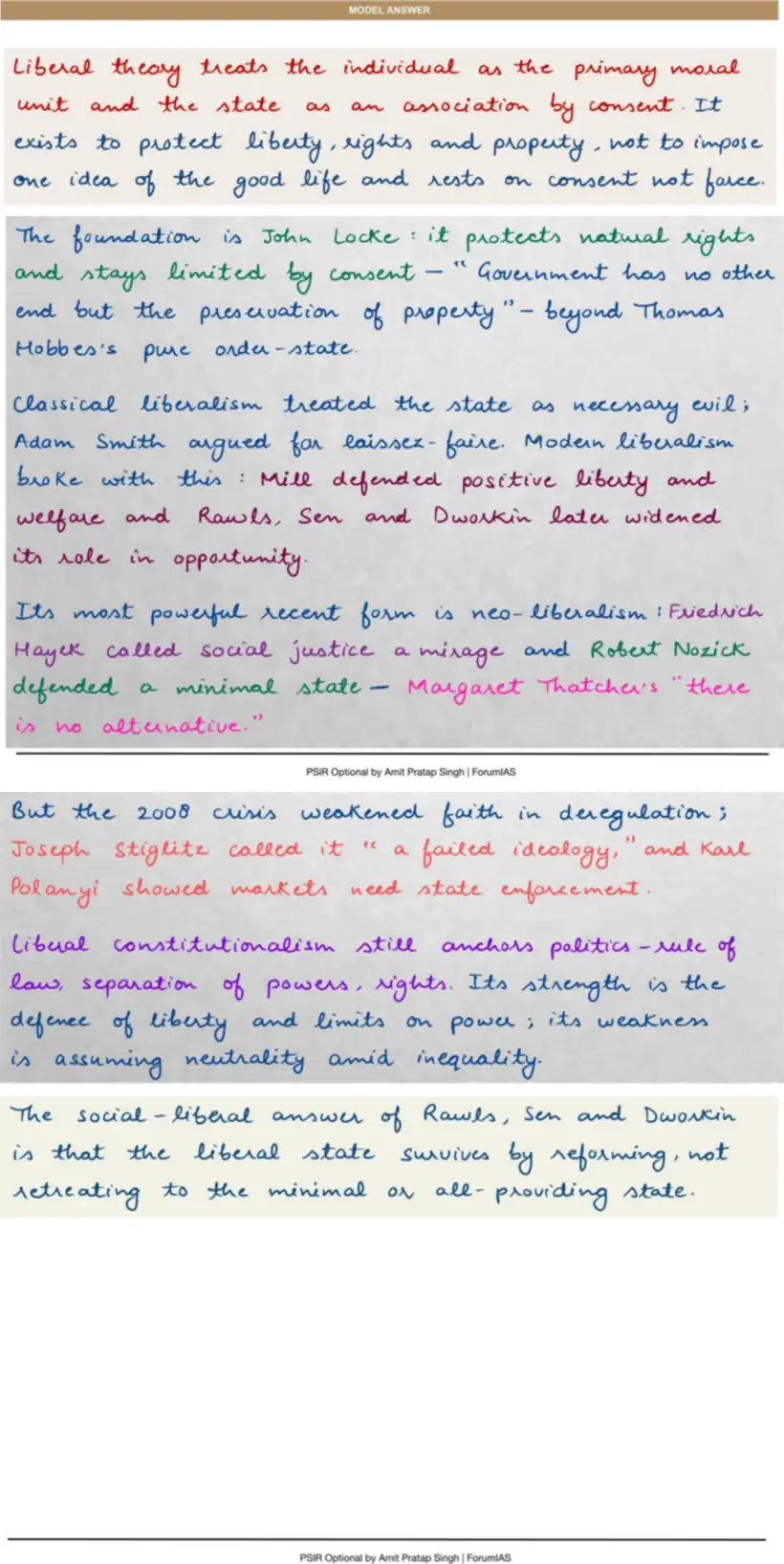
Locke foundation (natural rights, consent; “no other end but preservation of property”) vs Hobbes’s order-state → classical (Smith, laissez-faire, “necessary evil”) → modern (J. S. Mill; Rawls / Sen / Dworkin → welfare + opportunity) → neo-liberal turn (Hayek “mirage”, Nozick minimal state; Thatcher TINA; LPG 1991)
2008 crisis + Stiglitz “failed ideology” + Polanyi (markets need the state) → inequality → feminist / Marxist / neo-pluralist denial of neutrality
Route 1 constitutionalism still central → strength = liberty + limits; weakness = assumed neutrality amid inequality
Route 2 social-liberal reform (Rawls / Sen / Dworkin) → liberal state survives by reforming, not retreating
Model answer
Handwritten, in the form it would be written in the examination hall.
Also asked on this head
Theories of the State — 10 questions in the Vault.
- Post-colonial theory of State (150 words)
- What is the Marxist and liberal approach towards the state? On what grounds are the theoretical differences between them premised? Explain.
- Comment on the pluralist theory of the state in about 150 words.
How this is taught
The same flow snapshot, built for every head of the syllabus, with the answer written in class.
The first session of Foundation 2027 is published in full.
Six programmes across three levels.