
What is the Marxist and liberal approach towards the state? On what grounds are the theoretical differences between them premised? Explain.
How the answer moves
The flow snapshot — the routes in, the body, the counter-view and the routes out.
Route 1 both ask what the state is and whom it serves → opposite starting points: individual vs class
Route 2 liberalism from individual + consent → Marxism from class + mode of production → one root divide
liberal: individual moral unit → consent, neutral umpire, rule of law → Locke (rights, property) → Rawls / Sen / Dworkin (opportunity) → Marxist: class not individual → state from private property + class division → Manifesto “committee of the bourgeoisie” → Lenin “organ of class rule” → Miliband instrumentalist vs Poulantzas relative autonomy → Gramsci hegemony (consent + coercion)
neither places the state above class → liberal neutral umpire vs Marxist class-domination → no neutral ground, premises do not meet
Route 1 difference is over where analysis begins → individual + neutral order vs class power + production
Route 2 contemporary tests (inequality, 2008 rescue, limits of welfare) keep both alive → umpire or guardian of the propertied order
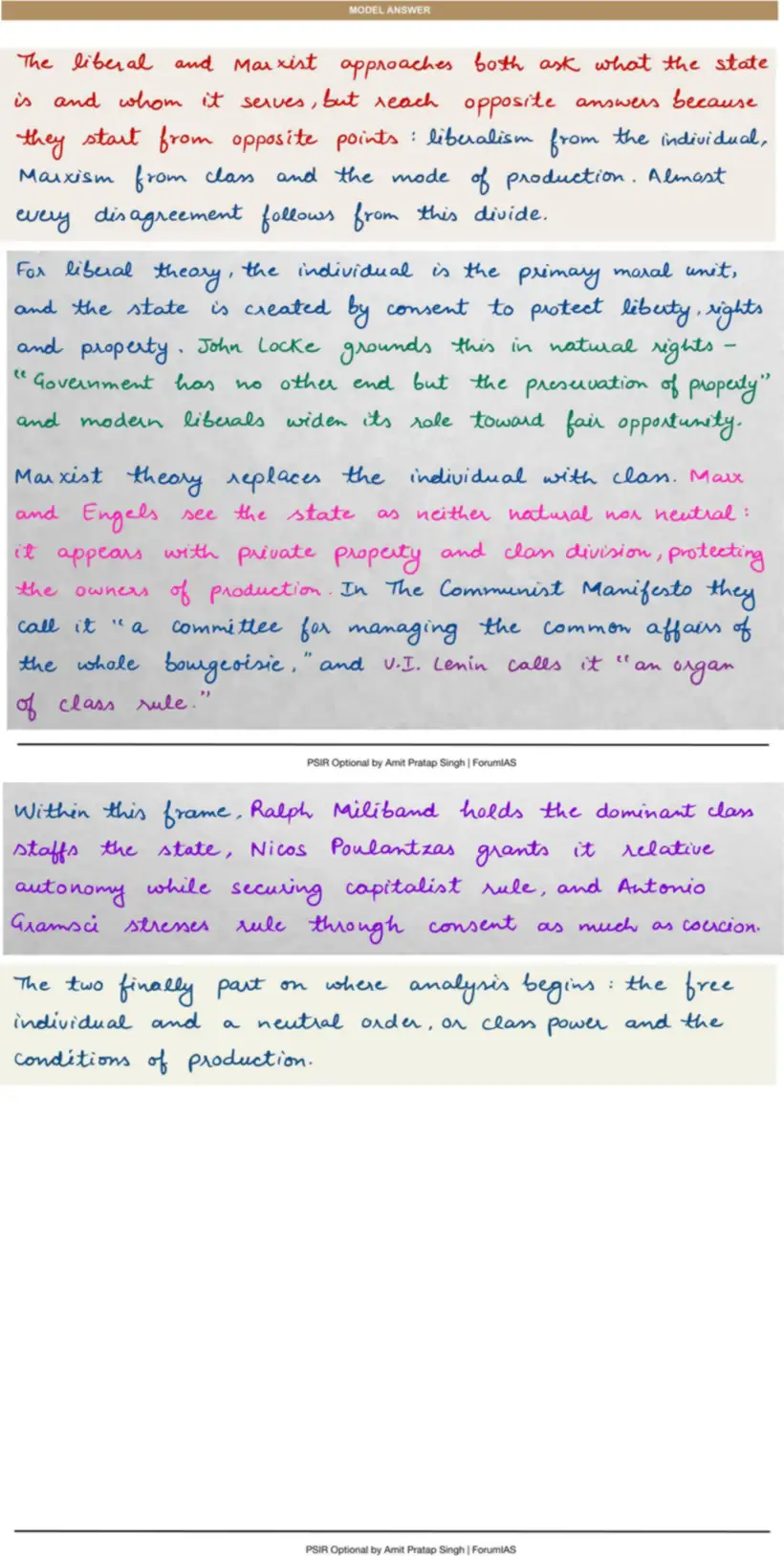
Model answer
Handwritten, in the form it would be written in the examination hall.
Also asked on this head
Theories of the State — 10 questions in the Vault.
- Post-colonial theory of State (150 words)
- Comment on the pluralist theory of the state in about 150 words.
- Examine the liberal theory of the State in contemporary politics.
How this is taught
The same flow snapshot, built for every head of the syllabus, with the answer written in class.
The first session of Foundation 2027 is published in full.
Six programmes across three levels.