
Do you agree with the view that the USA uses NATO as a traditional tool of strategy to perpetuate its hegemony in the world?
How the answer moves
The flow snapshot — the routes in, the body, the counter-view and the routes out.
Route 1 NATO 1949, US-led mutual defence pact vs USSR; Warsaw Pact 1955 → agree on the purpose, dispute the method → hegemony perpetuated, but not by coercion
Route 2 the question’s premise is realist (Mearsheimer: hegemon strengthens self, weakens rivals) → NATO’s post-1991 record fits that purpose → but the method is consent, not coercion
realist premise stated (Mearsheimer) → NATO outlives the enemy it was built against → institutionalises US military leadership in Europe → carries American influence eastward into the former Soviet space → Hurrell: Cold War’s end frees the USA from geopolitical constraints, less tolerant of alternative orders → Ukraine war read partly as a contest over that expansion → European strategic autonomy discouraged → pivot: how the alliance holds its members → US backing for European reconstruction and integration → allies “bandwagon” instead of balancing → Gramsci: leadership by consent vs by force beats a purely material account → explains the alliance holding together after the Soviet threat went
a pure instrument of American will would obey → Europe resents being “dragged into” US confrontations → “Sinatra Doctrine” impulse → separate China policy → burden-sharing: “fund its security” → Rapp-Hooper’s “alliance deficit”
Route 1 agreement must be qualified → hegemony perpetuated by consent → consent can be withheld
Route 2 Zakaria: the future of that hegemony turns on America’s capacity to adapt
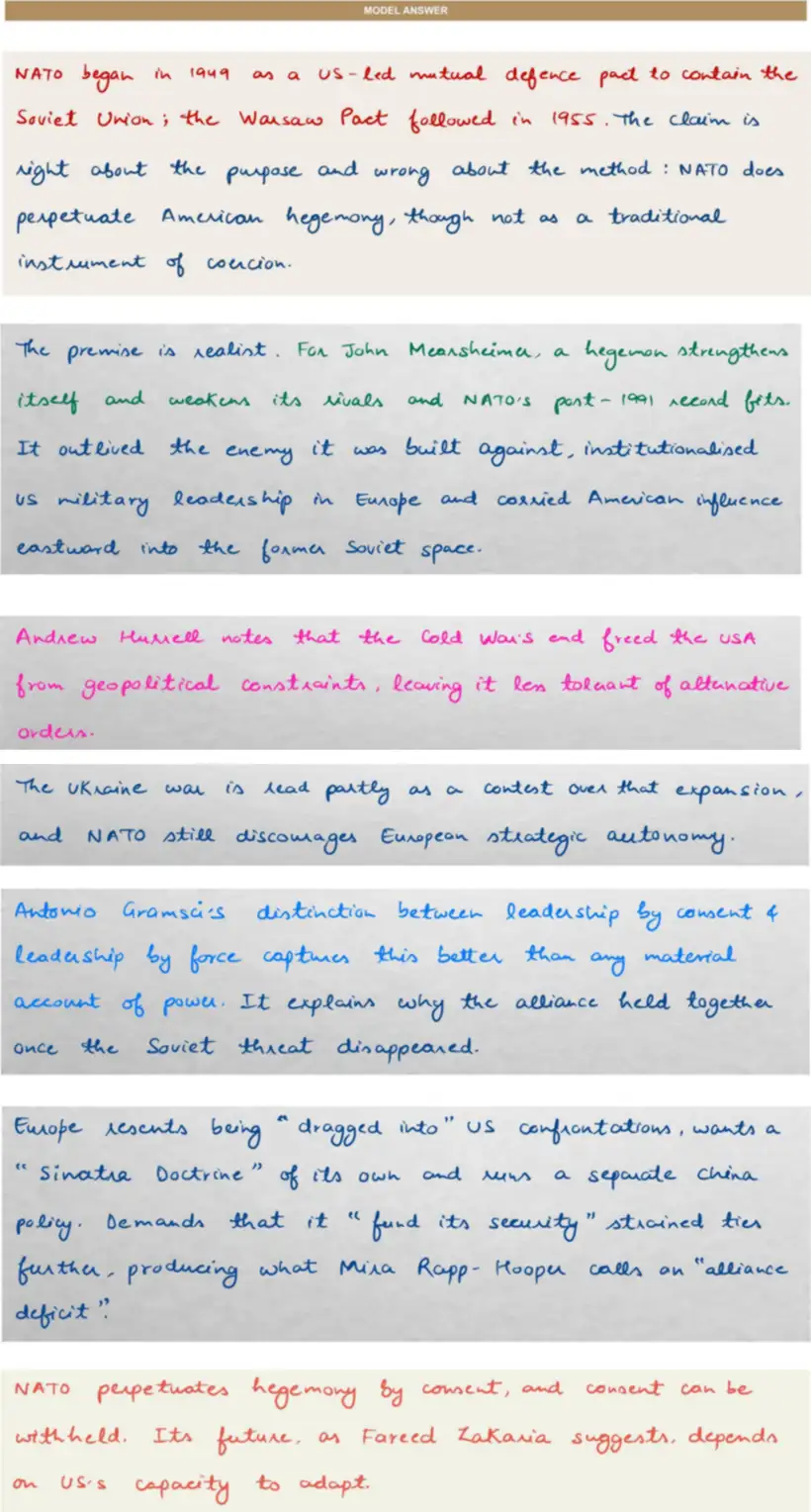
Model answer
Handwritten, in the form it would be written in the examination hall.
Also asked on this head
Changing International Political Order — 21 questions in the Vault.
- Does power transition theory reflect the dynamics of US-China relations?
- NATO, the oldest surviving collective security system, is facing challenge of transactional coercion from its own biggest member. What future does NATO have amidst such developments?
- The expansionist tendencies of the current Russian regime indicate its intentions for the realisation of a Greater Russia on the lines of the Soviet era. Comment....
How this is taught
The same flow snapshot, built for every head of the syllabus, with the answer written in class.
The first session of Foundation 2027 is published in full.
Six programmes across three levels.