
Imprint of the British Constitution on the Indian Constitution.
How the answer moves
The flow snapshot — the routes in, the body, the counter-view and the routes out.
Route 1 clear British imprint → rooted in colonial familiarity with parliamentary institutions
Route 2 parliamentary system as the strongest mark → the natural starting point
parliamentary core (nominal President + real PM & Council of Ministers) → collective responsibility to Lok Sabha, as in British practice → rule of law → bicameralism + legislative procedure → parliamentary privileges → single citizenship → prerogative writs
not a copy → written Constitution, judicial review, federalism, justiciable Fundamental Rights set India apart
Route 1 borrowed core joined to Indian concerns of diversity, justice, social transformation
Route 2 imprint real but reshaped for Indian conditions → adaptation, not imitation
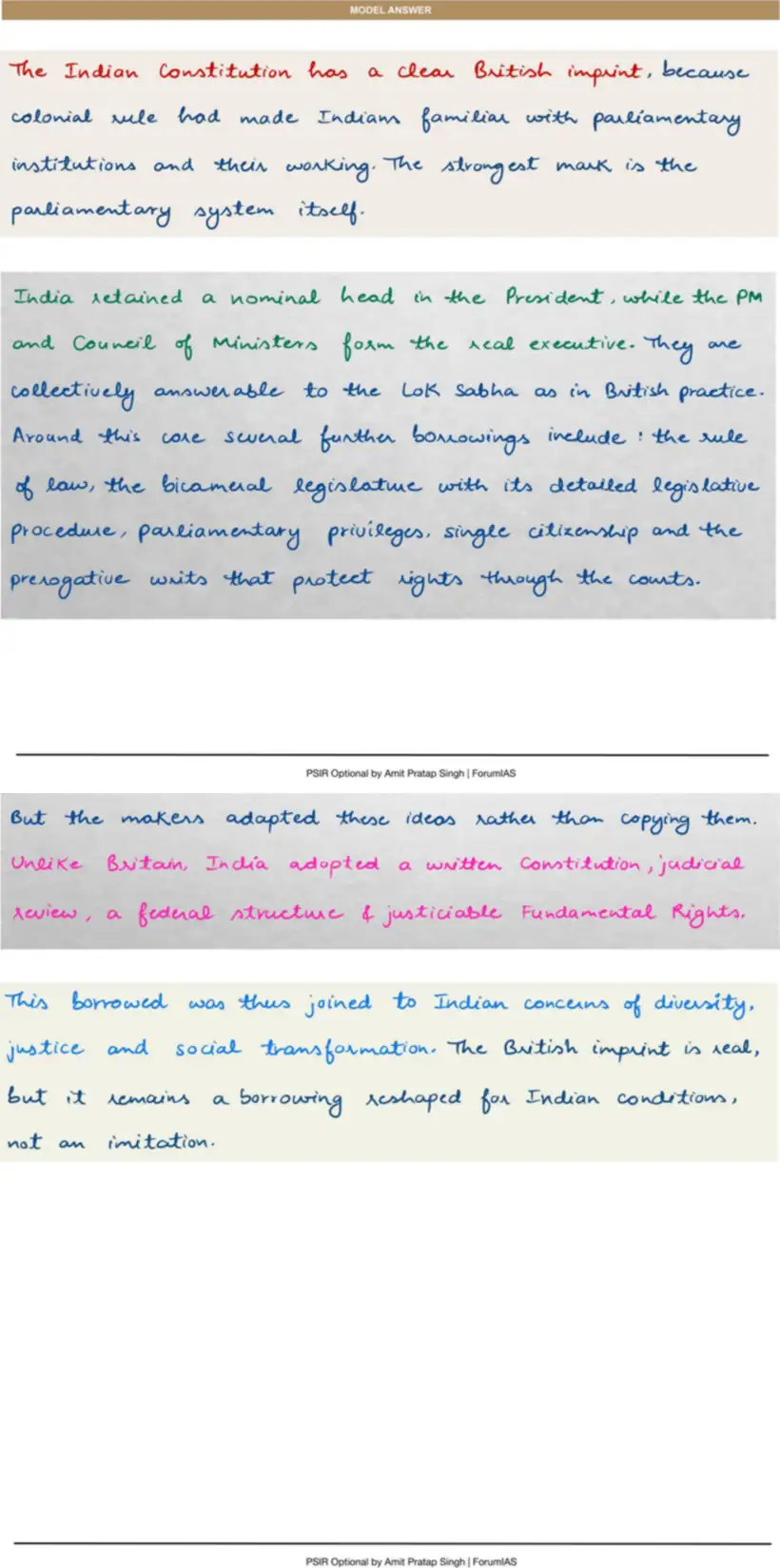
Model answer
Handwritten, in the form it would be written in the examination hall.
Also asked on this head
Making of the Indian Constitution — 10 questions in the Vault.
- The Constitution of India is the ‘cornerstone of a nation’. (Granville Austin). Analyze.
- Comment on the Objective Resolution of the Constituent Assembly in 150 words.
- Comment on the Constitutional morality in the Indian Constitution in 150 words.
How this is taught
The same flow snapshot, built for every head of the syllabus, with the answer written in class.
The first session of Foundation 2027 is published in full.
Six programmes across three levels.