
The making of the Indian Constitution is described as an attempt towards ‘social revolution’. Comment.
How the answer moves
The flow snapshot — the routes in, the body, the counter-view and the routes out.
Route 1 not merely a transfer of power → makers aimed to remake an unequal society → “social revolution” fits
Route 2 Santhanam’s three revolutions → social revolution = exit from medievalism of birth, religion, custom, community
intent shaped the core design → Preamble (justice, liberty, equality, fraternity) → Fundamental Rights attack discrimination, untouchability, forced labour → Directive Principles seek welfare state, economic justice, education, social security → universal adult suffrage = revolutionary democratic step → reservations for SC / ST / backward classes = historical injustice addressed → Austin: a social document; Part III + Part IV = “conscience of the Constitution”
revolution by constitutional, peaceful means, not sudden upheaval → Ambedkar: political democracy must rest on social democracy → persisting inequality can betray it
Route 1 description holds: a legal and moral framework for social transformation
Route 2 revolution in design and intent; its completion lay in society, not in the text alone
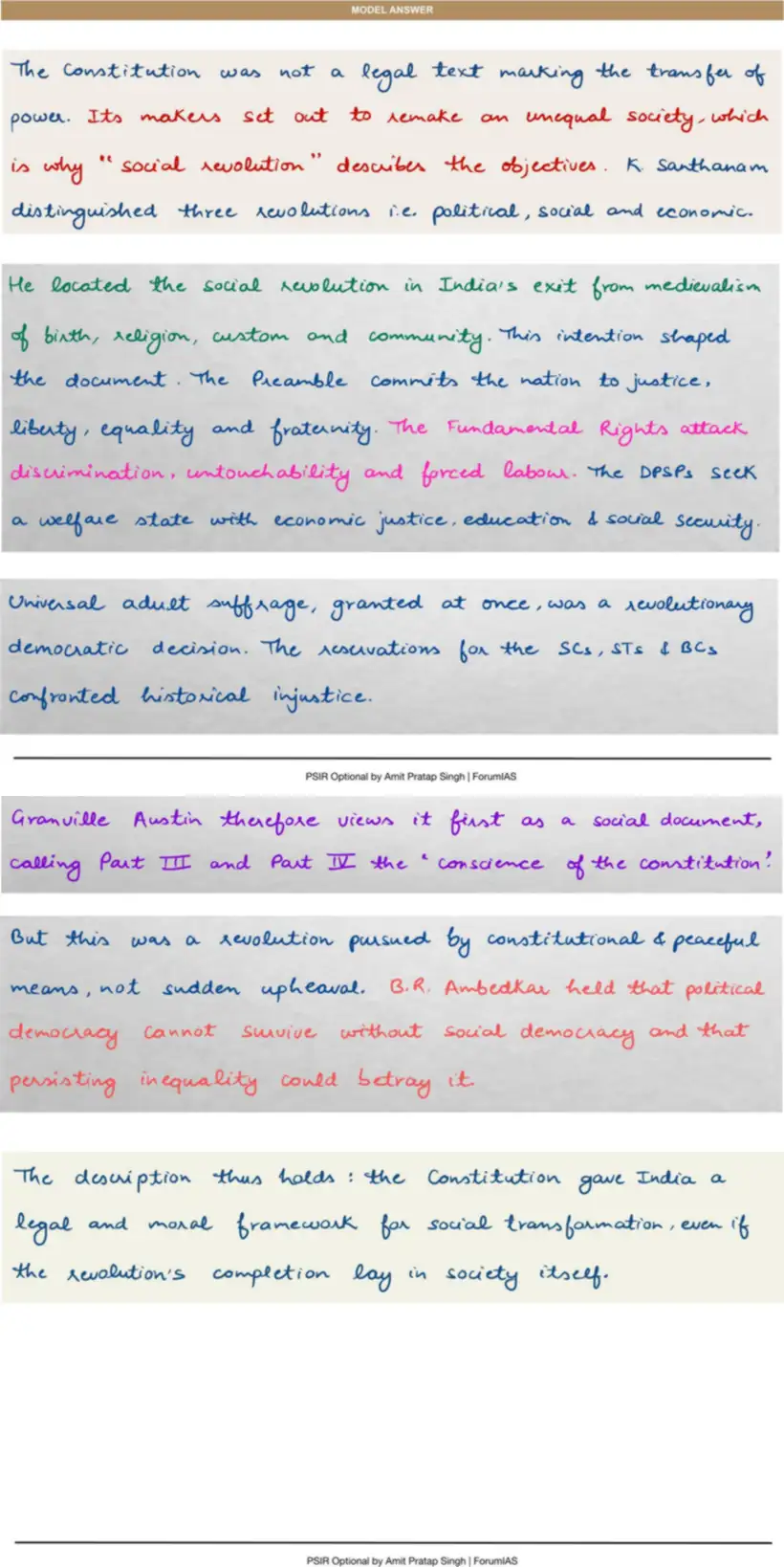
Model answer
Handwritten, in the form it would be written in the examination hall.
Also asked on this head
Making of the Indian Constitution — 10 questions in the Vault.
- The Constitution of India is the ‘cornerstone of a nation’. (Granville Austin). Analyze.
- Comment on the Objective Resolution of the Constituent Assembly in 150 words.
- Comment on the Constitutional morality in the Indian Constitution in 150 words.
How this is taught
The same flow snapshot, built for every head of the syllabus, with the answer written in class.
The first session of Foundation 2027 is published in full.
Six programmes across three levels.