
“The Constitution of India is a product of a historical process, rich with constitutional antecedents.’ Comment.
How the answer moves
The flow snapshot — the routes in, the body, the counter-view and the routes out.
Route 1 not a sudden 1950 document → product of a long historical process
Route 2 two streams feed it → colonial statutes + nationalist demands → reworked for India
colonial line builds governance → Regulating Act 1773 / Charter Acts / GoI Act 1858 → Indian Councils Acts + Morley-Minto + Montagu-Chelmsford → limited representation → GoI Act 1935 contributes most (federation, governor, PSCs, judiciary, emergency) → parallel nationalist tradition supplies values → Swaraj Bill 1895 / Nehru Report 1928 (rights, federalism, secularism, responsible govt) / Karachi Resolution 1931 (freedom + socio-economic justice) → Cripps + Cabinet Missions → Constituent Assembly → British model (parliamentary govt, rule of law)
not mechanical copying → antecedents adapted to Indian needs
Route 1 layered inheritance, colonial + nationalist
Route 2 endpoint of evolution, not an overnight document
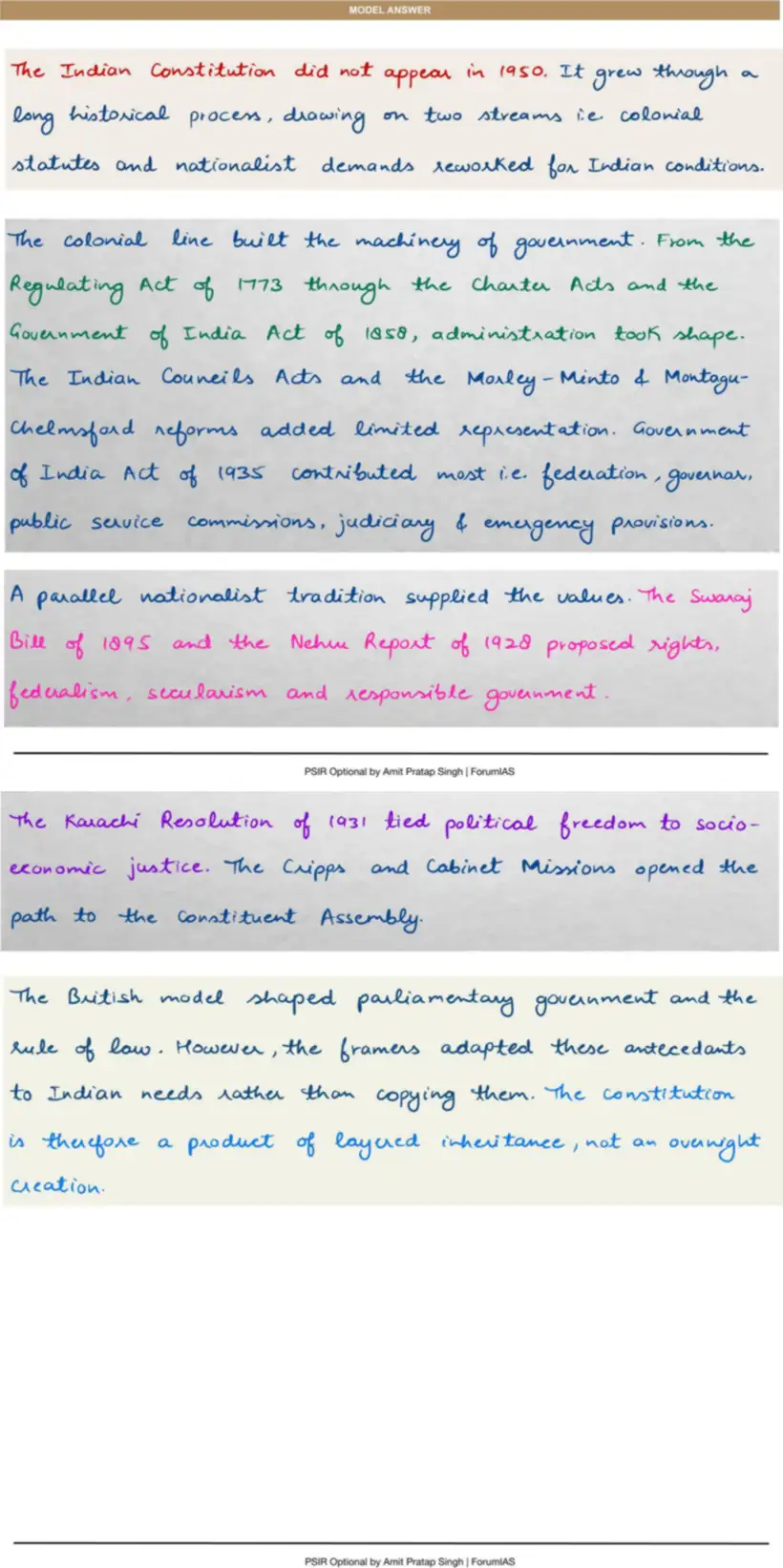
Model answer
Handwritten, in the form it would be written in the examination hall.
Also asked on this head
Making of the Indian Constitution — 10 questions in the Vault.
- The Constitution of India is the ‘cornerstone of a nation’. (Granville Austin). Analyze.
- Comment on the Objective Resolution of the Constituent Assembly in 150 words.
- Comment on the Constitutional morality in the Indian Constitution in 150 words.
How this is taught
The same flow snapshot, built for every head of the syllabus, with the answer written in class.
The first session of Foundation 2027 is published in full.
Six programmes across three levels.