
The Indian Monsoon is the foundation of India’s climate and one of the most important topics in physical geography. This article explains the concept and mechanism of the monsoon, the origin and characteristics of the Southwest and Northeast Monsoons, factors influencing their onset and intensity, the role of the ITCZ, jet streams, ocean–atmosphere interactions, and their significance in shaping India’s rainfall pattern.
Study Approach
Start with the Big Picture
First understand the Indian Monsoon as a seasonal wind system driven by the differential heating of land and sea and the seasonal migration of global pressure belts. Then follow the natural flow:
Concept of Monsoon → Mechanism of the Indian Monsoon → Southwest Monsoon → Northeast Monsoon → Role of ITCZ → Factors Influencing Monsoon → Significance
This sequence helps you connect atmospheric circulation with India’s climate, rainfall distribution, agriculture, economy, water resources, and disaster management.
Major Study Blocks
Block 1: Concept and Mechanism of the Indian Monsoon
Study:
- Meaning and origin of the term Monsoon
- Seasonal reversal of winds
- Land and sea heating
- Pressure differences
- Summer and winter circulation
- Southwest and Northeast Monsoon
What to understand:
- Why winds reverse direction seasonally.
- Why India experiences two distinct monsoon seasons.
- Why the Southwest Monsoon brings most of India’s rainfall.
- Why the Northeast Monsoon mainly benefits Tamil Nadu and the southeastern coast.
Block 2: Southwest and Northeast Monsoon
Southwest Monsoon
- Tibetan Low Pressure
- Southern Indian Ocean High Pressure
- Arabian Sea Branch
- Bay of Bengal Branch
- Onset over Kerala
- Rainfall distribution
Northeast Monsoon
- Siberian High
- Tibetan High Pressure
- Retreating Monsoon
- Rainfall over Tamil Nadu
- Winter circulation
Block 3: Factors Influencing the Indian Monsoon
Study the role of:
- Tibetan Plateau
- Southern Indian Ocean High Pressure
- Subtropical Jet Stream (STJ)
- Tropical Easterly Jet (TEJ)
- Somali Jet
- Somali Current
- Walker Circulation
- Indian Ocean Dipole (IOD)
- Inter-Tropical Convergence Zone (ITCZ)
Block 4: Role of the Inter-Tropical Convergence Zone (ITCZ)
Focus on:
- Definition of ITCZ
- Seasonal migration
- Crossing of the Equator by Southeast Trade Winds
- Coriolis Force
- Formation of Southwest Monsoon
- Monsoon Front
- Monsoon Trough
- Northern ITCZ (NITCZ)
- Southern ITCZ (SITCZ)
Block 5: Significance of the Indian Monsoon
Study under different dimensions:
- Climatic
- Agricultural
- Economic
- Ecological
- Hydrological
- Disaster Management
Understand interconnections:
- Monsoon → Agriculture → Food Security
- Monsoon → Rivers → Water Resources
- Monsoon → Hydroelectric Power → Energy
- Monsoon → Economy → GDP Growth
- Monsoon → Floods & Droughts → Disaster Management
- Monsoon → Biodiversity → Ecosystem Stability
Important for Prelims
- Meaning and origin of Monsoon
- Southwest vs Northeast Monsoon
- Onset and withdrawal of the monsoon
- ITCZ and Monsoon Trough
- STJ and TEJ
- Somali Jet
- Indian Ocean Dipole (IOD)
- Walker Circulation
- Tibetan Plateau
- Arabian Sea and Bay of Bengal Branches
- Rainfall distribution in India
Important for Mains
- Mechanism of the Indian Monsoon
- Factors influencing the onset and strength of the monsoon
- Role of ITCZ and Jet Streams
- Southwest and Northeast Monsoon comparison
- Monsoon variability and climate change
- Monsoon and Indian agriculture
- Economic significance of the monsoon
- Floods, droughts, and disaster management
- Monsoon forecasting and sustainable water resource management
Indian Monsoon
| Table Content |
| Southwest Monsoon |
| Northeast Monsoon |
| Role of the Inter-Tropical Convergence Zone (ITCZ) in the Indian Monsoon |
| Significance of the Indian Monsoon |
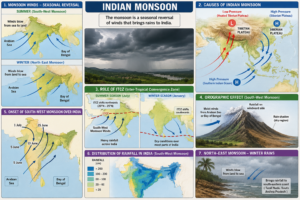
The word “Monsoon” is believed to have originated from the Arabic term “Mausin” or the Malay word “Monsin”, both of which mean “season.” Monsoons are seasonal wind systems that change their direction periodically with the change of seasons. They represent a rhythmic pattern of atmospheric circulation and are often categorized as periodic or secondary winds.
A distinctive feature of the monsoon system is its seasonal reversal:
- During summer, winds generally blow from the ocean towards the land.
- During winter, the direction reverses and winds flow from the land towards the sea.
Because of this behavior, some geographers consider monsoons to be an enlarged version of the land and sea breeze system.
Monsoon climates are mainly found in the Indian subcontinent, Southeast Asia, and certain regions of Central and Western Africa. However, the phenomenon is most developed and pronounced over the Indian subcontinent. The Indian monsoon can be viewed as a giant atmospheric convection system, operating on a continental scale. India experiences:
- Southwest Monsoon during summer.
- Northeast Monsoon during winter.
The Southwest Monsoon develops due to the formation of an intense low-pressure area over the Tibetan Plateau during summer. In contrast, the Northeast Monsoon is associated with strong high-pressure systems over the Tibetan and Siberian Plateaus during winter. The Southwest Monsoon provides the bulk of annual rainfall to most parts of India, whereas the Northeast Monsoon mainly brings rainfall to the southeastern coast of India, particularly the coastal regions of Tamil Nadu and southern Andhra Pradesh.
Countries such as India, Bangladesh, Myanmar, and Indonesia receive a major share of their annual precipitation during the Southwest Monsoon season. On the other hand, regions like Southeast China and Japan receive significant rainfall during the Northeast Monsoon period.
Southwest Monsoon
The development of the Southwest Monsoon is primarily influenced by:
- Intense summer heating of the Tibetan Plateau, which creates a strong low-pressure area.
- The presence of a permanent high-pressure cell over the southern Indian Ocean, situated east and northeast of Madagascar.
Factors Influencing the Onset of the Southwest Monsoon
The arrival of the Southwest Monsoon over India is affected by several atmospheric conditions:
- Intense heating over Tibet.
- High-pressure conditions over the southern Indian Ocean.
- Position and behavior of the Subtropical Jet Stream (STJ).
- Development of the Tropical Easterly Jet (TEJ).
- Northward migration of the Inter-Tropical Convergence Zone (ITCZ).
Factors Affecting the Strength of the Southwest Monsoon
The intensity and effectiveness of monsoon rainfall depend on:
- The strength of the low-pressure area over Tibet and the high-pressure cell over the southern Indian Ocean.
- The Somali Jet (Findlater Jet).
- The Somali Current (Findlater Current).
- The Indian Ocean branch of the Walker Circulation.
- The Indian Ocean Dipole (IOD).
Northeast Monsoon
The Northeast Monsoon develops due to:
- The establishment and strengthening of high-pressure systems over the Tibetan and Siberian Plateaus during winter.
- Westward movement and weakening of the high-pressure cell located in the southern Indian Ocean.
- Southward migration of the ITCZ beyond the Indian landmass.
Created by ForumIAS
Role of the Inter-Tropical Convergence Zone (ITCZ) in the Indian Monsoon
The Inter-Tropical Convergence Zone (ITCZ) is a belt of low pressure near the equator where:
- The Northeast Trade Winds of the Northern Hemisphere meet the Southeast Trade Winds of the Southern Hemisphere.
- Air converges and rises, leading to the formation of thick clouds and heavy rainfall.
Because the apparent position of the Sun shifts between the Tropics during the year, the ITCZ also migrates northward and southward with the seasons. During the Northern Hemisphere summer, when the Sun is overhead near the Tropic of Cancer, the ITCZ shifts northward.
As a result:
- Southeast Trade Winds from the Southern Hemisphere cross the equator.
- Due to the Coriolis Force, these winds are deflected to the right and begin blowing from the southwest towards the northeast.
- After crossing the equator, they are identified as the Southwest Monsoon Winds over the Indian subcontinent.
The boundary where these Southwest Monsoon winds encounter the Northeast Trade Winds is called the Monsoon Front. Significant rainfall occurs along this zone of convergence. During July, the ITCZ moves further north and generally lies between 20°N and 25°N latitude, extending across the Indo-Gangetic Plain. At this stage, moisture-laden winds from both the Arabian Sea and the Bay of Bengal actively contribute to widespread rainfall. In this position, the ITCZ is often referred to as the Monsoon Trough, which is associated with the maximum monsoon rainfall over India.
The seasonal migration of the ITCZ gives rise to two important concepts:
- Northern ITCZ (NITCZ): Found during summer and associated with the rainy season.
- Southern ITCZ (SITCZ): Found during winter and associated with comparatively dry conditions over most parts of India.
The NITCZ serves as the principal zone of cloud formation and heavy rainfall during the Indian summer monsoon season.
Significance of the Indian Monsoon
The Indian Monsoon is the lifeline of the country’s economy and environment, influencing climate, agriculture, water resources, and socio-economic development.
- Climatically, it provides nearly 75% of India’s annual rainfall, regulates temperature, and shapes regional climatic diversity.
- Agriculturally, it supports rain-fed farming and the cultivation of Kharif crops such as rice, maize, cotton, and soybean, ensuring food security. For example, Punjab, Uttar Pradesh, and West Bengal depend on timely monsoon rains for rice production.
- Economically, a good monsoon boosts agricultural output, rural employment, industrial demand, and GDP growth, while poor rainfall increases inflation. The RBI closely monitors monsoon performance due to its impact on food prices.
- Hydrologically, the monsoon replenishes rivers, reservoirs, wetlands, and groundwater, sustaining projects like Bhakra-Nangal, Hirakud, Tehri, and Nagarjuna Sagar. It also supports hydroelectric power generation, enhancing renewable energy security.
- Ecologically, monsoon rainfall sustains biodiversity hotspots such as the Western Ghats and Sundarbans, while maintaining ecosystem balance. From a disaster management perspective, timely forecasting helps mitigate floods, droughts, and landslides.
- Socially, the monsoon shapes festivals, livelihoods, and rural culture. However, climate change, frequent El Niño events, erratic rainfall, cloudbursts, and urban flooding highlight the need for climate-resilient agriculture, integrated water resource management, and sustainable monsoon adaptation strategies.
Prelims Questions
Q.1) Assertion(A): India is a Monsoonal Country.
Reason (R): The high Himalayas impart it climatic distinctiveness.
Code:
a) Both (A) and (R) are true, and (R) is the correct explanation of (A).
b) Both (A) and (R) are true, but (R) is not the correct explanation of (A).
c) (A) is true, but (R) is false.
d) (A) is false, but (R) is true.
U.P.P.C.S. (Pre) 1996
Q.2) In which of the following States does the Monsoon arrive first?
a) Assam
b) West Bengal
c) Maharashtra
d) Kerala
U.P.P.C.S. (Pre) 2006
Q.3) The state which receives maximum rainfall due to North-East monsoon is:
a) Assam
b) West Bengal
c) Tamil Nadu
d) Odisha
U.P.P.C.S. (Pre) 2009
Q.4) Which amongst the following States gets the highest average annual rainfall?
a) Arunachal Pradesh
b) Sikkim
c) Kerala
d) Jammu and Kashmir
U.P.P.C.S. (Mains) 2016
Q.5) Among the following places which one gets the least rainfall?
a) Leh
b) Bikaner
c) Jaisalmer
d) Cherrapunji
U.P.P.C.S. (Pre) 2008
Q.6) India has an abundant volume of rainfall but is still regarded as a thirsty land. This is due to:
a) Rapid run off of water
b) Quick evaporation of rainwater
c) Concentration of rainfall during a few months only
d) All the above
U.P.P.C.S. (Pre) 1994
Q.7) Consider the following statements and select the correct answer using the codes given
below: Assertion (A): Inland waterways are not well developed in India.
Reason (R): Most parts of India receive rainfall only for four months in a year.
Code:
(a) Both (A) and (R) are true, and (R) is the correct explanation of (A)
(b) Both (A) and (R) are true, but (R) is NOT the correct explanation of (A).
(c) (A) is true, but (R) is false.
(d) (A) is false, but (R) is true.
U.P.P.C.S. (Pre) 2008
Q.8) Which one of the following places has the lowest rainfall during the South-West Monsoon?
a) Kolkata
b) Mangalore
c) Chennai
d) Delhi
U.P.P.C.S. (Pre) 2016
Expected Mains Questions
Q.1) Explain the concept of the Indian Monsoon. Discuss the factors responsible for the seasonal reversal of winds over the Indian subcontinent.
Q.2) Discuss the role of the Tibetan Plateau in the development and strengthening of the Southwest Monsoon over India.
Q.3) Explain the origin of the Northeast Monsoon. Why does it bring significant rainfall only to the southeastern coast of India?