
Marxism is a political theory of action demanding strict compliance with its core principles. Comment.
How the answer moves
The flow snapshot — the routes in, the body, the counter-view and the routes out.
Route 1 Marxism as praxis: theory must change the world → scientific self-image creates logic of compliance
Route 2 Historical materialism + class struggle → deviation = betrayal of revolutionary project
Lenin formalizes compliance: vanguard party, democratic centralism → strict discipline necessary → dictatorship of party, not proletariat
Luxemburg: spontaneous mass action vs. bureaucratic centralism Popper: closed unfalsifiable system Arendt: doctrinal rigidity feeds totalitarianism
Route 1 Later traditions (Gramsci, Marcuse, Frankfurt School) open the framework → compliance belongs to one strand, not the whole tradition
Route 2 Marxism remains theory of action — but emancipation, not orthodoxy, is its core demand
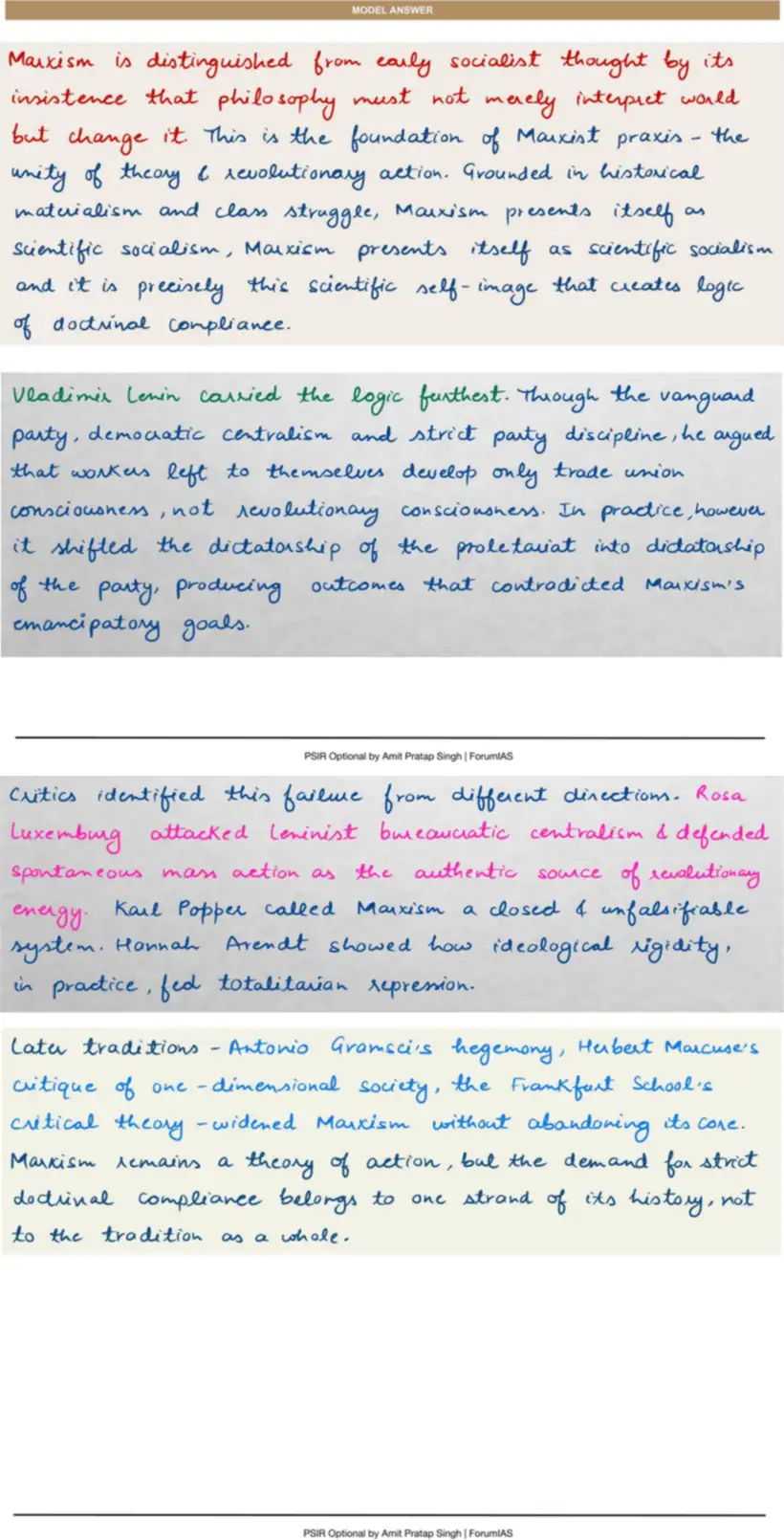
Model answer
Handwritten, in the form it would be written in the examination hall.
Also asked on this head
Political Ideologies — 23 questions in the Vault.
- Wollstonecraft developed first systematic feminist critique. Discuss her main ideas.
- Herbert Marcuse turned Freudianism on its head in his critical theory. (150 words)
- Factors like community, culture and nation weaken the hegemony of neo-liberalism today. Discuss.
How this is taught
The same flow snapshot, built for every head of the syllabus, with the answer written in class.
The first session of Foundation 2027 is published in full.
Six programmes across three levels.