
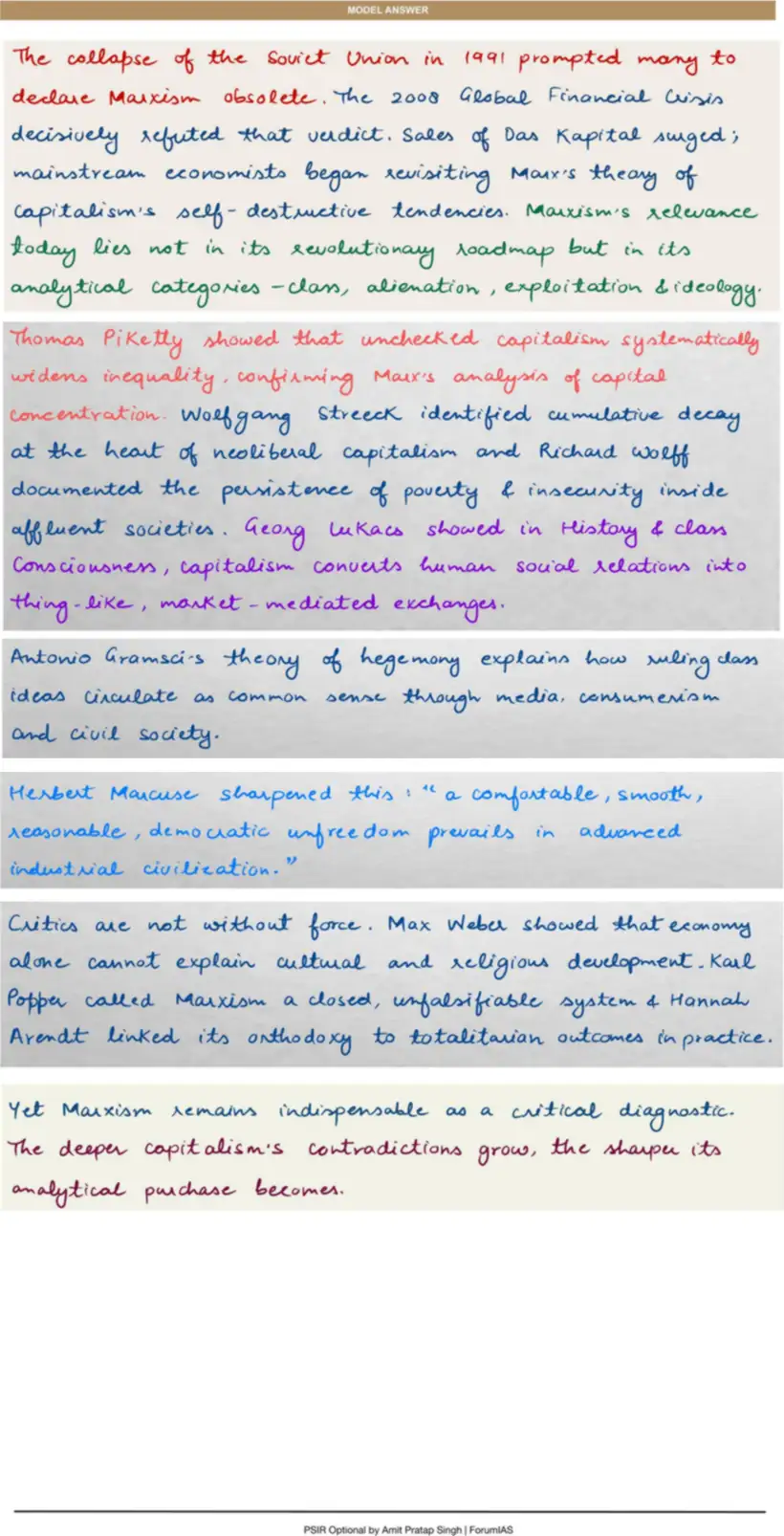
What is the contemporary relevance of Marxism?
How the answer moves
The flow snapshot — the routes in, the body, the counter-view and the routes out.
Route 1 Post-1991 funeral declared premature → 2008 crisis revived Marx as diagnostic lens
Route 2 Marxism outlasted Soviet collapse → capitalism’s own contradictions returned the question
Core categories: inequality + labour precarity (Piketty, Streeck, Wolff) → alienation reappears in gig economy (Lukács: reification) → cultural/ideological domination: Gramsci’s hegemony + Marcuse’s democratic unfreedom → global capitalism: world-systems and imperialism still Marxist terrain → Marxism itself forced capitalism toward welfare reform
Economic reductionism (Weber); authoritarian outcomes (Popper, Arendt) weaken revolutionary prescription while leaving analytical categories intact
Route 1 Marxism survives not as blueprint but as indispensable critique of capital
Route 2 Its categories grow sharper as inequality deepens — relevance is structural, not nostalgic
Model answer
Handwritten, in the form it would be written in the examination hall.
Also asked on this head
Political Ideologies — 23 questions in the Vault.
- Wollstonecraft developed first systematic feminist critique. Discuss her main ideas.
- Herbert Marcuse turned Freudianism on its head in his critical theory. (150 words)
- Factors like community, culture and nation weaken the hegemony of neo-liberalism today. Discuss.
How this is taught
The same flow snapshot, built for every head of the syllabus, with the answer written in class.
The first session of Foundation 2027 is published in full.
Six programmes across three levels.