
“Political ideology is primarily concerned with the allocation and utilization of power.’ Comment.
How the answer moves
The flow snapshot — the routes in, the body, the counter-view and the routes out.
Route 1 Ideology as a system of ideas → centrally about who rules, by what authority, in whose interest → power is its organizing question
Route 2 Freeden: ideologies as “maps of the political landscape” → every map must first locate power → allocation + utilization are the map’s two axes
Four ideological positions each as a power-project → Liberalism (allocates power to individual + limited state) → Socialism (shifts power from private capital to society) → Marxism (exposes class domination as the real site of power) → Feminism (extends power to the private sphere, patriarchy as a power-structure) → Gramsci: coercion alone insufficient, hegemony makes power “common sense” → Foucault: power dispersed through discourse and surveillance, not reducible to the state
Ideology is not only about power — it also addresses moral values, rights, justice, and human dignity; Arendt: power is the human ability “to act in concert,” not merely domination; ideologies are also moral vocabularies, not just power-manuals
Route 1 Statement is substantially true but partial — ideologies diagnose, morally judge, and propose redistribution of power; the moral dimension completes the power-question, not replaces it
Route 2 Ideologies are power-projects anchored in values — they cannot be reduced to power alone, but every enduring ideology must settle the power question first
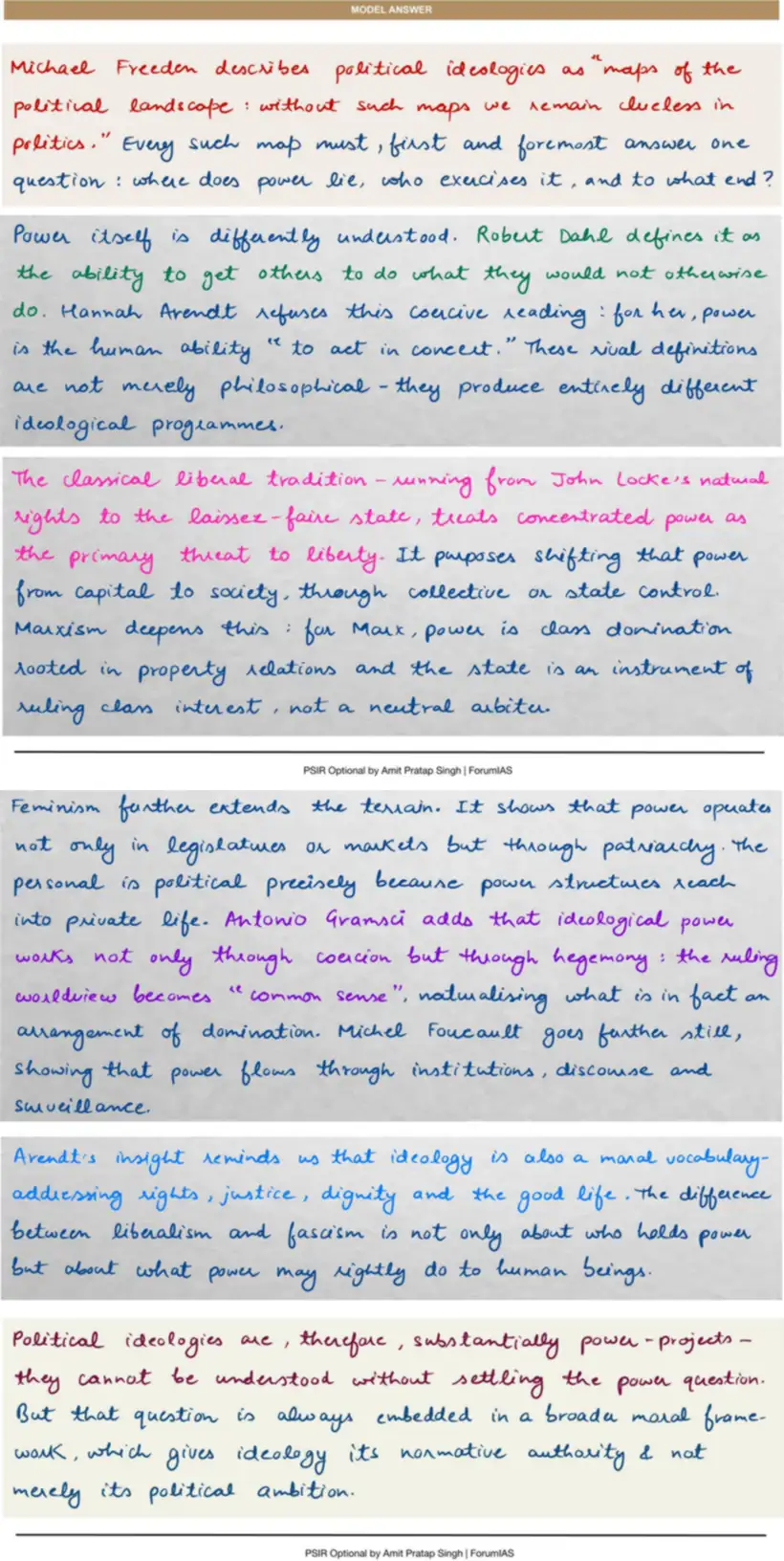
Model answer
Handwritten, in the form it would be written in the examination hall.
Also asked on this head
Political Ideologies — 23 questions in the Vault.
- Wollstonecraft developed first systematic feminist critique. Discuss her main ideas.
- Herbert Marcuse turned Freudianism on its head in his critical theory. (150 words)
- Factors like community, culture and nation weaken the hegemony of neo-liberalism today. Discuss.
How this is taught
The same flow snapshot, built for every head of the syllabus, with the answer written in class.
The first session of Foundation 2027 is published in full.
Six programmes across three levels.