
Write a brief note on The End of History debate.
How the answer moves
The flow snapshot — the routes in, the body, the counter-view and the routes out.
Route 1 Cold War ends → liberal democracy appears without rival → Fukuyama’s triumphalist thesis emerges
Route 2 Ideological century closes → question: is liberal democracy the final destination or merely a dominant moment?
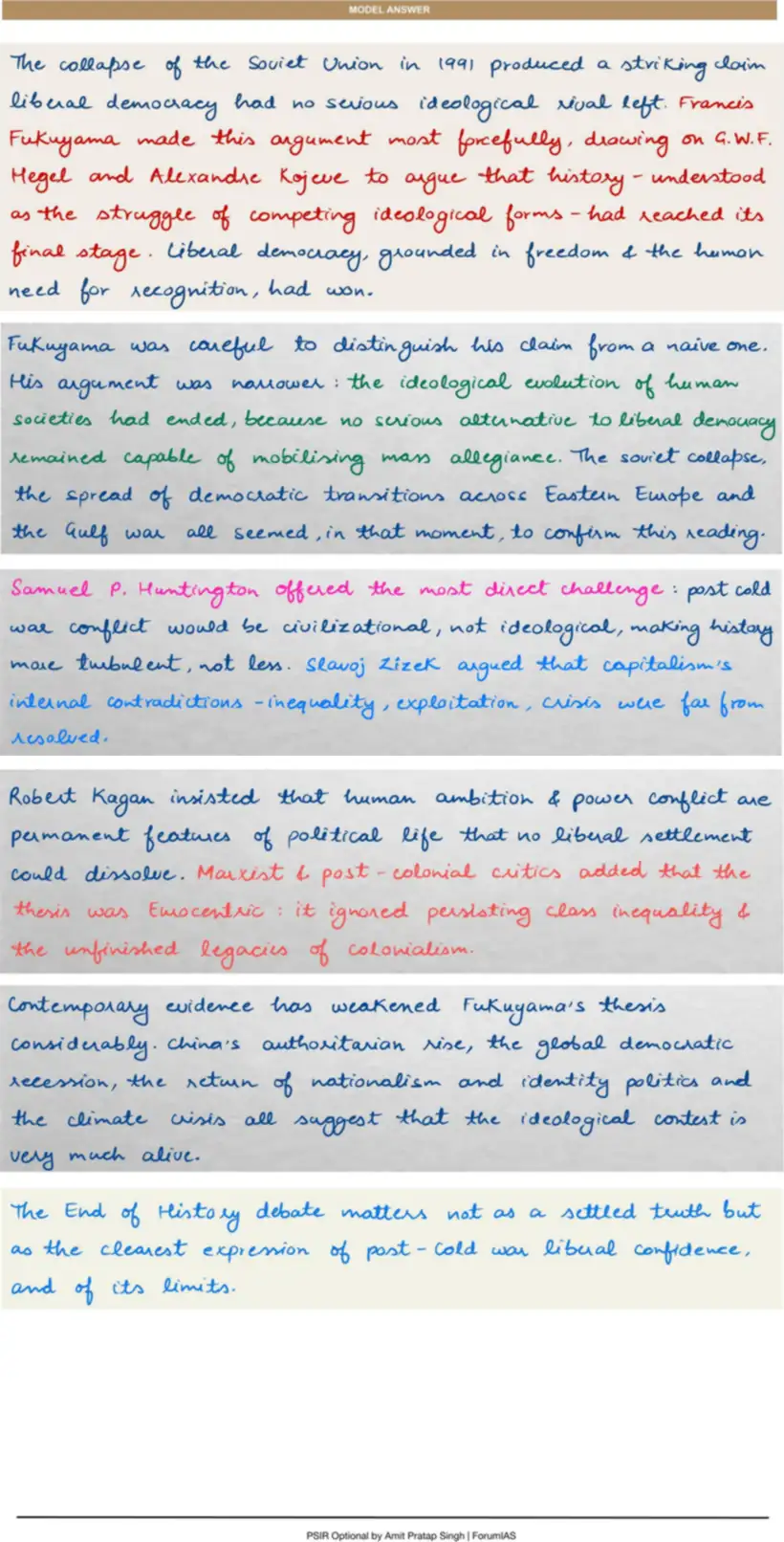
Fukuyama’s core claim (ideological endpoint, not cessation of events) → Hegelian basis: Hegel + Kojève, freedom and recognition → Cold War context validates thesis (Soviet collapse, Eastern Europe) → Huntington (civilizational conflict replaces ideological conflict) → Žižek (capitalism’s contradictions unresolved) → Kagan (power and ambition endure) → Marxist/post-colonial (class inequality and Eurocentrism ignored) → empirical falsification: China, democratic recession, nationalism, identity politics
Fukuyama not claiming events cease — claiming ideological evolution ends; critics show even this narrower claim cannot hold
Route 1 Thesis remains historically significant as document of liberal triumphalism, not as settled truth
Route 2 History’s grammar changed after 1991; it did not end
Model answer
Handwritten, in the form it would be written in the examination hall.
Also asked on this head
Political Ideologies — 23 questions in the Vault.
- Wollstonecraft developed first systematic feminist critique. Discuss her main ideas.
- Herbert Marcuse turned Freudianism on its head in his critical theory. (150 words)
- Factors like community, culture and nation weaken the hegemony of neo-liberalism today. Discuss.
How this is taught
The same flow snapshot, built for every head of the syllabus, with the answer written in class.
The first session of Foundation 2027 is published in full.
Six programmes across three levels.