
Why does global human security need to be emphasized along with economic security? Explain with examples.
How the answer moves
The flow snapshot — the routes in, the body, the counter-view and the routes out.
Route 1 traditional/economic security is state- and income-centred → human security shifts the referent to the individual (freedom from fear, want, indignity) → the two are not interchangeable
Route 2 a country can grow and guard its borders yet its people stay unsafe → income ≠ dignity or safety → human security must sit alongside economic security
referent shift (state → individual) → Truong: economically secure states, insecure people → working-woman example (earns well, faces harassment) → comprehensive dimensions (economic/food/health/environmental/personal/community/political) → Buzan’s interconnected sectors (threat in one spreads) → Tickner’s feminist critique + “security paradox” → shift “freedom from fear” → “freedom from want” → global examples (COVID/health, Syria/societal, Rohingya/political, climate/environmental)
realist caution: over-stretched concept risks meaninglessness; state resources finite; raises false expectations
Route 1 balance: human security complements, not replaces, economic security
Route 2 economic security safeguards the aggregate, human security safeguards the person → both needed together
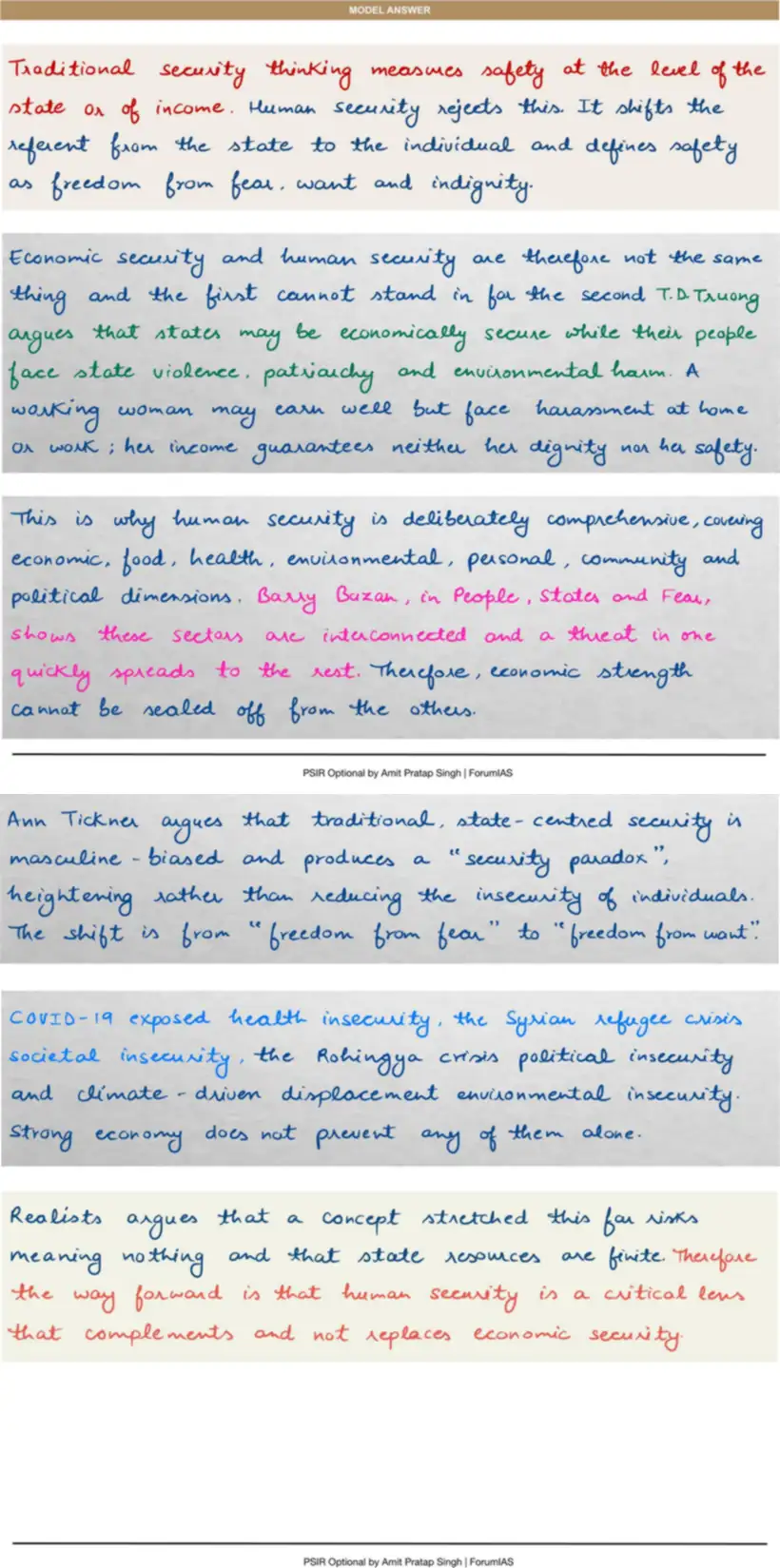
Model answer
Handwritten, in the form it would be written in the examination hall.
Also asked on this head
Key Concepts in International Relations — 16 questions in the Vault.
- Diplomacy has always rested on two pillars: Institutional memory and individual craft. Elaborate.
- Discuss various methods of Balance of Power. (150 words)
- Collective security and responsibility to protect (R2P) are similar but different in scope, goals and methods. Explain.
How this is taught
The same flow snapshot, built for every head of the syllabus, with the answer written in class.
The first session of Foundation 2027 is published in full.
Six programmes across three levels.