
Discuss the utility of Nuclear Deterrence Theory in the context of the recent standoff between India and Pakistan.
How the answer moves
The flow snapshot — the routes in, the body, the counter-view and the routes out.
Route 1 deterrence’s core logic: catastrophic retaliation / MAD deters attack → Brodie’s dictum → applied to India–Pakistan dyad
Route 2 India’s NFU + credible minimum deterrence vs Pakistan’s TNW → grounded back in MAD logic
MAD logic → Brodie “ready, never used” → India’s NFU/CMD vs Pakistan’s TNW (offsets conventional asymmetry) → held since 1998 → 2019 Pulwama–Balakot: escalation but restraint → Schelling’s stability-instability paradox → non-state actors evade the nuclear threshold
Manoj Joshi: deterrence alone insufficient → strategic stability still needs conventional capability + diplomacy
Route 1 deterrence secures against full-scale war, not full peace
Route 2 balance of terror real but bounded → conventional strength and diplomacy fill the rest
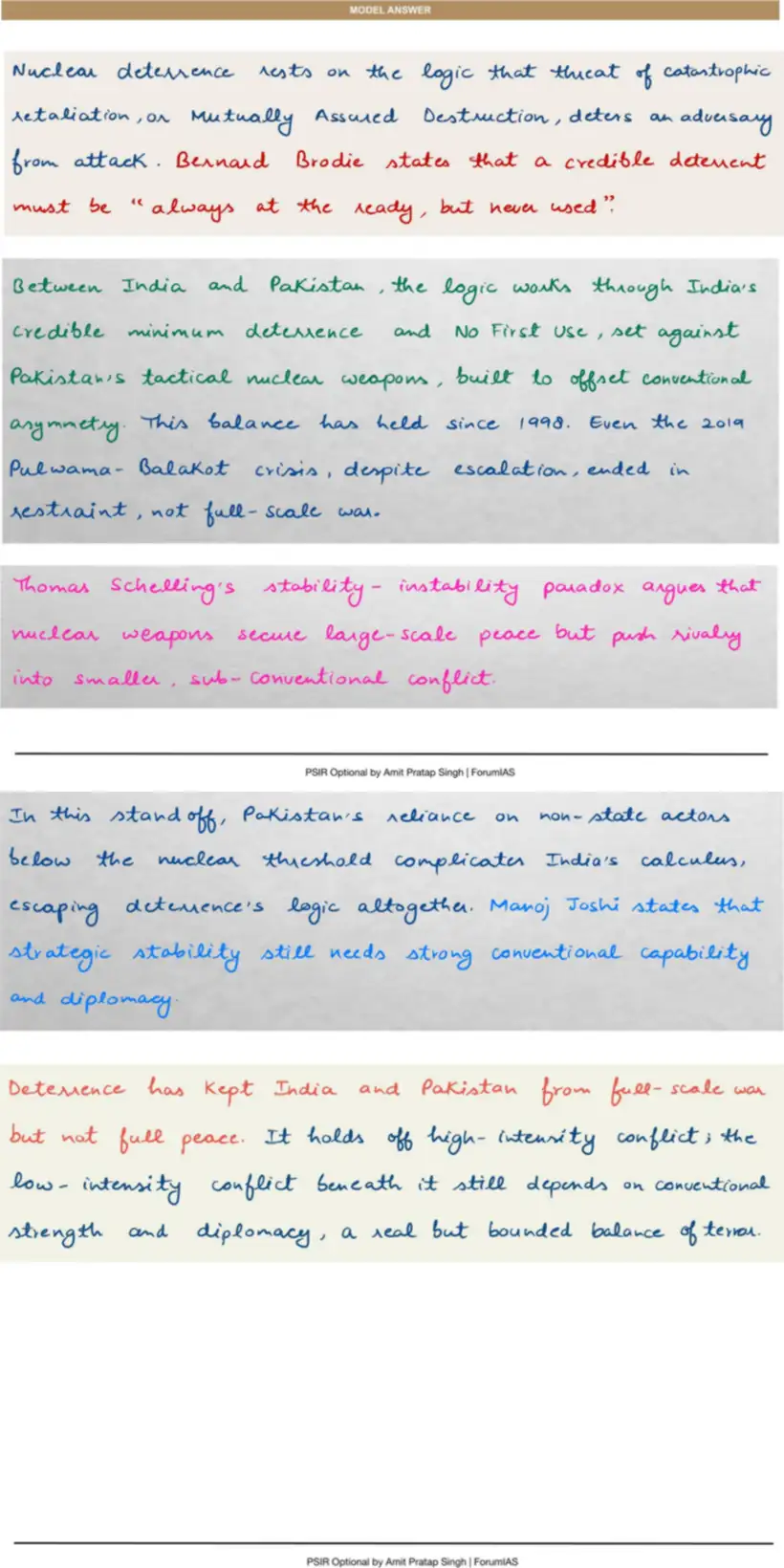
Model answer
Handwritten, in the form it would be written in the examination hall.
Also asked on this head
Key Concepts in International Relations — 16 questions in the Vault.
- Diplomacy has always rested on two pillars: Institutional memory and individual craft. Elaborate.
- Discuss various methods of Balance of Power. (150 words)
- Collective security and responsibility to protect (R2P) are similar but different in scope, goals and methods. Explain.
How this is taught
The same flow snapshot, built for every head of the syllabus, with the answer written in class.
The first session of Foundation 2027 is published in full.
Six programmes across three levels.