
What, according to Joseph Nye, are the major sources of a country’s soft power? Discuss its relevance in the contemporary world politics.
How the answer moves
The flow snapshot — the routes in, the body, the counter-view and the routes out.
Route 1 soft power (Nye) = make others want what you want → attraction / co-option, not coercion → set against hard power
Route 2 power is not only force → Nye adds a second face: attraction through appeal → opens the three sources
three sources → culture (when attractive) → political values: democracy / human rights / rule of law (applied consistently) → foreign policy (when legitimate, just) → US illustration → relevance rises with interdependence + information tech → instruments: cultural diplomacy / education / media (yoga, China’s broadcasting, EU multilateralism) → issue areas: institutional reform, climate justice, peacekeeping
attraction alone insufficient → Jaishankar: soft power without hard power is pointless → Nye’s own move to smart power (hard + soft)
Route 1 attraction now integral to world politics → but supplements, not replaces, material capability
Route 2 soft power reshapes influence in an interdependent, information age → yet effective only when anchored in hard power (smart power)
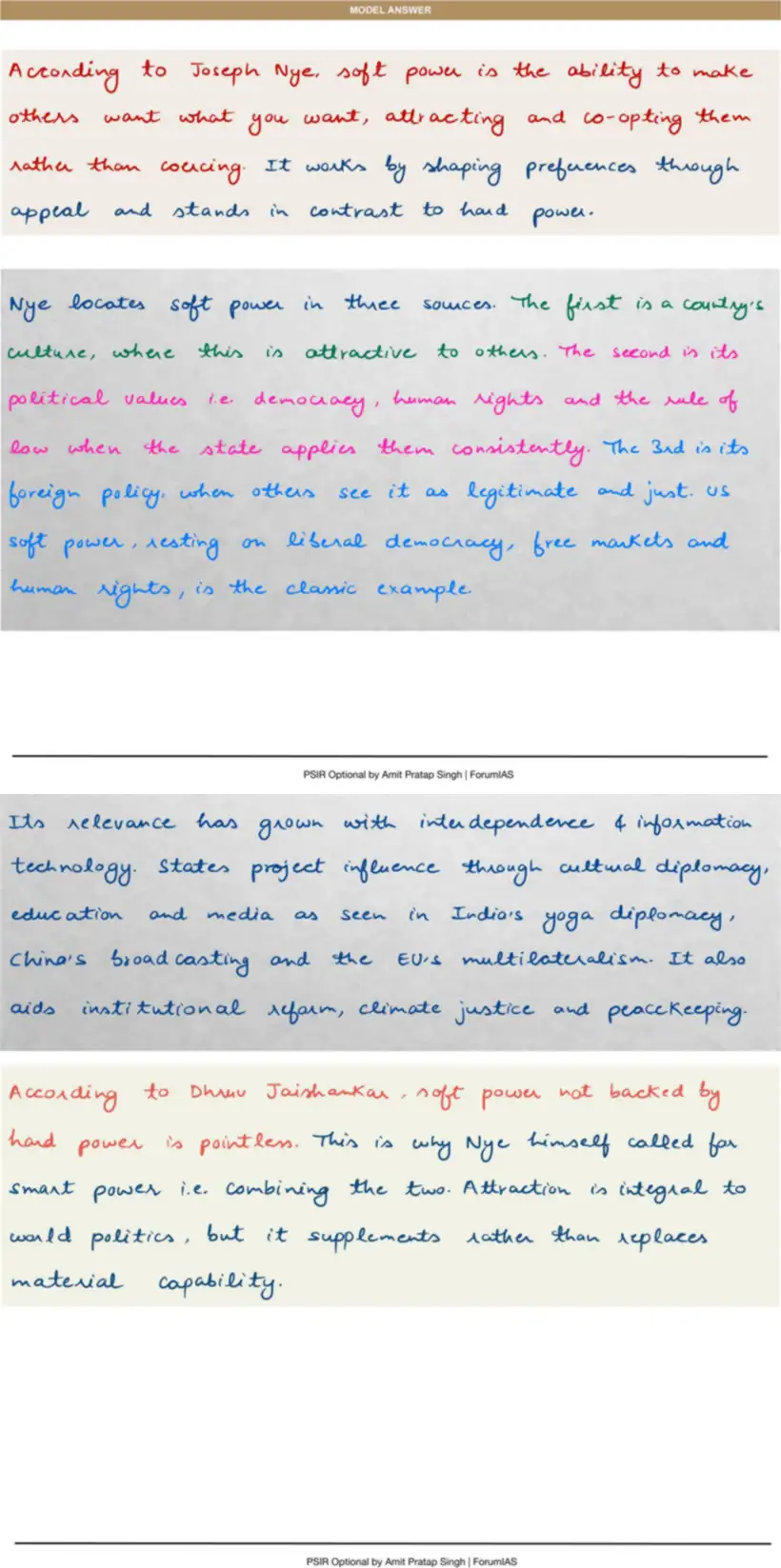
Model answer
Handwritten, in the form it would be written in the examination hall.
Also asked on this head
Key Concepts in International Relations — 16 questions in the Vault.
- Diplomacy has always rested on two pillars: Institutional memory and individual craft. Elaborate.
- Discuss various methods of Balance of Power. (150 words)
- Collective security and responsibility to protect (R2P) are similar but different in scope, goals and methods. Explain.
How this is taught
The same flow snapshot, built for every head of the syllabus, with the answer written in class.
The first session of Foundation 2027 is published in full.
Six programmes across three levels.