
Discuss the conceptual dimensions of collective security.
How the answer moves
The flow snapshot — the routes in, the body, the counter-view and the routes out.
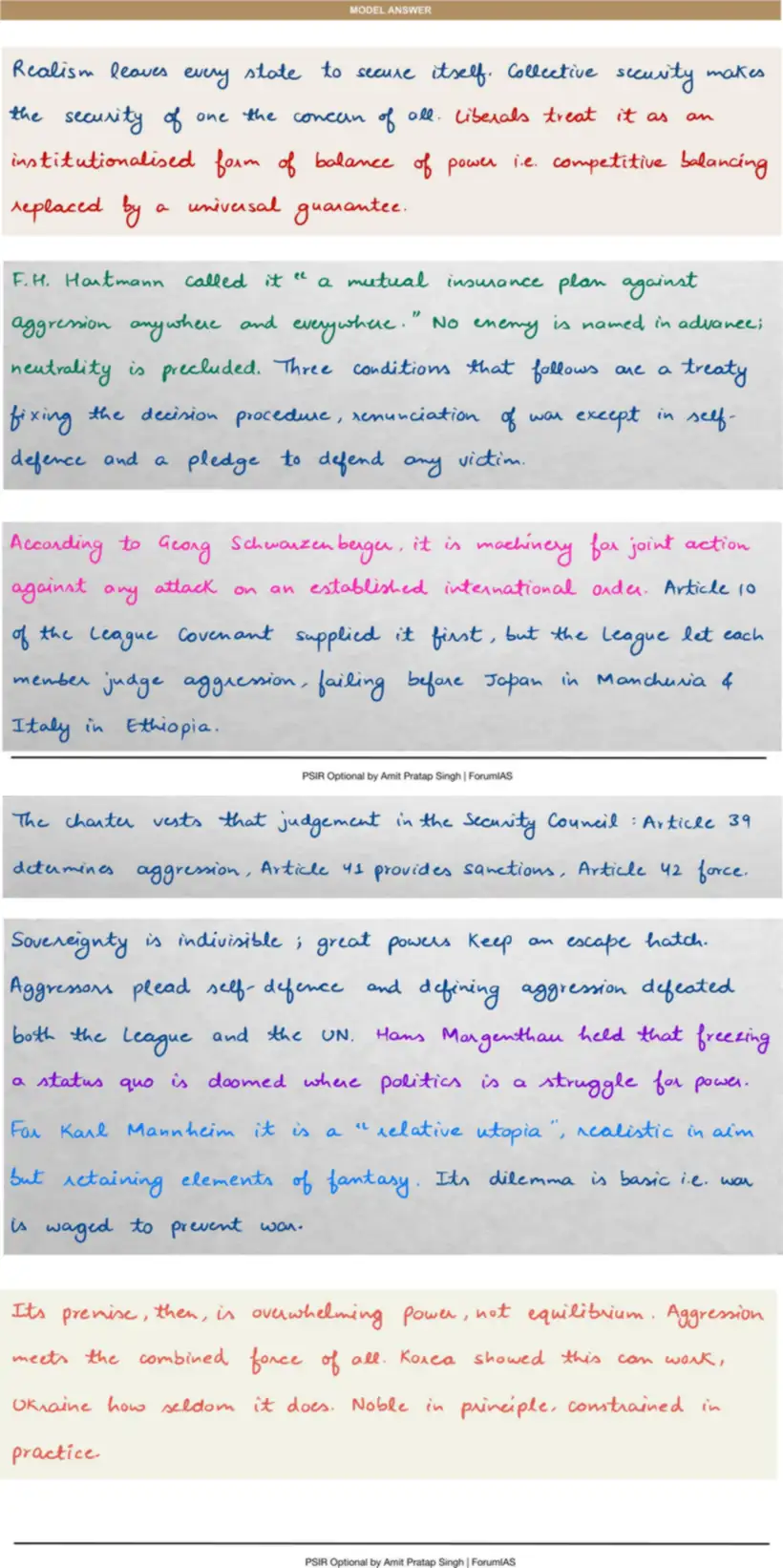
Route 1 realism leaves every state to secure itself → collective security makes security of one the concern of all → liberals read it as an institutionalised balance of power
Route 2 the defining shift → competitive balancing replaced by a universal guarantee → every conceptual dimension follows from that shift
universality as the defining mark → Hartmann’s “mutual insurance plan… anywhere and everywhere” → no enemy named in advance, neutrality precluded → three conditions (treaty procedure / renunciation of war except self-defence / pledge to defend the victim) → Schwarzenberger’s machinery for joint action → institutional dimension → League: Article 10, each member judged aggression → Manchuria, Ethiopia → Charter centralises the judgement in the Security Council → Articles 39, 41, 42
the same universality strains → sovereignty indivisible, escape hatch retained → aggressor pleads self-defence, aggression left undefined → Morgenthau: freezing a status quo vs politics as struggle for power → Mannheim: “relative utopia” → the dilemma of waging war to prevent war
Route 1 premise is overwhelming power, not equilibrium
Route 2 Korea shows it can work, Ukraine how seldom it does → noble in principle, constrained in practice
Model answer
Handwritten, in the form it would be written in the examination hall.
Also asked on this head
Key Concepts in International Relations — 16 questions in the Vault.
- Diplomacy has always rested on two pillars: Institutional memory and individual craft. Elaborate.
- Discuss various methods of Balance of Power. (150 words)
- Collective security and responsibility to protect (R2P) are similar but different in scope, goals and methods. Explain.
How this is taught
The same flow snapshot, built for every head of the syllabus, with the answer written in class.
The first session of Foundation 2027 is published in full.
Six programmes across three levels.