
“The notion of balance of power is notoriously full of confusion.’ In the light of this quotation, do you think that the concept of balance of power is relevant?
How the answer moves
The flow snapshot — the routes in, the body, the counter-view and the routes out.
Route 1 realist device against domination, works in multipolarity → Wight’s “confusion” conceded, but located in definition, not use
Route 2 concept notoriously confused → Inis Claude “too many meanings,” Morgenthau’s four / Haas’s eight → confusion definitional, not fatal
sources of confusion (power hard to measure, interpretations differ, relations unpredictable) → yet practical worth intact: prevents hegemony, manages security competition, explains alliances / power transitions → Waltz’s structural pull (“abhors unbalanced power”) → US–China, NATO–Russia, Quad → concept adapts not dies: Walt’s balance of threat, Paul’s soft balancing (direct balancing of US too costly)
liberals: entrenches rivalry → stops operating under unipolarity → globalisation + transnational threats defy balancing
Route 1 confused in definition but resilient in practice
Route 2 survives in altered forms → relevant, not redundant
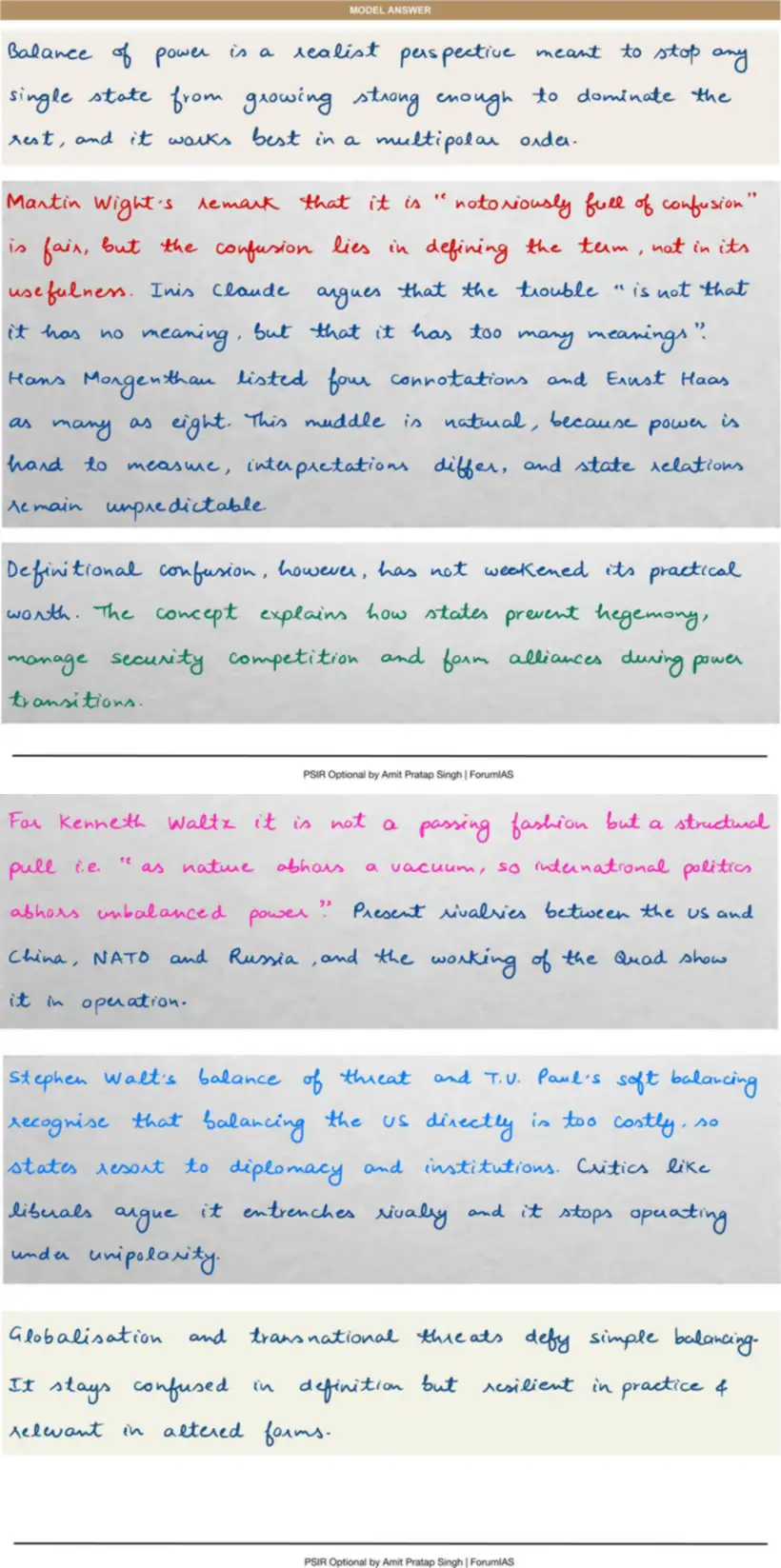
Model answer
Handwritten, in the form it would be written in the examination hall.
Also asked on this head
Key Concepts in International Relations — 16 questions in the Vault.
- Diplomacy has always rested on two pillars: Institutional memory and individual craft. Elaborate.
- Discuss various methods of Balance of Power. (150 words)
- Collective security and responsibility to protect (R2P) are similar but different in scope, goals and methods. Explain.
How this is taught
The same flow snapshot, built for every head of the syllabus, with the answer written in class.
The first session of Foundation 2027 is published in full.
Six programmes across three levels.