
Discuss the changing nature of modern state with reference to transnational actors.
How the answer moves
The flow snapshot — the routes in, the body, the counter-view and the routes out.
Route 1 modern state = sole authority over security & economy → transnational actors unsettle it → state now shares space it once held alone
Route 2 modern state historically supreme within its borders → cross-border actors work independently of governments → line staked: state reshaped, not replaced
Thiel: transnational actors = agents with trans-societal goals, apart from state control (MNCs, NGOs, terror/criminal, diasporas) → MNCs / Nye: loss of control over currency & trade → transfer mispricing + treaty shopping → extraterritoriality → diluted labour/health regulation → NGOs / Simmons: agenda-setting, negotiating outcomes, conferring legitimacy → aid agencies bypass governments → suspected as Western agents (China, Russia, India) → terrorist/non-state actors: security dilemma + distorted policy → FDI deterred → Scholte: states pushed into post-sovereign governance (Basel, OECD, FATF) → Cooper: European “postmodern states” within security communities
realist rejoinder, Buzan → state still the principal security provider → only body with both capacity to act and authority to define a threat
Route 1 state transformed and constrained, but not displaced → remains central
Route 2 authority now shared, sovereignty reshaped → state adapts via post-sovereign governance rather than dissolving
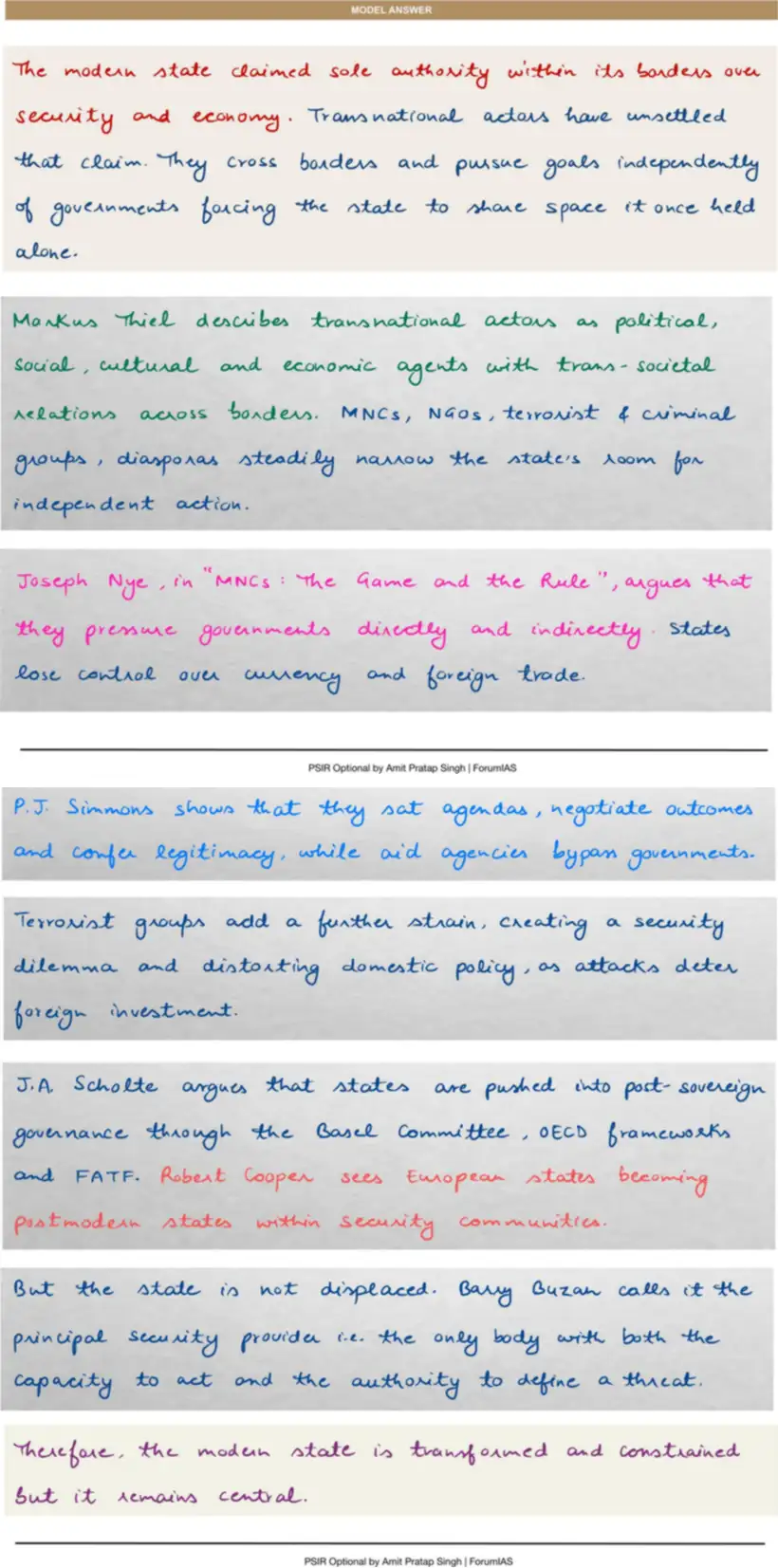
Model answer
Handwritten, in the form it would be written in the examination hall.
Also asked on this head
Key Concepts in International Relations — 16 questions in the Vault.
- Diplomacy has always rested on two pillars: Institutional memory and individual craft. Elaborate.
- Discuss various methods of Balance of Power. (150 words)
- Collective security and responsibility to protect (R2P) are similar but different in scope, goals and methods. Explain.
How this is taught
The same flow snapshot, built for every head of the syllabus, with the answer written in class.
The first session of Foundation 2027 is published in full.
Six programmes across three levels.