
“A combination of internal pressures (ethnic and regional forces) and external threats (EU, UN, TNC, global market, etc.) has produced what is commonly 999 referred to as a ‘crisis of the nation-state.” Elaborate.
How the answer moves
The flow snapshot — the routes in, the body, the counter-view and the routes out.
Route 1 nation-state as long-central actor → now squeezed from three directions at once → subnational + transnational + supranational
Route 2 the ‘crisis’ = simultaneous pressure from below, across and above → state pressed on all three fronts
internal squeeze (militancy / secession / autonomy / identity denial / regional discrimination → Yugoslavia) → external squeeze (globalisation + regionalisation → sovereignty made multinational) → Nye: MNC direct/indirect pressure → Simmons: NGO policy influence → forced re-regulation (climate / terrorism / finance via transnational frameworks) → hyperglobalist redundancy claim
Buzan → economic role reduced, but state still the sole security provider → uniquely holds both capacity to act + authority to define a threat
Route 1 reshaped, not dissolved → survives as the central unit
Route 2 continuous crisis, not collapse → the state is remade, not ended
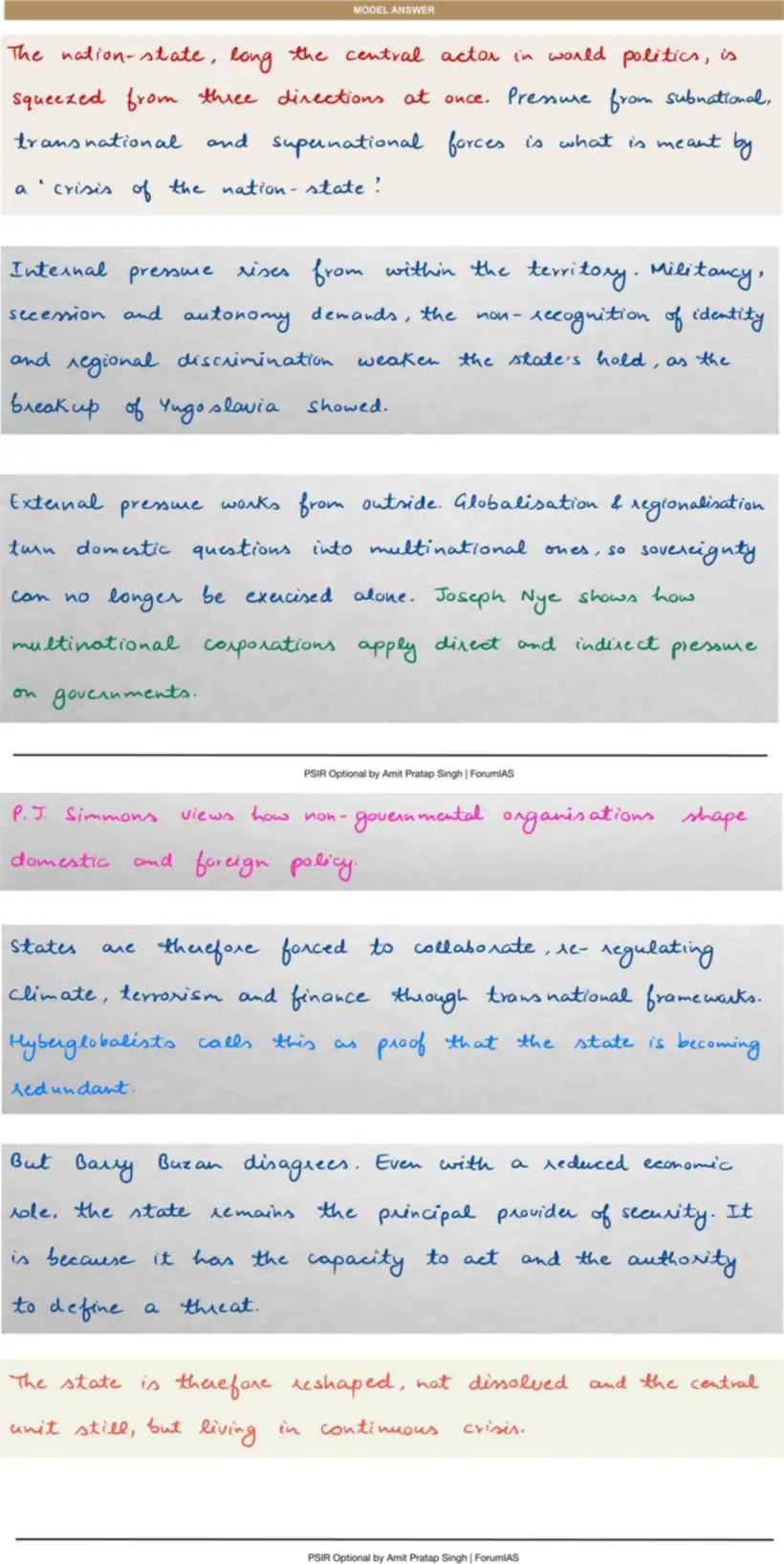
Model answer
Handwritten, in the form it would be written in the examination hall.
Also asked on this head
Key Concepts in International Relations — 16 questions in the Vault.
- Diplomacy has always rested on two pillars: Institutional memory and individual craft. Elaborate.
- Discuss various methods of Balance of Power. (150 words)
- Collective security and responsibility to protect (R2P) are similar but different in scope, goals and methods. Explain.
How this is taught
The same flow snapshot, built for every head of the syllabus, with the answer written in class.
The first session of Foundation 2027 is published in full.
Six programmes across three levels.