
Discuss the potential role India can play in initiating a possible phase of trilateral economic engagement among India, China and Nepal.
How the answer moves
The flow snapshot — the routes in, the body, the counter-view and the routes out.
Route 1 Nepal land-locked between two rising economies → foreign policy narrowed to both, not widened to the world → trilateral converts zero-sum contest over Kathmandu into positive-sum
Route 2 India already holds trade, power and transit instruments → constraint is not capacity but sequencing → begin project by project, not by grand framework
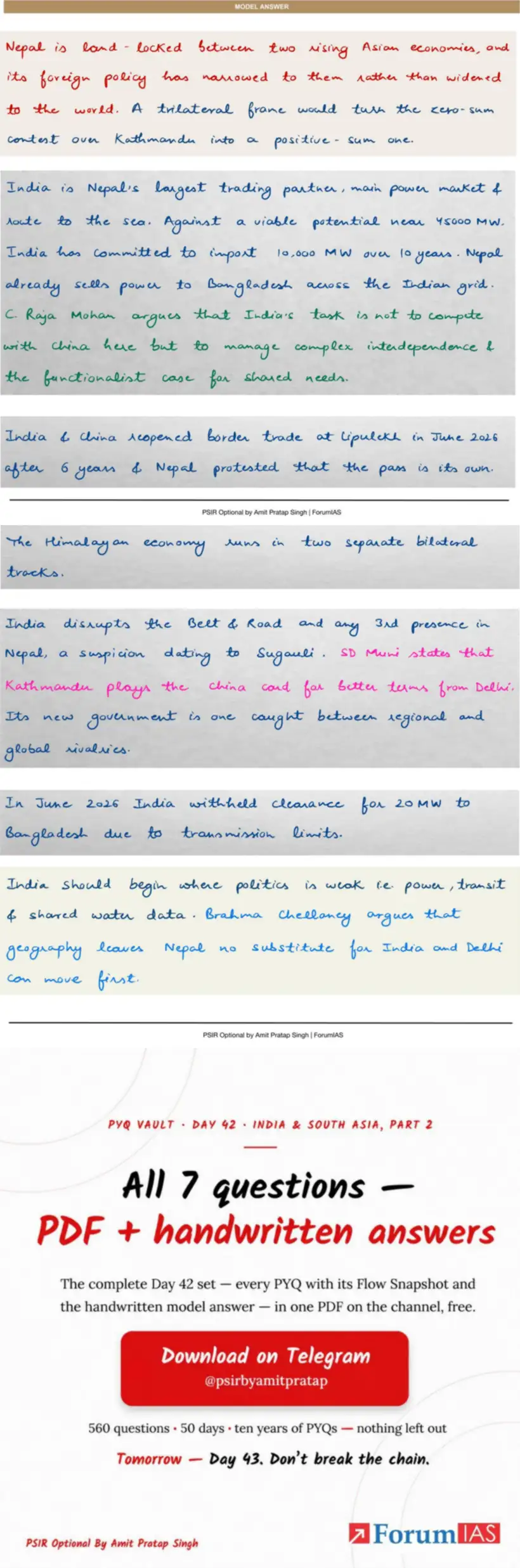
functional advantage: largest trading partner + main power market + route to sea → ~45,000 MW viable potential vs 10,000 MW committed over ten years → Nepal already sells power to Bangladesh across Indian grid = trilateral working in practice → Raja Mohan: manage complex interdependence, not compete → functionalist case for shared needs → Lipulekh border trade reopened June 2026, Nepal protests the pass is its own → Himalayan economy still in two separate bilateral tracks
India distrusts BRI and any third presence in Nepal → suspicion dating to Sugauli → China rarely joins what it has not begun → Muni: Kathmandu plays the China card for better terms from Delhi; new government caught between regional and global rivalries
Route 1 India’s own delivery is the first ceiling — 20 MW withheld, transmission limits → begin where politics is thinnest: power, transit, shared water data
Route 2 Chellaney: geography leaves Nepal no substitute for India → Delhi can move first, trilateralism built project by project
Model answer
Handwritten, in the form it would be written in the examination hall.
Also asked on this head
India and South Asia — 32 questions in the Vault.
- The island of Kachchatheevu remains an intractable issue in India-Srilanka relations. Comment.
- How does illegal cross border migration pose challenges to India’s security? Discuss the steps taken by the government in this direction and their effectiveness.
- Critically evaluate the important factors of India-Maldives relations on the eve of sixty years of diplomatic ties between the two countries.
How this is taught
The same flow snapshot, built for every head of the syllabus, with the answer written in class.
The first session of Foundation 2027 is published in full.
Six programmes across three levels.