
What are the impediments in the development of South Asian Free Trade Area (SAFTA)?
How the answer moves
The flow snapshot — the routes in, the body, the counter-view and the routes out.
Route 1 in force since 2006 → intra-regional trade still ~5% against ASEAN’s 25% → tariffs were never the real barrier
Route 2 the region cut the one barrier it could agree on → kept every barrier that mattered → an instrument narrower than the problem
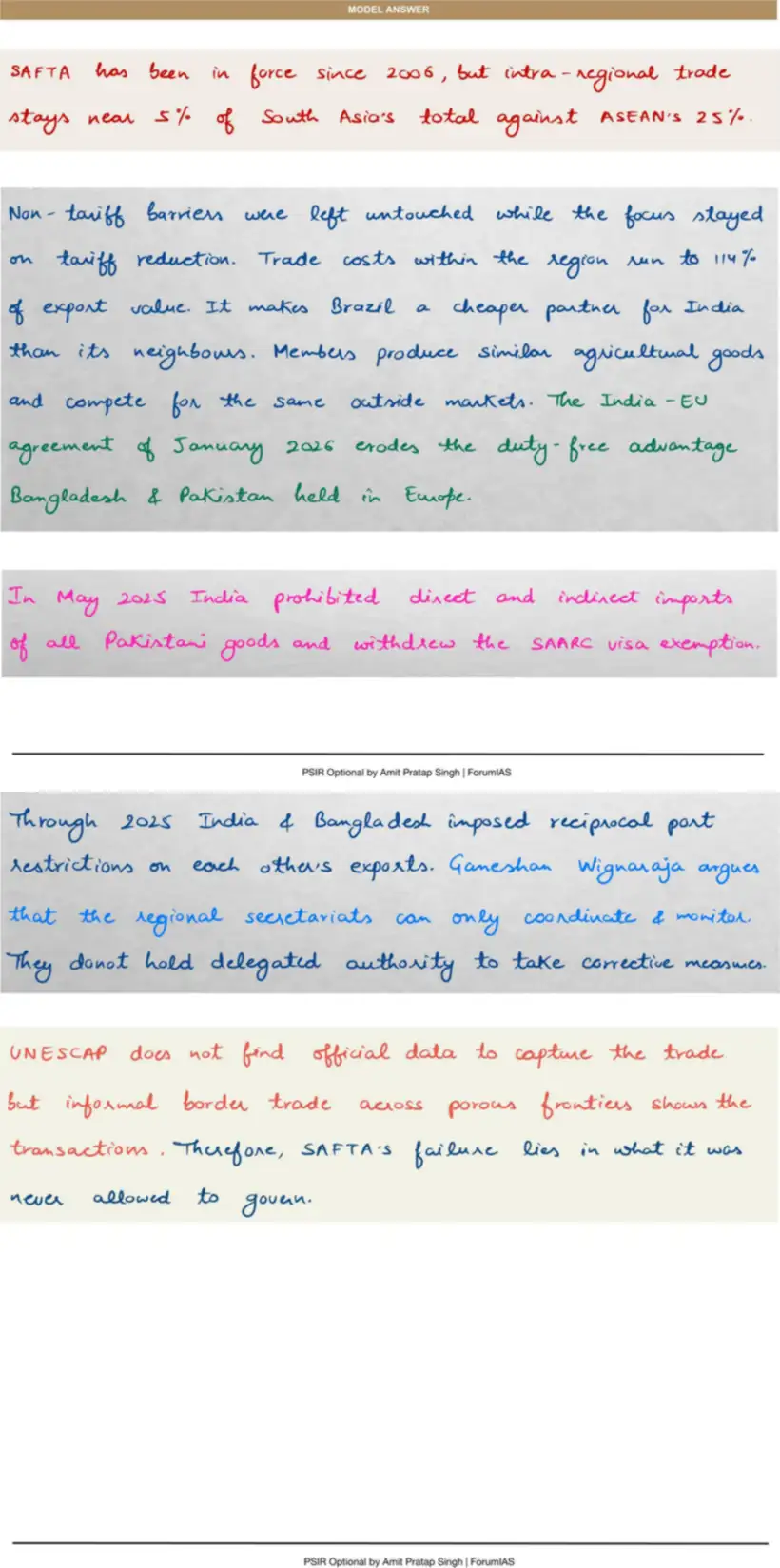
NTBs untouched, focus on tariffs alone → trade costs 114% of export value, Brazil cheaper than neighbours → similar agricultural baskets, competitors not partners → India–EU 2026 sharpens the contest for outside markets → political discretion overrides the text: May 2025 prohibition on Pakistani goods, SAARC visa exemption withdrawn, India–Bangladesh port restrictions → Wignaraja: secretariats coordinate and monitor, no delegated authority
informal trade across porous frontiers (UNESCAP) → official data understate actual exchange → the constraint is the agreement’s remit, not the region’s appetite
Route 1 SAFTA failed on what it was never allowed to govern
Route 2 tariff cuts cannot move the 5% until NTBs, transit and enforcement enter its remit
Model answer
Handwritten, in the form it would be written in the examination hall.
Also asked on this head
India and South Asia — 32 questions in the Vault.
- The island of Kachchatheevu remains an intractable issue in India-Srilanka relations. Comment.
- How does illegal cross border migration pose challenges to India’s security? Discuss the steps taken by the government in this direction and their effectiveness.
- Critically evaluate the important factors of India-Maldives relations on the eve of sixty years of diplomatic ties between the two countries.
How this is taught
The same flow snapshot, built for every head of the syllabus, with the answer written in class.
The first session of Foundation 2027 is published in full.
Six programmes across three levels.