
Identify the key sectors of cooperation between India and Israel since 2014. Examine their significance in strengthening the bilateral ties between the two countries.
How the answer moves
The flow snapshot — the routes in, the body, the counter-view and the routes out.
Route 1 2014 as inflection → discreet, defence-heavy ties turn public and broad-based
Route 2 Modi 2017 (first PM) + Netanyahu 2018 → cooperation widens past arms → two democracies / knowledge economies
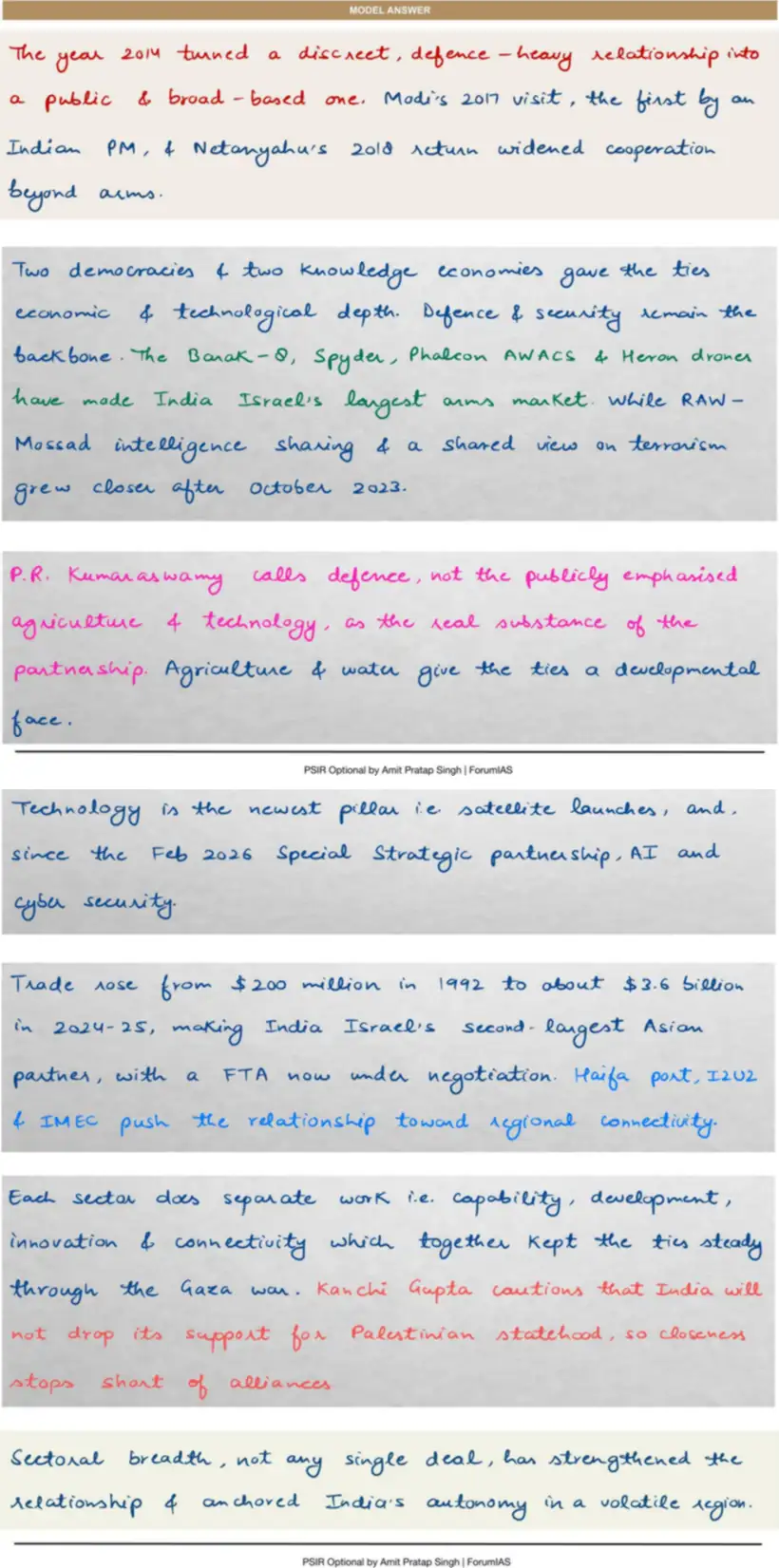
defence backbone (Barak-8 / Spyder / Phalcon AWACS / Heron → largest arms market → RAW–Mossad + terrorism convergence post-Oct 2023; Kumaraswamy: defence the real substance) → agriculture & water developmental face (≈35 CoEs → drip irrigation / desalination → food-water security) → technology newest pillar (satellites → Feb 2026 Special Strategic Partnership → AI, cyber) → trade & connectivity ($200m → ~$3.6bn 2024-25, 2nd-largest Asian partner, FTA under negotiation → Haifa Port / I2U2 / IMEC)
significance real but bounded → still defence-heavy → Kanchi Gupta: Palestine-statehood commitment holds → closeness stops short of alliance
Route 1 sectors do separate work (capability + development + innovation + connectivity) → breadth made ties resilient, steady through Gaza war
Route 2 breadth, not any single deal → strengthened ties + anchored India’s autonomy in a volatile West Asia
Model answer
Handwritten, in the form it would be written in the examination hall.
Also asked on this head
Recent Developments in Indian Foreign Policy — 23 questions in the Vault.
- India has recognised that West Asia is not a single contest, but a tangle of rivalries, bargains and anxieties. Comment.
- Discuss the three areas of security co-operation between India and Israel. (150 words)
- Critically examine India’s position on South China Sea Dispute.
How this is taught
The same flow snapshot, built for every head of the syllabus, with the answer written in class.
The first session of Foundation 2027 is published in full.
Six programmes across three levels.