
India’s reluctance to perceive any ‘existential threat’ inevitably made the multilateral path to nuclear security a ‘default option until it decided to cross the nuclear Rubicon in 1998. Identify and analyze some of the major reasons behind this shift in India’s position on the nuclear question.
How the answer moves
The flow snapshot — the routes in, the body, the counter-view and the routes out.
Route 1 multilateral path = “default,” not conviction → no acute existential threat → capability latent since the 1966 signal / 1974 Smiling Buddha
Route 2 four decades of restraint → what changed by 1998 was the reasons, not the capability → three pressures converge
dual programme (civilian + covert), difficult neighbourhood → Reason 1 security: China’s arsenal grows + Pakistan covert (Jaswant Singh) → Reason 2 discriminatory order hardens: NPT 1995 indefinite + CTBT 1996 → permanent exclusion → “nuclear apartheid” (Oak, current) → Reason 3 status + domestic politics: nuclear-weapon-state declaration + great-power recognition
Perkovich: security not the whole story → domestic democratic politics + prestige drove a break no comparable state made → synthesis: external pressure + internal ambition together
Route 1 aftermath measured, not reckless → No First Use + credible minimum deterrence (Sethi) → responsible weaponisation
Route 2 1998 = declaration of a long-latent capability, once the multilateral option ceased to serve India’s interests
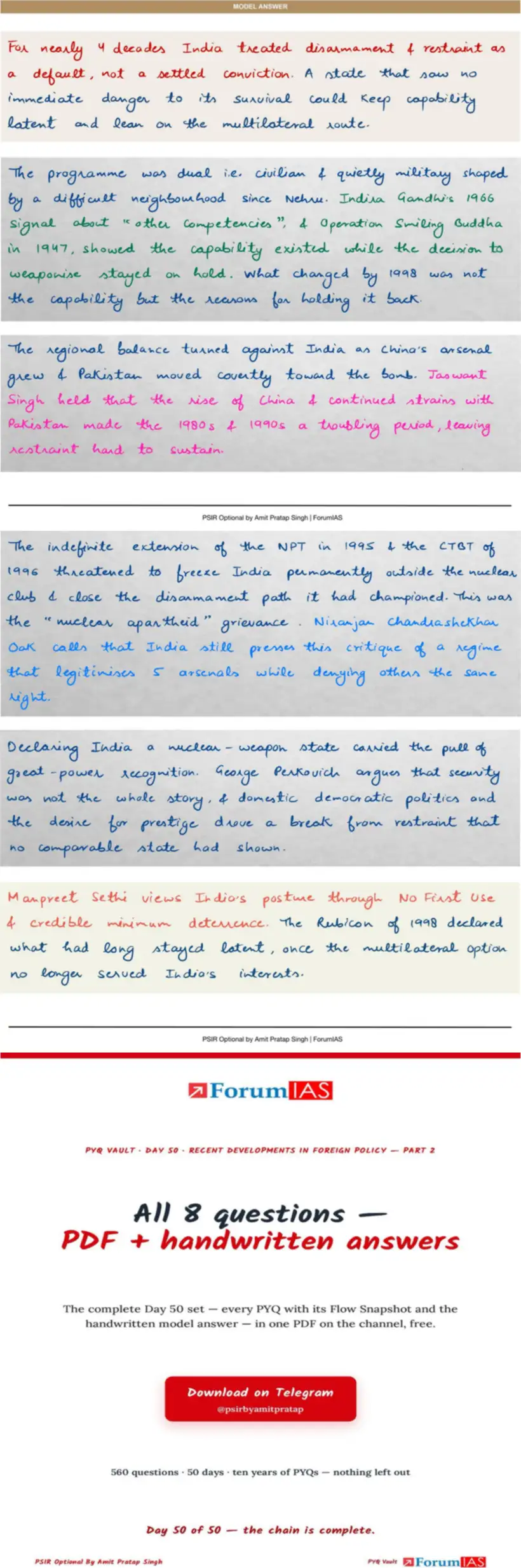
Model answer
Handwritten, in the form it would be written in the examination hall.
Also asked on this head
Recent Developments in Indian Foreign Policy — 23 questions in the Vault.
- India has recognised that West Asia is not a single contest, but a tangle of rivalries, bargains and anxieties. Comment.
- Discuss the three areas of security co-operation between India and Israel. (150 words)
- Critically examine India’s position on South China Sea Dispute.
How this is taught
The same flow snapshot, built for every head of the syllabus, with the answer written in class.
The first session of Foundation 2027 is published in full.
Six programmes across three levels.