
India continues to invoke its time-tested policy of strategic autonomy vis-a-vis both the United States of America and Russia by rejecting US’ offer of mediation on Kashmir issue and by refusing to criticize Russia in its ongoing war against Ukraine. Comment.
How the answer moves
The flow snapshot — the routes in, the body, the counter-view and the routes out.
Route 1 two refusals = one doctrine → Jaishankar’s “choice of action”
Route 2 “time-tested” ≠ static → non-alignment → multi-alignment (Raja Mohan) → issue-based, not ideological (Gokhale)
Kashmir: Simla 1972 bilateralism → Trump’s May 2025 mediation declined, US role unacknowledged → Quad/defence ties still deepen → Ukraine: non-interference pillar (Galwan / Crimea 2014 / Ukraine 2022) → Western sanctions → discounted oil, 2nd-largest buyer, ~600% trade → Pant: sharpest test + structural room from US–China rivalry
Tellis: refusal to choose undermines security → pick Washington vs China → Jacob’s rejoinder: “what is the alternative?” but energy/manufacturing/defence dependence caps autonomy → 2025 50% tariffs as the live test
Route 1 autonomy = deliberate action, not passive neutrality
Route 2 real agency, but exercised within structural limits, not above them
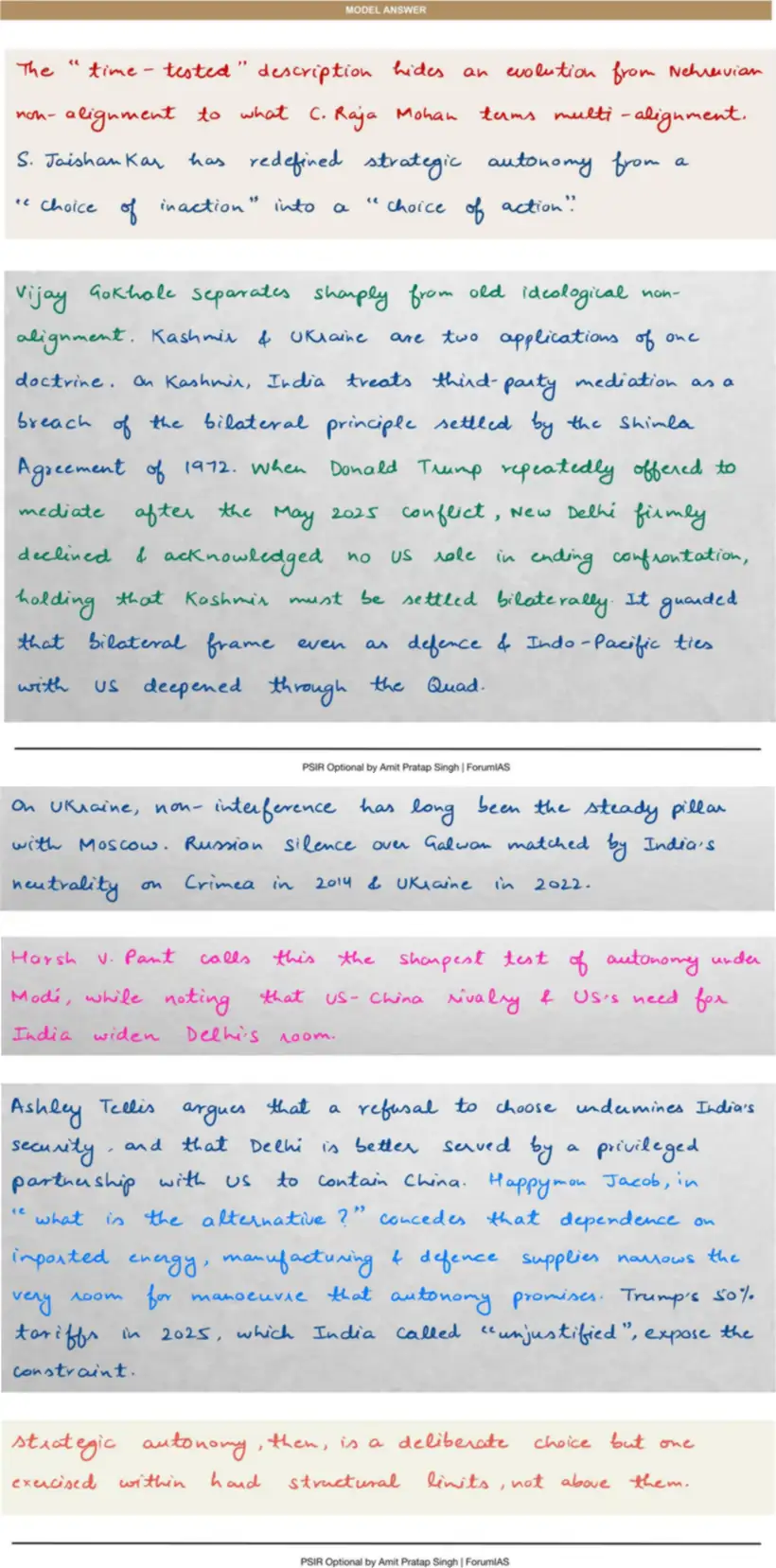
Model answer
Handwritten, in the form it would be written in the examination hall.
Also asked on this head
Recent Developments in Indian Foreign Policy — 23 questions in the Vault.
- India has recognised that West Asia is not a single contest, but a tangle of rivalries, bargains and anxieties. Comment.
- Discuss the three areas of security co-operation between India and Israel. (150 words)
- Critically examine India’s position on South China Sea Dispute.
How this is taught
The same flow snapshot, built for every head of the syllabus, with the answer written in class.
The first session of Foundation 2027 is published in full.
Six programmes across three levels.