
Critically examine the continuity and change in India’s Palestine policy in the wake of the ongoing Israel- Hamas War.
How the answer moves
The flow snapshot — the routes in, the body, the counter-view and the routes out.
Route 1 war didn’t break the policy → exposed two layers already there (declared position stable / weight + method moving)
Route 2 continuity in the two-state creed → change in how far India will spend on it → moral solidarity to interest-led balancing
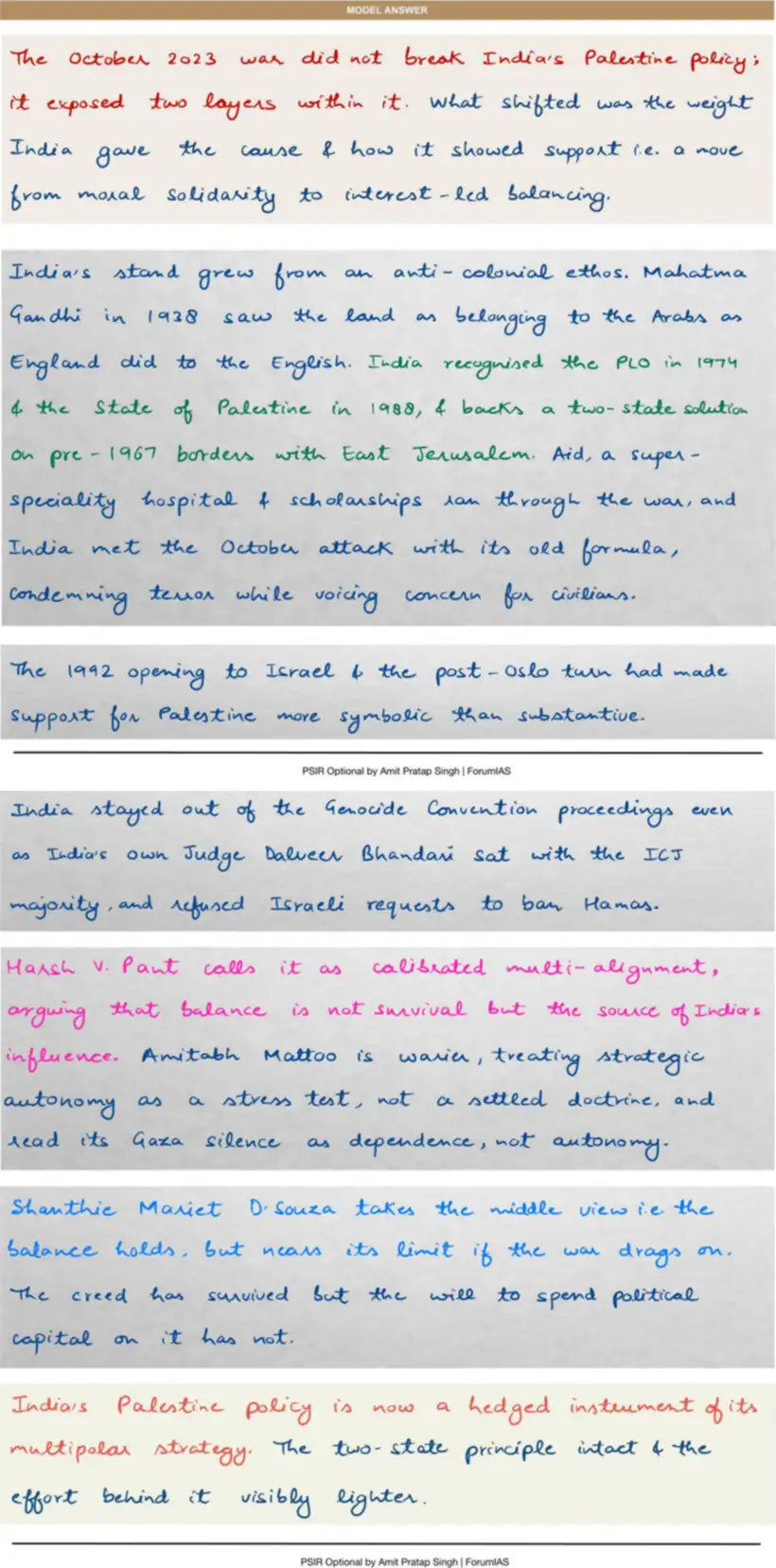
Continuity: anti-colonial ethos / Gandhi 1938 → PLO 1974 → State of Palestine 1988 → two-state / pre-1967 / East Jerusalem → aid + hospital + scholarships through the war → Oct-2023 formula (condemn terror + concern for civilians) → Change: 1992 Israel opening + post-Oslo → “symbolic not substantive” → de-hyphenation (Modi 2017) → uneven voting (Dec-2024 yes → June-2025 abstain / Asia outlier) → legal caution (out of Genocide proceedings while Bhandari sits with the ICJ majority) → refusal to ban Hamas
the multi-alignment debate → Pant (balance = essence of influence) vs Mattoo (autonomy a stress test) + dependence read vs D’Souza (holds, but nears its limit if war drags)
Route 1 creed survived, will to spend political capital has not → hedged instrument of a multipolar strategy
Route 2 two-state principle intact, effort behind it visibly lighter
Model answer
Handwritten, in the form it would be written in the examination hall.
Also asked on this head
Recent Developments in Indian Foreign Policy — 23 questions in the Vault.
- India has recognised that West Asia is not a single contest, but a tangle of rivalries, bargains and anxieties. Comment.
- Discuss the three areas of security co-operation between India and Israel. (150 words)
- Critically examine India’s position on South China Sea Dispute.
How this is taught
The same flow snapshot, built for every head of the syllabus, with the answer written in class.
The first session of Foundation 2027 is published in full.
Six programmes across three levels.