
How does India-Israel bilateral ties reflect the autonomy of India’s foreign policy choices?
How the answer moves
The flow snapshot — the routes in, the body, the counter-view and the routes out.
Route 1 autonomy = freedom of decision, not standing apart → Israel ties the sharpest live test
Route 2 India deepens Israel while holding Arab/Iran/Palestine → simultaneity, not closeness, proves autonomy
de-hyphenation, separate tracks judged on merit → Taneja: balancing/hedging/mediating in a fraying order + Sebastian: engaging all sides → 1950 recognition / 1992 full ties / Modi 2017 by choice, not bloc → issue-based cooperation for payoff (Barak-8, 27 CoEs, Haifa, IMEC/I2U2) → Hameed: bilateral → minilateral → Jaishankar: most-trusted partner set inside a multipolar world of autonomous decision-centres → autonomy under pressure (Palestine aid, settlement votes, June 2025 abstention, Global South) → Gupta: Palestine anchoring + P.P. Singh: strategic neutrality in 2025 crisis
de-hyphenation as drift from Palestine solidarity toward Israel reciprocity (peer-reviewed) → Haidar: abstentionism ambiguous → US–Israel tilt vs genuine independence
Route 1 values-based partnership converted into strategic asset while retaining freedom to decide
Route 2 in a fracturing order, calibration is autonomy’s proof, not its erosion
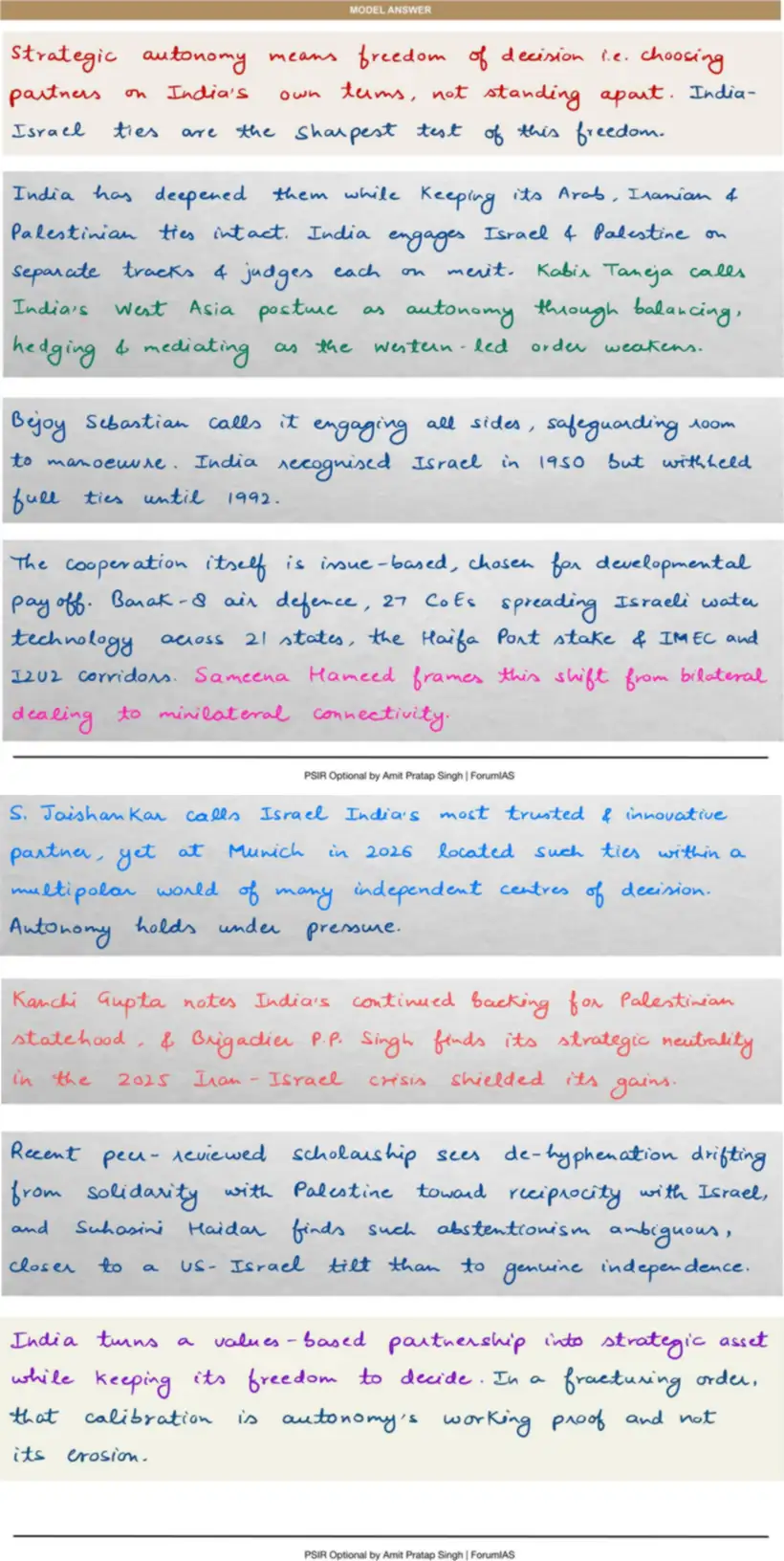
Model answer
Handwritten, in the form it would be written in the examination hall.
Also asked on this head
Recent Developments in Indian Foreign Policy — 23 questions in the Vault.
- India has recognised that West Asia is not a single contest, but a tangle of rivalries, bargains and anxieties. Comment.
- Discuss the three areas of security co-operation between India and Israel. (150 words)
- Critically examine India’s position on South China Sea Dispute.
How this is taught
The same flow snapshot, built for every head of the syllabus, with the answer written in class.
The first session of Foundation 2027 is published in full.
Six programmes across three levels.