
Do you think that India’s capacity building role in Afghanistan has shrunk the strategic space for Pakistan there? Discuss.
How the answer moves
The flow snapshot — the routes in, the body, the counter-view and the routes out.
Route 1 strategic depth = Pakistan’s doctrine of a pliant Kabul as leverage vs India → India replied with capacity building, not arms → space narrowed but conditional
Route 2 can soft/development power deny a rival strategic space? → yes, partly, but bounded by hard power
$3 bn footprint (Parliament, Salma Dam, 433 HICDP/34 provinces, ICCR students) → Pant: investment ties India to Afghan stability, goodwill Pakistan can’t match → connectivity (Chabahar, Delaram–Zaranj, air corridors) bypasses Pakistan, cuts transit chokehold → Sikri’s Kautilyan Mandal logic (friend of neighbour’s neighbour) = structural check → [counter enters] → post-2021 reset resolves it: Pakistan’s depth never arrived — Taliban reject Durand Line / shelter TTP / lean Iran–China → Islamabad fears encirclement, Kabul drifts to India → India’s capacity-building capital → Muttaqi Oct-2025 visit + Kabul embassy upgrade → Pant: pragmatism not endorsement
soft/development power vs hard power — can goodwill deny strategic space when the rival holds ISI–Taliban links, the Haqqani nexus and geography? (Jacob: no Plan B; the 2021 fall shrank India’s own space too)
Route 1 capacity building did shrink Pakistan’s space, by denying it a monopoly and building goodwill that outlived regime change — not by displacing proxies
Route 2 the decisive collapse of “strategic depth” came from the Taliban’s own nationalism; India’s development legacy is what let it profit
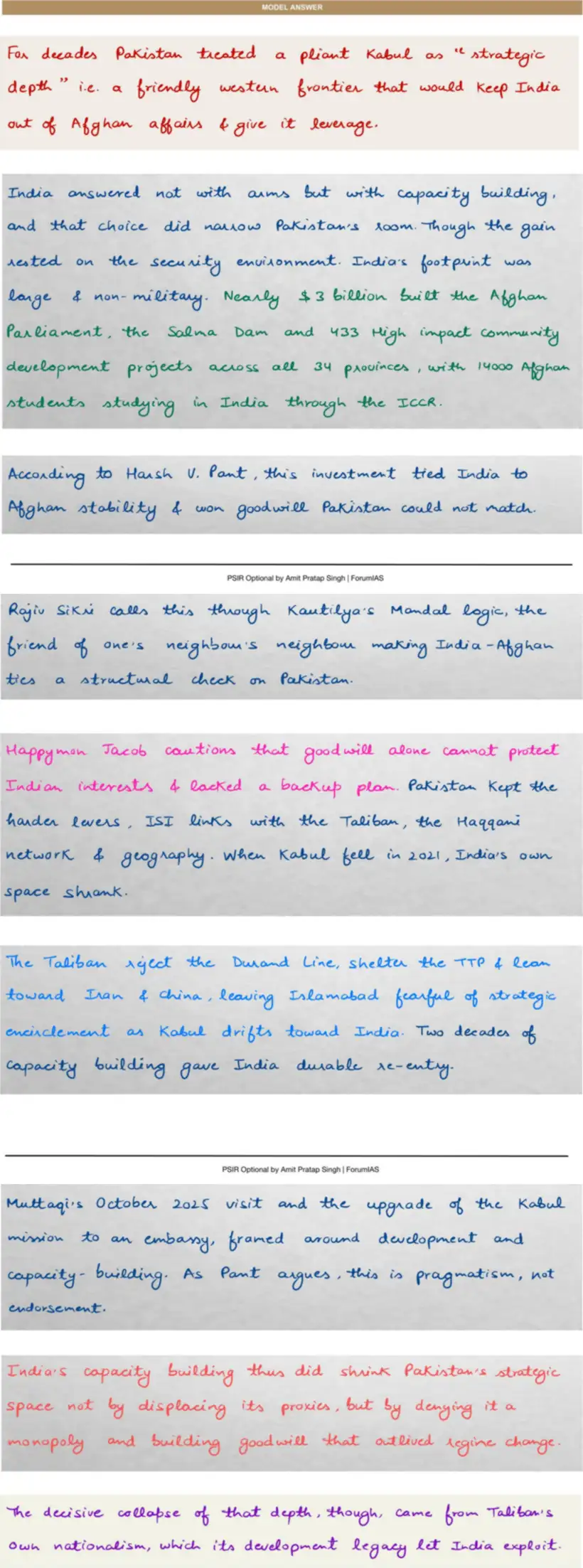
Model answer
Handwritten, in the form it would be written in the examination hall.
Also asked on this head
Recent Developments in Indian Foreign Policy — 23 questions in the Vault.
- India has recognised that West Asia is not a single contest, but a tangle of rivalries, bargains and anxieties. Comment.
- Discuss the three areas of security co-operation between India and Israel. (150 words)
- Critically examine India’s position on South China Sea Dispute.
How this is taught
The same flow snapshot, built for every head of the syllabus, with the answer written in class.
The first session of Foundation 2027 is published in full.
Six programmes across three levels.