
Analyze the impact of Hydro politics on Indo Bangladesh relations.
How the answer moves
The flow snapshot — the routes in, the body, the counter-view and the routes out.
Route 1 54 shared rivers, formal agreement on only two → JRC dormant since 2011 → hydro politics sets a ceiling, does not break the tie
Route 2 lower riparian, lean-season flow falling → Farakka and Teesta still open after five decades → the one file that stays stuck while the rest of the relationship advances
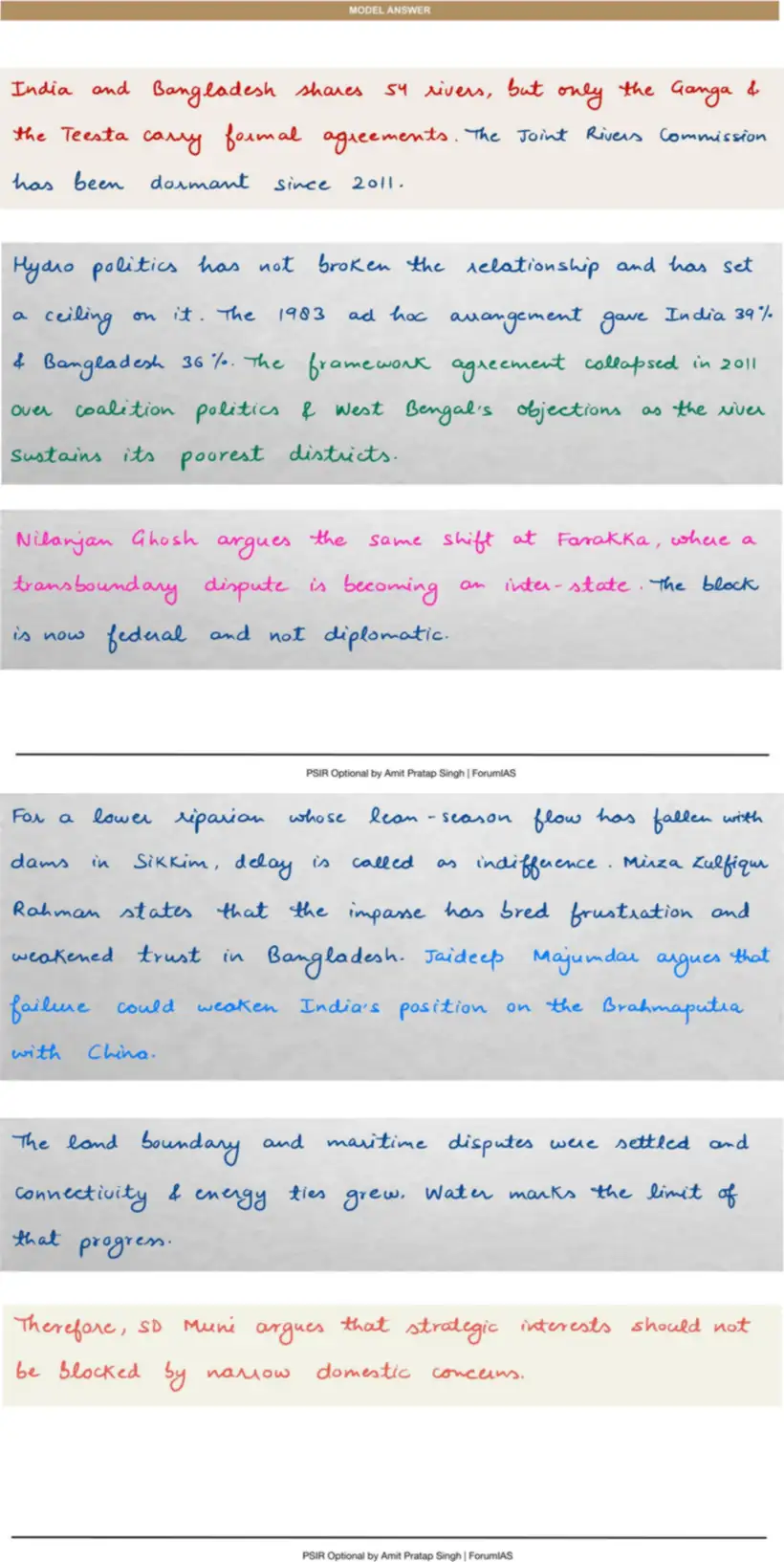
Teesta as the test case → 1983 ad hoc: India 39%, Bangladesh 36% → 2011 collapse → coalition politics + West Bengal’s objections → river sustains state’s poorest districts → Ghosh on Farakka: transboundary → inter-state → block is federal, not diplomatic → Sikkim dams cut lean-season flow → delay read as indifference → Rahman: frustration, trust weakened → Majumdar: spillover to India’s Brahmaputra position vs China
land boundary and maritime disputes settled → connectivity and energy ties grew alongside → impact is a ceiling, not a rupture
Route 1 water marks the limit of that progress → Muni: strategic interests not to be blocked by narrow domestic concerns
Route 2 constraint is internal, so the remedy is internal → settling Teesta protects India’s wider riparian position
Model answer
Handwritten, in the form it would be written in the examination hall.
Also asked on this head
India and South Asia — 32 questions in the Vault.
- The island of Kachchatheevu remains an intractable issue in India-Srilanka relations. Comment.
- How does illegal cross border migration pose challenges to India’s security? Discuss the steps taken by the government in this direction and their effectiveness.
- Critically evaluate the important factors of India-Maldives relations on the eve of sixty years of diplomatic ties between the two countries.
How this is taught
The same flow snapshot, built for every head of the syllabus, with the answer written in class.
The first session of Foundation 2027 is published in full.
Six programmes across three levels.