
“Despite the differences between India and Pakistan on various issues, Indus Water Treaty has stood the test of times.’ In the light of this statement, discuss the recent developments over this issue.
How the answer moves
The flow snapshot — the routes in, the body, the counter-view and the routes out.
Route 1 1960, World Bank → basin divided, not shared → design built to keep water out of politics
Route 2 three wars, standoffs 1987–2019, treaty intact → durability came from institutional insulation, not goodwill
eastern rivers India / western rivers Pakistan, ~20% non-consumptive → Permanent Indus Commission + neutral expert + arbitration → insulation from politics → Drabu: among the world’s most successful → survived 1965, 1971, 1999 → strain both ways: Tulbul objections / 80% grievance / Article XII lock → Ranjan: water nationalism, militant pick-up → Uri 2016 “blood and water” → 2019 threat → 23 April 2025 suspension, Article 62 Vienna Convention
leverage limited → Drabu’s arithmetic: diversion or storage, thirty to fifty years, severe environmental cost → Yaqoob: treaty a “non-exit” partnership
Route 1 treaty lasted because water stayed out of politics → recent turn breaks that insulation
Route 2 suspension short of termination → Chellaney: renegotiate for changed realities as the steadier route
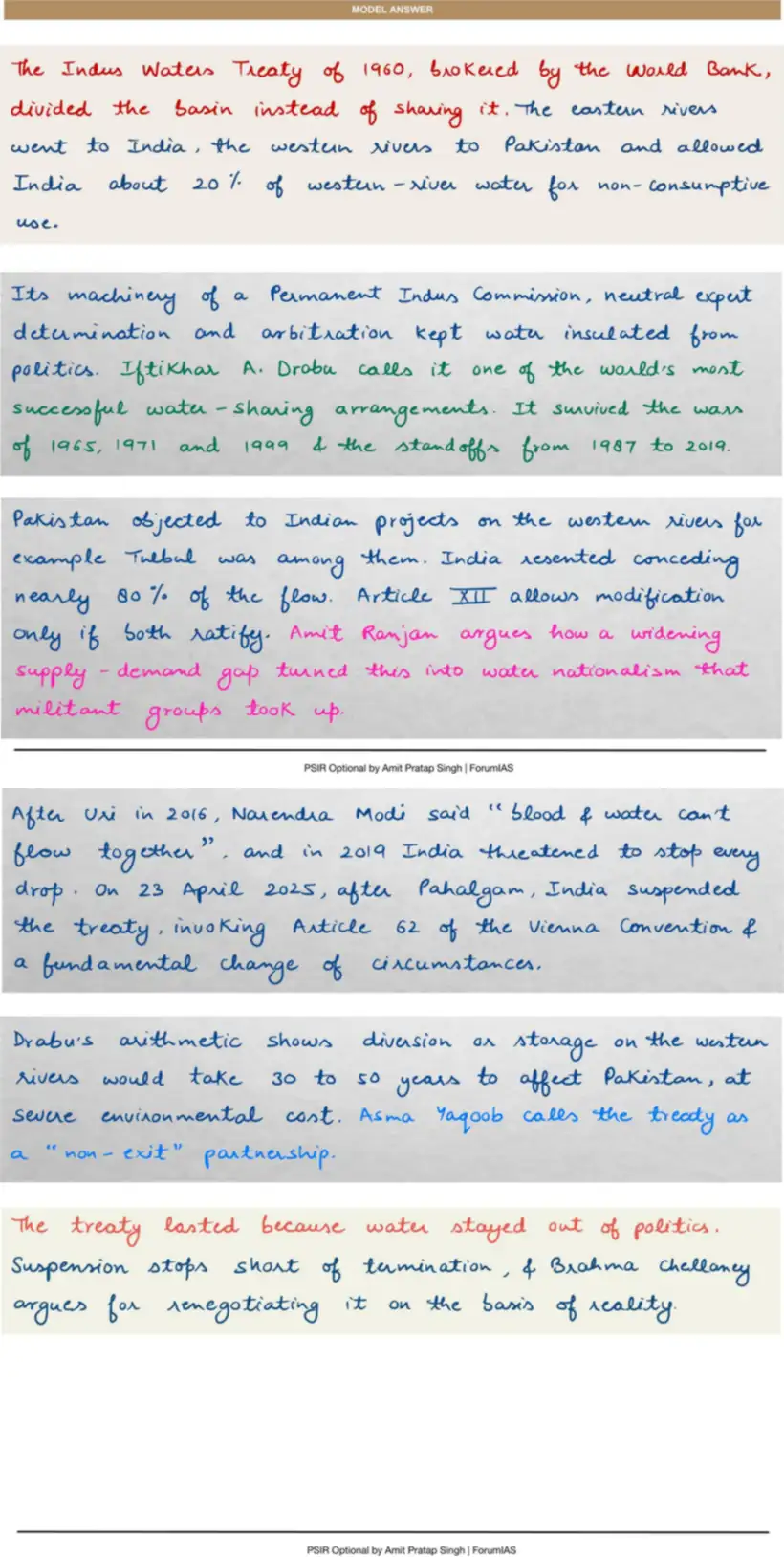
Model answer
Handwritten, in the form it would be written in the examination hall.
Also asked on this head
India and South Asia — 32 questions in the Vault.
- The island of Kachchatheevu remains an intractable issue in India-Srilanka relations. Comment.
- How does illegal cross border migration pose challenges to India’s security? Discuss the steps taken by the government in this direction and their effectiveness.
- Critically evaluate the important factors of India-Maldives relations on the eve of sixty years of diplomatic ties between the two countries.
How this is taught
The same flow snapshot, built for every head of the syllabus, with the answer written in class.
The first session of Foundation 2027 is published in full.
Six programmes across three levels.