
China’s growing footprint and a tangible shift in power dynamics in Bangladesh has weakened India’s leverage in Dhaka. Comment.
How the answer moves
The flow snapshot — the routes in, the body, the counter-view and the routes out.
Route 1 Doval: most important neighbour → showcase of Neighbourhood First → China has not displaced the record, only ended India’s monopoly as Dhaka’s option
Route 2 statement locates the cause outside → leverage has thinned, but the opening was made at home
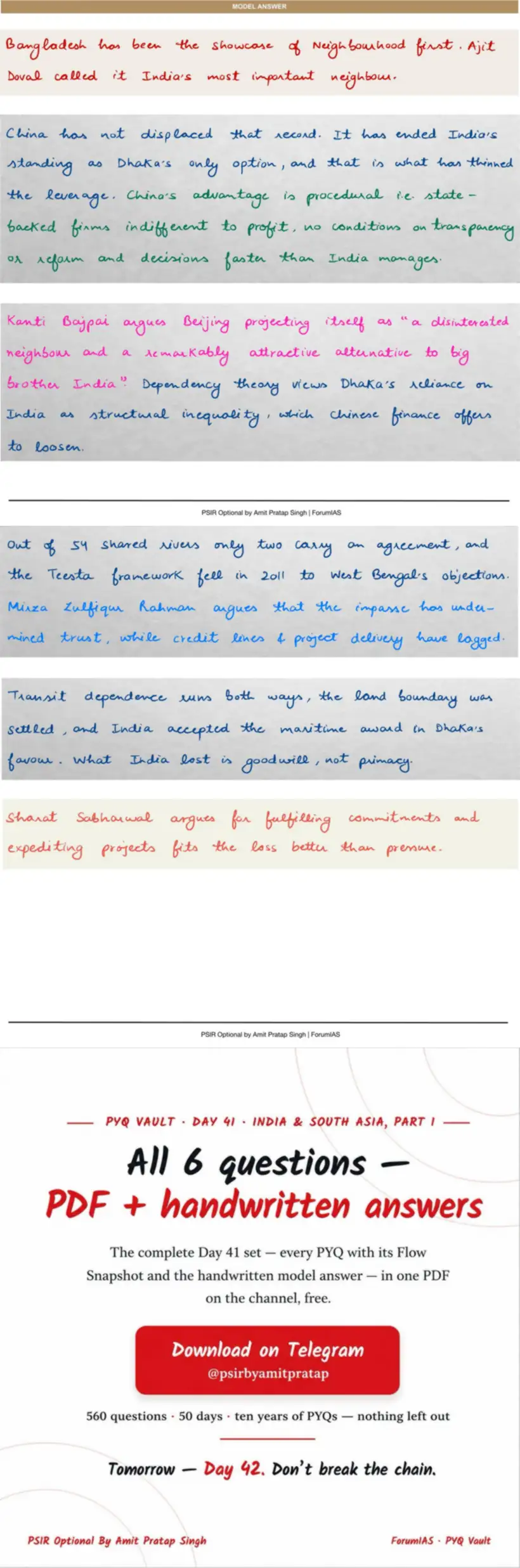
China’s advantage is procedural → firms indifferent to profit / no conditions on transparency or reform / faster decisions than India manages → Bajpai: disinterested neighbour vs big brother India → dependency theory: reliance as structural inequality, Chinese finance loosens it → India’s own unfinished business → 54 rivers, only two agreements → Teesta framework falls 2011 to West Bengal → Rahman: impasse undermines trust → credit lines and project delivery lagging
erosion is partial → transit dependence runs both ways → land boundary settled, maritime award accepted in Dhaka’s favour
Route 1 what thinned is goodwill, not primacy → Sabharwal: fulfil commitments, expedite projects
Route 2 leverage in Dhaka was never coercive → it returns through delivery, not pressure
Model answer
Handwritten, in the form it would be written in the examination hall.
Also asked on this head
India and South Asia — 32 questions in the Vault.
- The island of Kachchatheevu remains an intractable issue in India-Srilanka relations. Comment.
- How does illegal cross border migration pose challenges to India’s security? Discuss the steps taken by the government in this direction and their effectiveness.
- Critically evaluate the important factors of India-Maldives relations on the eve of sixty years of diplomatic ties between the two countries.
How this is taught
The same flow snapshot, built for every head of the syllabus, with the answer written in class.
The first session of Foundation 2027 is published in full.
Six programmes across three levels.