
How the answer moves
The flow snapshot — the routes in, the body, the counter-view and the routes out.
Route 1 universal conception defensible → rights inherent in all, equal moral worth & dignity (Kant, Locke)
Route 2 UDHR 1948 + Vienna 1993 already give universality a global, agreed form
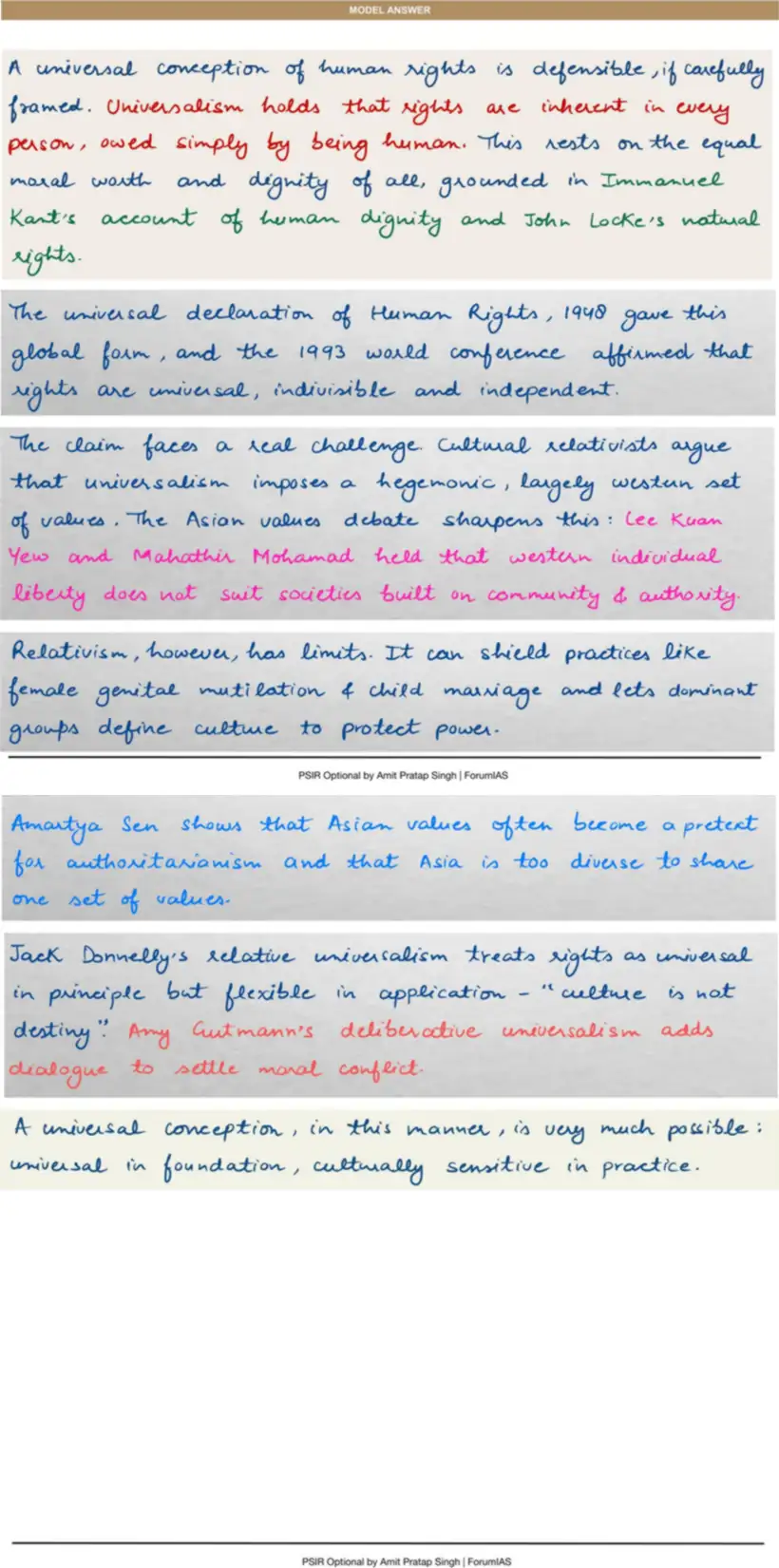
universalist foundation (inherent rights, dignity; Kant, Locke; UDHR, Vienna) → relativist challenge (hegemonic Western values; Asian values — Lee Kuan Yew, Mahathir; community over individual liberty) → limits of relativism (shields FGM, child marriage; dominant groups define “culture”; Sen — a pretext for authoritarianism, Asia too diverse) → resolution (Donnelly’s relative universalism, “culture is not destiny”; Gutmann’s deliberative universalism, dialogue)
is universality a Western imposition, or does relativism merely shield abuse and authoritarian power?
Route 1 universal in foundation, culturally sensitive in application
Route 2 not one imposed model, but a shared core settled through cross-cultural dialogue
Model answer
Handwritten, in the form it would be written in the examination hall.
Also asked on this head
Rights — 9 questions in the Vault.
- “Rights of the man are separate and independent of the State.” Critically analyze the perspective of Laski.
- The debate on human rights is caught between the
- Comment on the multicultural perspective on Rights
How this is taught
The same flow snapshot, built for every head of the syllabus, with the answer written in class.
The first session of Foundation 2027 is published in full.
Six programmes across three levels.