
How the answer moves
The flow snapshot — the routes in, the body, the counter-view and the routes out.
Route 1 reject “rights as moral possessions” → recast as a social practice born after WWII
Route 2 the Holocaust ended absolute sovereignty → the individual placed at the centre of political morality
the practice reorders three relations → individual (Kant: dignity, an end not a means) → society (shared standards, coexistence among diverse ways of life) → State (sovereignty into duty; protector and violator) → complexity = moral + legal + political registers, across domestic, international, cultural
contestation from the same root → Berlin (no single hierarchy of values) → Walzer, Spheres of Justice (justice rests on shared understandings and social practices; no one universal theory)
Route 1 contestation flows from its practical character → it does not weaken them
Route 2 keeps human dignity at the centre → among the most inspiring political ideas of the twentieth century
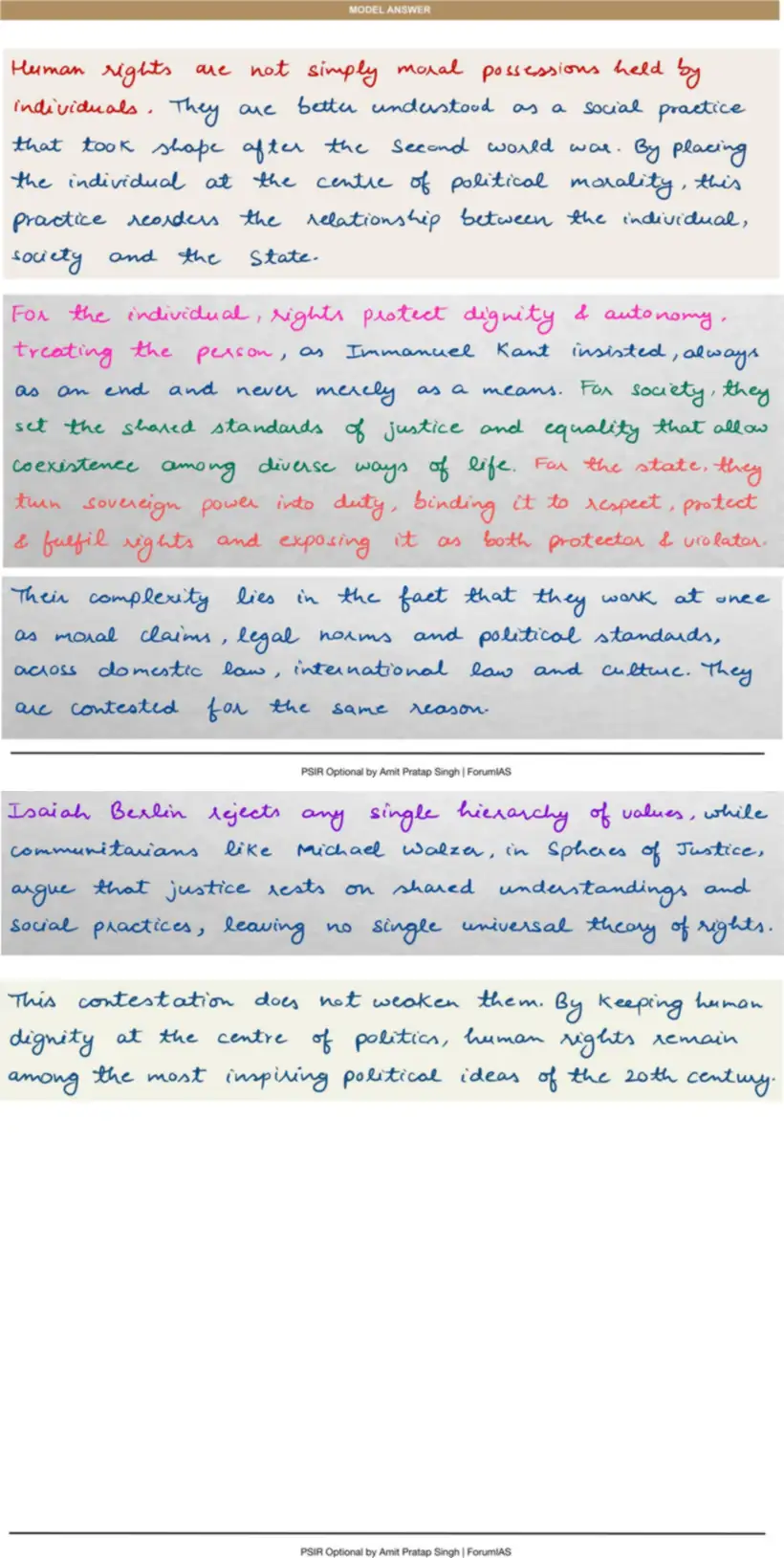
Model answer
Handwritten, in the form it would be written in the examination hall.
Also asked on this head
Rights — 9 questions in the Vault.
- “Rights of the man are separate and independent of the State.” Critically analyze the perspective of Laski.
- The debate on human rights is caught between the
- Comment on the multicultural perspective on Rights
How this is taught
The same flow snapshot, built for every head of the syllabus, with the answer written in class.
The first session of Foundation 2027 is published in full.
Six programmes across three levels.