
How the answer moves
The flow snapshot — the routes in, the body, the counter-view and the routes out.
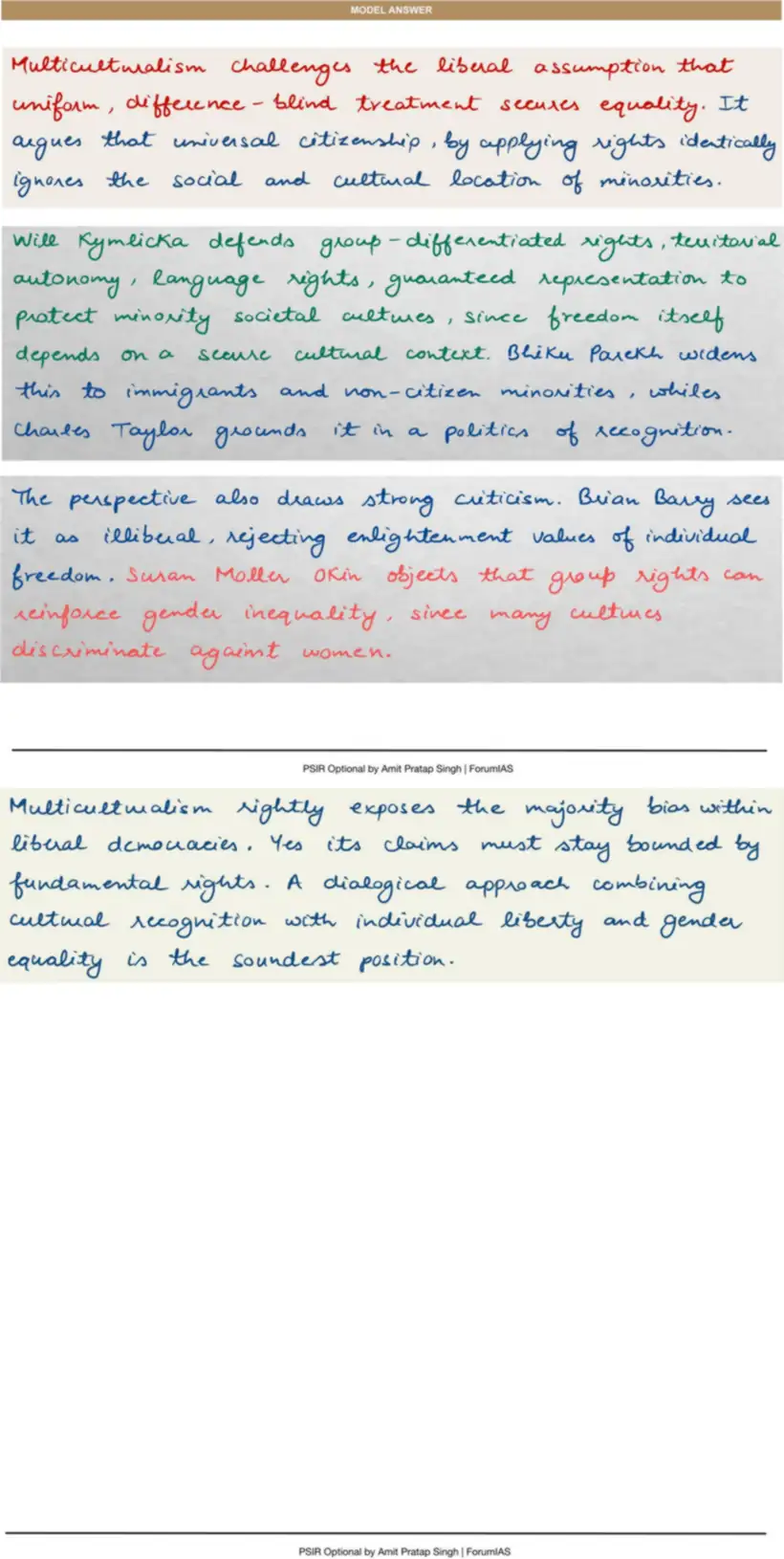
Route 1 difference-blind equality is insufficient → uniform treatment ignores cultural location
Route 2 universal citizenship vs social / cultural diversity → real equality needs recognition, not sameness
recognition + accommodation premise → Kymlicka: group-differentiated rights (autonomy, language, representation), freedom depends on a societal culture → Parekh broadens it to immigrants / non-citizens → Taylor: a politics of recognition
Barry: illiberal, anti-Enlightenment → Okin: group rights reinforce gender inequality
Route 1 exposes majority bias, but must stay bounded by fundamental rights
Route 2 dialogical multiculturalism = recognition + individual liberty + gender equality
Model answer
Handwritten, in the form it would be written in the examination hall.
Also asked on this head
Rights — 9 questions in the Vault.
- “Rights of the man are separate and independent of the State.” Critically analyze the perspective of Laski.
- The debate on human rights is caught between the
- Human Rights are complex and contested social practice that organises relations between individuals, society and the State. Comment.
How this is taught
The same flow snapshot, built for every head of the syllabus, with the answer written in class.
The first session of Foundation 2027 is published in full.
Six programmes across three levels.